ISO 50001 Certification
ISO 50001:2018 Energy Management System (EnMS) Certification — Optimise Energy Performance, Reduce Costs and Minimise Greenhouse Gas Emissions. Applicable to Organisations of Any Size.


2000
Happy Clients

1500
Expert Advisors

2+
Branch Offices
Free Consultation by Expert
.png)


.png)
.png)
What is ISO 50001 Certification?
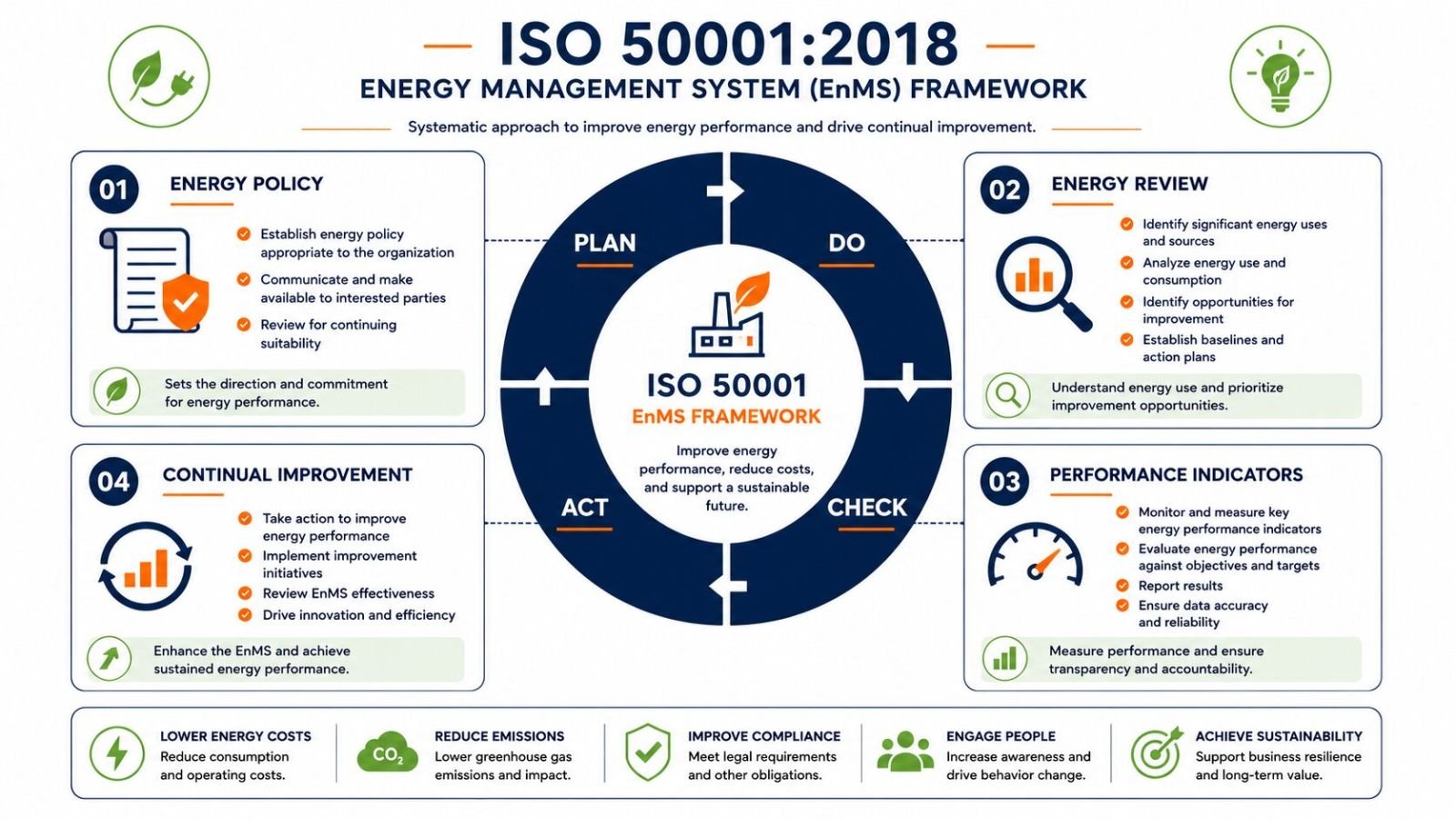
ISO 50001 is an internationally recognised standard for Energy Management Systems (EnMS), providing a practical way to improve energy use through the systematic development and implementation of an energy management system. The current version is ISO 50001:2018, which was first published in August 2018 and replaced ISO 50001:2011.
ISO 50001 certification is an internationally recognised standard that provides a systematic, data-driven framework for organisations to optimise energy performance, reduce operating costs, minimise greenhouse gas emissions, and demonstrate a commitment to long-term sustainability. It applies to organisations of any size, and provides requirements for establishing, managing, and improving energy consumption and efficiency.
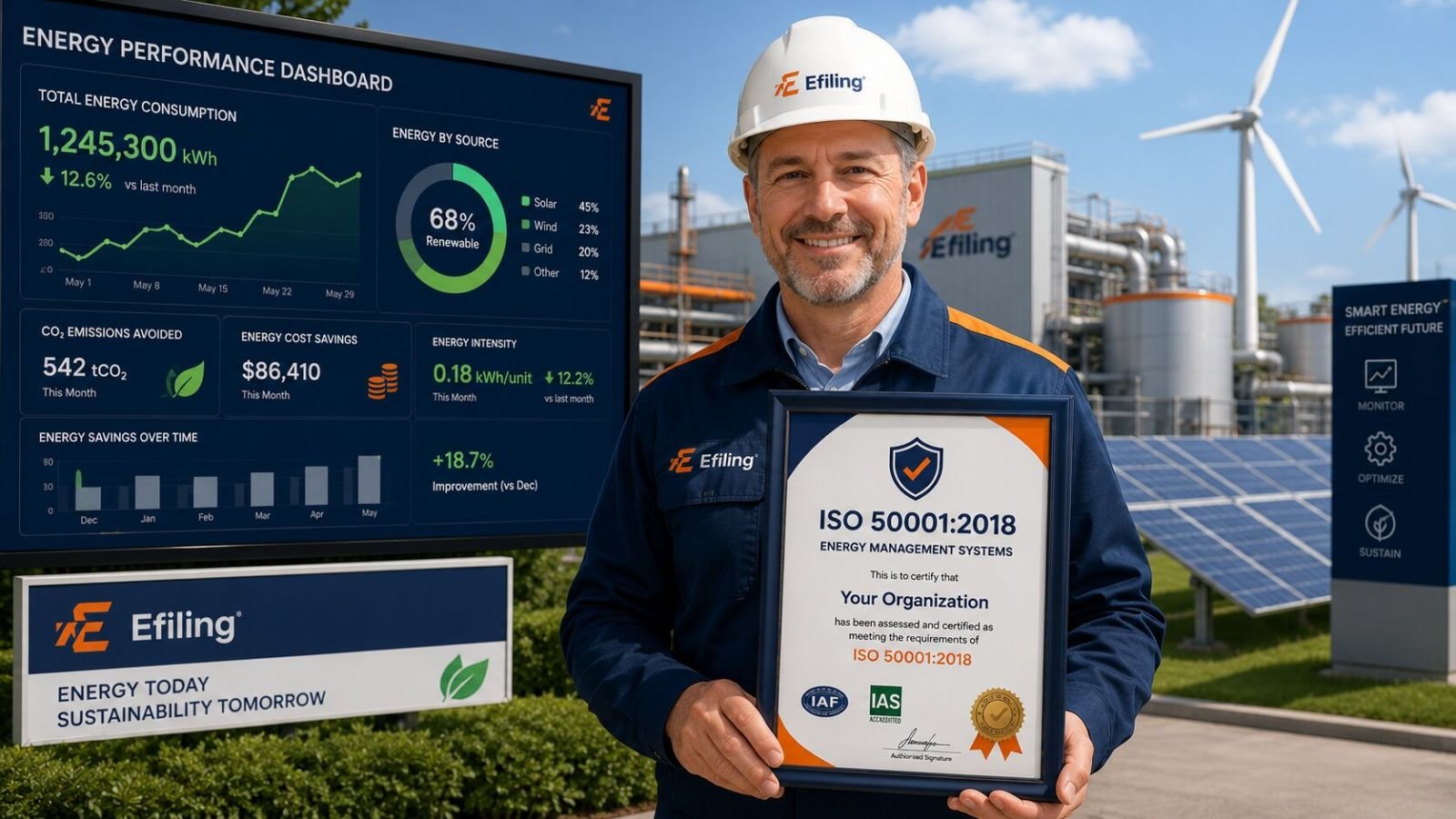
EfilingCompany provide end-to-end ISO 50001 certification consultancy — from gap analysis and complete EnMS documentation preparation to implementation training, audit coordination, and IAF-accredited certificate delivery.
Expertise in ISO 50001 Certification

Enquiry Form
Among Asia Top
100
Consulting Firm

Get Consultation
Lowest Fees
100,000 + Clients.

Service Delivery
4.9 Customers Rating
50+ Offices
Contact us today to schedule your appointment.
You can call us on +919953004880 or write to us at info@efilingcompany.com
What ISO 50001 Helps Organisations Achieve
ISO 50001 assists organisations in multiple ways through a structured energy management approach:
- Evaluating and prioritising the implementation of new energy-efficient technologies and improving energy efficiency, energy use and consumption
- Creating transparency and facilitating communication on the management of energy resources
- Promoting energy management best practices and behaviours throughout the organisation
- Providing a framework for promoting energy efficiency throughout the supply chain
- Facilitating energy management improvements for greenhouse gas emission reduction projects
Benefits of ISO 50001 Certification
Certifying your Energy Management System to the ISO 50001 standard confirms that your organisation is working in a structured and strategic way to reduce its environmental footprint and is committed to continual improvement. Certification can contribute to:
- Cost Reduction: Continually monitoring and managing energy consumption directly leads to lowered utility bills and reduced energy operating costs.
- Improvement of Energy Performance: Including energy efficiency, energy use and energy consumption — measured through documented Energy Performance Indicators (EnPIs).
- Reduced Environmental Impact: Reducing greenhouse gas emissions without affecting operations, while simultaneously increasing profitability.
- Compliance Demonstration: ISO 50001 is an internationally recognised standard for energy management solutions — certification proves compliance to customers, regulators, and stakeholders.
- Identified Opportunities for Cost Savings: Through systematic optimisation of energy consumption across the organisation's operations and supply chain.
- Enhanced Reputation: By demonstrating a clear commitment to sustainability — important for ESG reporting, investor expectations, and corporate responsibility.
- Future-Proofing: By tackling upcoming energy consumption challenges today, organisations reduce exposure to energy price volatility and tightening carbon regulations.
- Continual Improvement: The EnMS framework drives ongoing measurement, documentation, reporting, and benchmarking of energy consumption over time.
- Credible Market Communication: Certification provides credible, independently verified communication about the organisation's energy performance efforts.
ISO 50001:2018 — What Changed from ISO 50001:2011?
The ISO 50001:2018 revision aligned the standard with the High-Level Structure (HLS) shared by ISO 9001, ISO 14001, ISO 45001, and other ISO management system standards. The objective is to ease the integration of new and existing management systems in an organisation. Key changes in ISO 50001:2018 include:
- Adoption of ISO's requirements for management system standards — including a high-level structure, identical core text, and common terms and definitions — to ensure a high level of compatibility with other management system standards
- Improved integration with strategic management processes
- Clarification of language and document structure
- Stronger emphasis on the role of top management, to instil a cultural change in the organisation
- Inclusion of new definitions, including energy performance improvement
- Clarification on exclusions of energy types and clarification of the concept of 'energy review'
- Introduction of the concept of normalisation of Energy Performance Indicators (EnPI(n)) and associated energy baselines (EnB(n))
- Addition of details on the energy data collection plan and related requirements
Important: All ISO 50001:2011 certificates expired on 28th February 2022. Only ISO 50001:2018 certification is currently valid.
ISO 50001 and Its Relationship with ISO 14001 and ISO 9001
ISO 50001:2018 is designed to be compatible and harmonised with ISO 14001 for environmental management systems and ISO 9001 for quality management systems. It shares the same High-Level Structure, making it ideal for integrating into existing management systems and processes such as environmental management, quality management, and health and safety.
A key distinction noted from the Wikipedia comparison is that ISO 50001 is data-driven and focuses specifically on energy performance improvement, while ISO 14001 provides a more qualitative look at all significant environmental aspects. Organisations seeking both environmental compliance and measurable energy performance improvement benefit from implementing both standards together as an Integrated Management System.
Key ISO 50001 Terminology
Understanding ISO 50001 requires familiarity with its core terminology:
- EnMS — Energy Management System: the overarching framework established under ISO 50001
- EnPI — Energy Performance Indicator: a quantitative value or measure that an organisation uses to monitor and evaluate energy performance
- EnB — Energy Baseline: a quantitative reference point providing a basis for comparison of energy performance over time
- SEU — Significant Energy Use: an energy use that has substantial energy consumption or that offers considerable potential for energy performance improvement
- Energy Policy: the top management statement of the organisation's overall intentions and direction related to energy performance
- Energy Objectives and Targets: measurable outcomes to be achieved in relation to energy performance improvement
ISO 50001 Certification Process
Step 1 — Free Gap Analysis: We assess your current energy management practices, documentation, and systems against ISO 50001:2018 requirements. You receive a written gap report at no cost, identifying what needs to be done.
Step 2 — EnMS Documentation: Our consultants prepare your complete Energy Management System documentation — energy policy, energy objectives and targets, energy data collection plan, Significant Energy Uses (SEUs), Energy Performance Indicators (EnPIs), energy baselines, and all required ISO 50001 records. You review and approve.
Step 3 — Implementation and Training: Your relevant teams — operations, facilities, engineering, and management — are trained on EnMS requirements and their specific roles in energy data collection, monitoring, and improvement.
Step 4 — Internal Audit: A pre-certification internal audit is conducted to identify and close any non-conformities before the official certification body audit.
Step 5 — Certification Audit: An IAF-accredited certification body conducts Stage 1 (document review) and Stage 2 (on-site assessment). Your ISO 50001:2018 certificate is issued on passing — valid for 3 years with annual surveillance audits.
Why Choose EfilingCompany for ISO 50001 Certification?
- Complete EnMS documentation preparation: Energy policy, EnPIs, energy baselines, SEU documentation, data collection plans — all prepared by our consultants. You review and approve.
- IAF-accredited certification only: We work exclusively with internationally recognised, IAF-accredited certification bodies — your certificate is globally valid.
- Integrated management system expertise: For organisations already holding ISO 14001, ISO 9001, or ISO 45001, we structure the ISO 50001 implementation to integrate with your existing management systems — avoiding duplication and reducing the overall compliance burden.
- Fixed all-inclusive pricing: The quote we provide is the final price — no hidden certification body fees, no add-ons.
- Surveillance audit support: We support your organisation through annual surveillance audits and the 3-year recertification cycle.