CDSCO Registration
CDSCO registration explained: Class A registration is free, Class C import is USD 3,000 per site. Official fee table, forms MD-3 to MD-42, timelines and portals.


2000
Happy Clients

1500
Expert Advisors

2+
Branch Offices
Free Consultation by Expert
.png)


.png)
.png)
CDSCO Registration
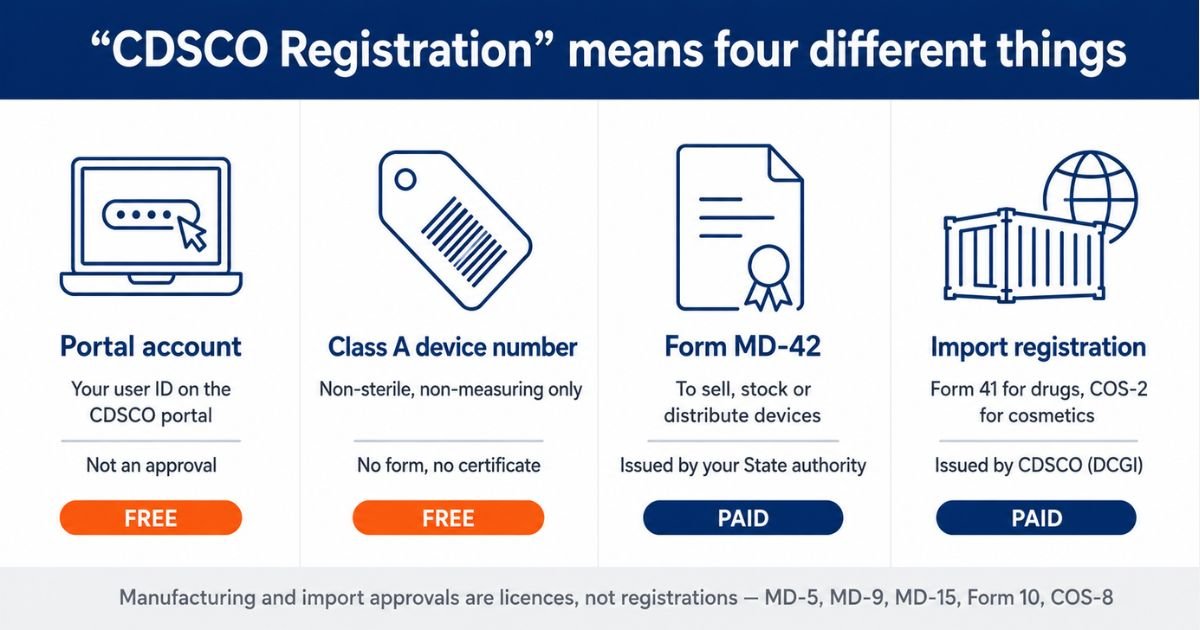
CDSCO registration means four different things, and most failed applications start with people mixing them up. One person means creating a login on the CDSCO portal. Another means the free registration number for a low-risk medical device. A third means the Registration Certificate needed to sell or distribute. A fourth means an import licence, which is not a registration at all.
This page separates them. It covers what CDSCO actually issues, who issues it (central or state), which portal you file on, the exact government fee from the Second Schedule, the statutory timelines, and the mistakes that get applications rejected. Everything here is drawn from the Drugs and Cosmetics Act 1940, the Medical Devices Rules 2017, the Cosmetics Rules 2020 and CDSCO's own published FAQs and fee schedule.
If you already know what you need, call us on [INSERT PHONE NUMBER] or write to info@efilingcompany.com and we will tell you the correct pathway before you spend anything.
Get Started TodayWhat CDSCO Registration Actually Means
The phrase is used loosely. Here is what each version really is:
| What people call it | What it really is | Who issues it | Government fee |
| CDSCO registration / CDSCO login | Applicant account on the CDSCO online portal. Just a user ID. It is not an approval. | System generated | Nil |
| CDSCO registration number | Registration for Class A non-sterile and non-measuring medical devices. No form, no certificate, only a system generated number. | Medical Devices online portal | Nil |
| CDSCO registration certificate (devices) | Registration Certificate in Form MD-42 to sell, stock, exhibit or distribute medical devices. | State Licensing Authority | As per Second Schedule |
| CDSCO import registration | Registration Certificate in Form 41 for drugs, or Form COS-2 for cosmetics. | Central Licensing Authority (DCGI) | Paid in USD |
| CDSCO licence | Manufacturing licence (MD-5, MD-9) or import licence (MD-15, Form 10, COS-8). This is a licence, not a registration. | Central or State, depending on class | As per Second Schedule |
The practical consequence: a consultant quoting you a single price for "CDSCO registration" without first asking your product type, risk class and whether you manufacture or import does not yet know what he is selling you.
What Is CDSCO
The Central Drugs Standard Control Organisation is India's national drug regulator. It sits under the Directorate General of Health Services, Ministry of Health and Family Welfare. Its head office is at FDA Bhawan, ITO, Kotla Road, New Delhi 110002. The Drugs Controller General (India), commonly called DCGI, heads it and is the Central Licensing Authority for medical devices.
CDSCO regulates four product families, and each family runs on its own set of rules:
| Product | Governing law | Typical approval |
| Medical devices and IVDs | Medical Devices Rules, 2017 | MD-5, MD-9, MD-15, MD-42 |
| Drugs (import) | Drugs and Cosmetics Act 1940 and Drugs Rules 1945 | Form 41, then Form 10 |
| Cosmetics | Cosmetics Rules, 2020 | COS-2 (import), COS-8 (manufacture) |
| New drugs and clinical trials | New Drugs and Clinical Trials Rules, 2019 | CT series permissions |
Central or State: Who Actually Issues Your Approval
This is where most people waste months. CDSCO does not issue every approval. For a large share of applicants, the correct authority is the state drug controller, not Delhi.
| Central Licensing Authority (CDSCO) | State Licensing Authority |
|
|
Read that carefully. If you manufacture a Class A or Class B medical device in India, CDSCO does not grant your manufacturing licence. Your state drug controller does. Anyone promising you a "CDSCO manufacturing licence" for a Class B device is describing the wrong authority, and your file will sit in the wrong queue.
Which CDSCO Portal Do You File On
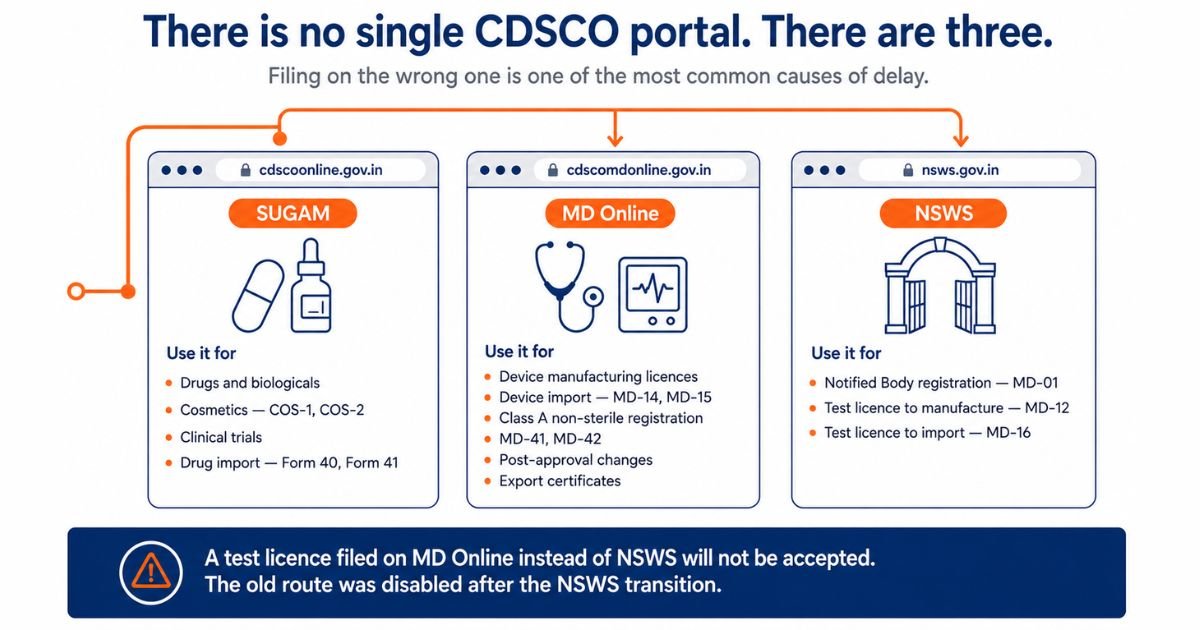
There is no single CDSCO portal. There are three, and they are not interchangeable. Filing on the wrong one is a common cause of delay.
| Portal | Used for | Commonly called |
| cdscoonline.gov.in | Drugs, biologicals, cosmetics, clinical trials, import registration in Form 40 and 41, cosmetic registration in COS-1 and COS-2 | SUGAM portal |
| cdscomdonline.gov.in | Medical device manufacturing and import licences, Class A non-sterile non-measuring registration, Form MD-41 and MD-42, post approval changes, export certificates | MD Online, CDSCO MD |
| nsws.gov.in | Notified Body registration (MD-01), test licence to manufacture (MD-12) and test licence to import (MD-16) | National Single Window System |
CDSCO's own FAQ on the Medical Devices Rules names cdscomdonline.gov.in and nsws.gov.in as the submission routes for device applications. The older cdscomdonline route for the three NSWS forms above was disabled after the NSWS transition, so a test licence application filed on the wrong portal will simply not be accepted.
CDSCO Registration for Medical Devices
Since notification S.O. 648(E) dated 11 February 2020, all medical devices are regulated under the Medical Devices Rules, 2017. There is no longer a category of "unnotified" device that escapes the rules. Devices intended for use on animals are also covered.
Risk classification and the correct form
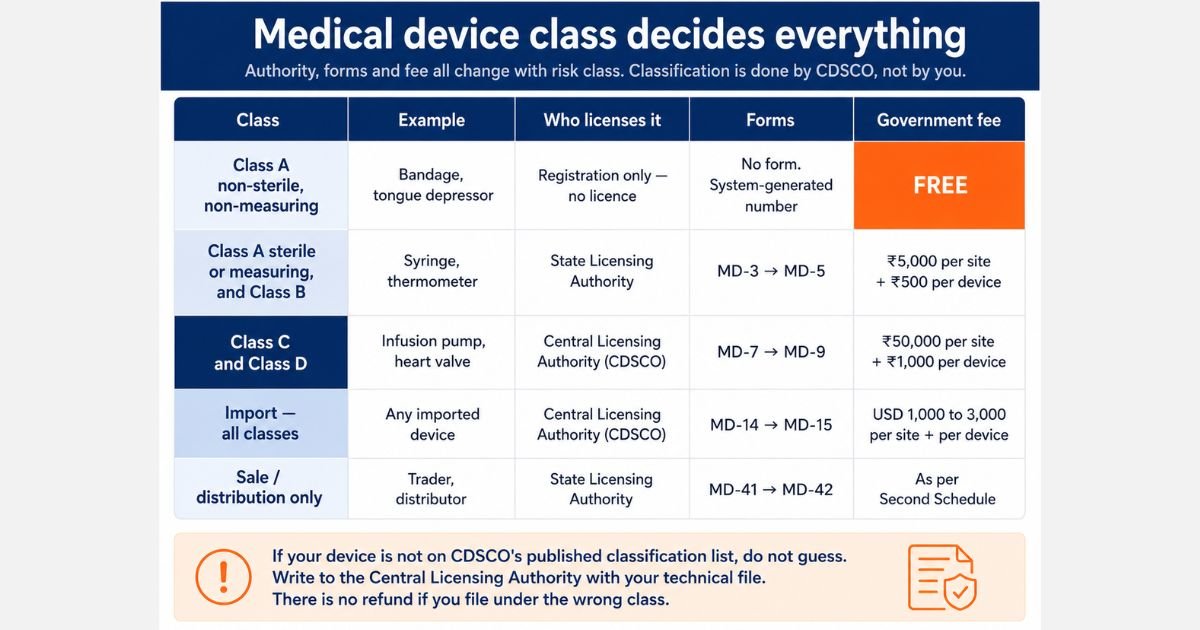
Classification is done by the Central Licensing Authority under Rule 3 and Part I of the First Schedule. You do not classify your own device. CDSCO publishes risk-based classification lists on its website and updates them regularly.
| Class | Risk | Authority | Application form | Licence form |
| Class A, non-sterile and non-measuring | Low | Registration only, no licence | No form | System generated number |
| Class A (sterile or measuring) and Class B, manufacture | Low to low-moderate | State Licensing Authority | MD-3 (loan licence MD-4) | MD-5 (loan licence MD-6) |
| Class C and Class D, manufacture | Moderate-high and high | Central Licensing Authority | MD-7 (loan licence MD-8) | MD-9 (loan licence MD-10) |
| All classes, import | All | Central Licensing Authority | MD-14 | MD-15 |
| Sale, stock or distribution only | All | State Licensing Authority | MD-41 | MD-42 |
| Test licence, manufacture | All | Central Licensing Authority | MD-12 | MD-13 |
| Test licence, import | All | Central Licensing Authority | MD-16 | MD-17 |
| Clinical investigation | Investigational | Central Licensing Authority | MD-22 | MD-23 |
| Device without a predicate | Investigational | Central Licensing Authority | MD-26 | MD-27 |
| Personal use import | All | Central Licensing Authority | MD-20 | MD-21 |
If your device is not on the classification list
This happens often with new technology and imported niche products. The rule is not to guess. You submit a separate request to the Central Licensing Authority with the product technical documents, label, instructions for use, and the regulatory status of the same or a similar product in other countries. CDSCO conveys the class to you and updates the published list. Guessing the class and filing on that basis is one of the fastest ways to lose your fee, because there is no refund provision under the Medical Devices Rules.
Where a device is classified differently in IMDRF countries than in India, the licensing authority may take the higher risk class for approval purposes.
Class A non-sterile and non-measuring devices: the free route most people miss
Class A devices that are both non-sterile and non-measuring are exempt from Chapters IV, V, VII, VIII and XI of the Medical Devices Rules, 2017. In plain terms, no manufacturing licence and no import licence.
What you must still do:
- Complete mandatory registration on the Medical Devices online portal
- Comply with the labelling requirements in Chapter VI of the rules
- Comply with applicable BIS or other standards
What you get: a system generated registration number. No certificate is issued. What you pay: nothing. CDSCO's published FAQ states plainly that no fee is required for a Class A non-sterile non-measuring registration number.
A measuring device is one that quantitatively measures a physiological or anatomical parameter, or a quantity of energy or substance delivered to or removed from the body, and displays that result in legal or other acceptable units. If your device does that, it is out of this exemption.
One catch worth knowing: for these devices, Free Sale Certificates, Market Standing Certificates and Non-Conviction Certificates come from your State Licensing Authority, not from CDSCO, because control of Class A devices sits with the state.
CDSCO Registration for Imported Drugs
Importing a drug into India is a two-step approval, and people frequently apply for the second before securing the first.
- Registration Certificate. Application in Form 40 under Rule 24A, granted in Form 41. This registers the overseas manufacturing premises and the specific drugs made there. Form 41 is valid for three years from the date of issue.
- Import Licence. Once Form 41 is in hand, apply in Form 8 for the import licence granted in Form 10.
Form 40 can be filed only by the overseas manufacturer holding a valid Indian wholesale licence, or by his authorised agent in India holding a valid manufacturing licence or wholesale licence. The application carries the undertakings specified in Schedule D-I and Schedule D-II, plus a notarised Plant Master File. Where the drug is a new drug under the applicable rules, new drug approval is a prerequisite before the registration application.
Fees under Rule 24A(3) are payable in USD for the manufacturing premises and separately for each drug, with a further inspection charge if CDSCO decides to inspect the overseas site.
CDSCO Registration for Cosmetics
Cosmetics moved to their own rulebook in 2020. Every cosmetic manufactured outside India and sold in India must be registered before import.
- Form COS-1 is the application for an import registration certificate, filed with the Central Licensing Authority through the SUGAM portal by the importer, the Indian subsidiary or the authorised agent.
- Form COS-2 is the registration certificate CDSCO grants.
- Form COS-4 and COS-4A cover a different situation. Where a cosmetic from a foreign site is already registered in Form COS-2, another person may import it by applying online in Form COS-4 for an Import Registration Number granted in Form COS-4A, with the undertaking specified in the Sixth Schedule. You do not need a fresh COS-2 for an already registered product.
- Domestic manufacture is a state subject and follows the COS-5 application route to a manufacturing licence, with a GMP inspection of the site.
Products must be categorised against the Fourth Schedule of the Cosmetics Rules, 2020, which runs to roughly 80 defined categories. Fees are charged per category, per variant and per manufacturing site, so the same brand filed as three categories costs three times the category fee. Getting the categorisation wrong inflates cost or triggers a query.
On validity, CDSCO's own cosmetics FAQ states that a Registration Certificate granted in Form COS-2 remains valid in perpetuity subject to payment of a registration certificate retention fee. A large number of consultant websites still say five years. If a quote you receive is built around a five-year renewal, ask which rule it comes from.
CDSCO Registration Process Step by Step
The sequence below applies to medical devices. The drug and cosmetic routes follow the same shape with different forms.
- Decide what you are applying for. Manufacture, import, sale and distribution, or test purposes. These are four different applications with four different fee heads.
- Confirm the risk class. Check the published classification list. If your device is absent, write to the Central Licensing Authority with the technical file for a formal classification before you file anything.
- Create the portal account. This is the "applicant registration" step that many people search for. You will need a Class 3 Digital Signature Certificate and, for the NSWS route, the emBridge connector software.
- Appoint an Indian Authorised Agent, if you are a foreign manufacturer. The agent must hold a valid manufacturing licence, wholesale licence or a Form MD-42 registration certificate. The Power of Attorney must be authenticated in India by a Magistrate of the First Class, or by the Indian Embassy in the country of origin, or through apostille. An unauthenticated POA is an automatic query.
- Build the technical dossier. Device Master File and Plant Master File as prescribed in the Fourth Schedule, quality management system evidence under the Fifth Schedule, essential principles of safety and performance, labels and instructions for use, and for Class C and D, clinical and biocompatibility data.
- Pay the fee. Fees are per site and per distinct device, and a separate fee applies for each brand of a device. There is no refund provision if you later withdraw.
- Submit and track. Only an authorised person of the company can ask the licensing authority for application status. A third party consultant cannot.
- Answer queries fast. See the 2026 rejection rule below.
- Inspection or audit. Class A other than non-sterile non-measuring needs no site audit before grant. Class B, C and D do. For Class A and B, the Notified Body is assigned by the State Licensing Authority; you cannot choose your own.
- Grant. Licence issued in the corresponding MD form, valid in perpetuity subject to retention fee.
Documents Required for CDSCO Registration
Exact checklists live on the online portal and vary by form. The common core is:
| Category | Documents |
| Applicant identity | Constitution documents, PAN, GST registration, address proof of premises, list of directors or partners |
| Technical | Device Master File, Plant Master File or Site Master File as per Appendix I of the Fourth Schedule, essential principles checklist, risk management file, product standards |
| Quality | Quality management system certificate, ISO 13485 certificate where held, undertaking of compliance with the Fifth Schedule signed by the manufacturer |
| Product | Labels, instructions for use, pack insert, shelf life data (real-time ageing data, or accelerated data with an ongoing real-time study) |
| Import only | Power of Attorney duly authenticated, Free Sale Certificate naming both legal and actual manufacturer, quality certificate for the actual manufacturing site, copy of the agent's wholesale licence or Form MD-42 |
| Financial | Fee challan or online payment receipt |
Two document traps worth flagging. First, the Free Sale Certificate must carry both the legal manufacturer and the actual manufacturer's name and address. Second, a Certificate of Exportability is not accepted in place of a Free Sale Certificate. That single substitution has cost applicants months.
CDSCO Registration Fees
Government fees for medical devices are fixed in the Second Schedule of the Medical Devices Rules, 2017. The table below reproduces the fee schedule published on CDSCO's own Medical Devices online portal. Domestic fees are in rupees; import fees are in US dollars.
Manufacturing licence and loan licence
| Rule | Head | Fee |
| 20(2) | Class A or Class B device, one site | ?5,000 |
| 20(2) | Class A or Class B device, each distinct device | ?500 |
| 21(2) | Class C or Class D device, one site | ?50,000 |
| 21(2) | Class C or Class D device, each distinct device | ?1,000 |
| 29(1) | Retention fee, Class A or B site | ?5,000 |
| 29(1) | Retention fee, Class C or D site | ?50,000 |
| 29(1) | Retention fee, each distinct Class A or B device | ?500 |
| 29(1) | Retention fee, each distinct Class C or D device | ?1,000 |
| 31(1) | Test licence to manufacture, each distinct device | ?500 |
Import licence
| Rule | Head | Fee |
| 34(2) | Class A device (non-IVD), one site | USD 1,000 |
| 34(2) | Class A device (non-IVD), each distinct device | USD 50 |
| 34(2) | Class B device (non-IVD), one site | USD 2,000 |
| 34(2) | Class B device (non-IVD), each distinct device | USD 1,000 |
| 34(2) | Class C or D device (non-IVD), one site | USD 3,000 |
| 34(2) | Class C or D device (non-IVD), each distinct device | USD 1,500 |
| 34(2) | Class A or B in vitro diagnostic, one site | USD 1,000 |
| 34(2) | Class A or B in vitro diagnostic, each distinct device | USD 10 |
| 34(2) | Class C or D in vitro diagnostic, one site | USD 3,000 |
| 34(2) | Class C or D in vitro diagnostic, each distinct device | USD 500 |
| 35(2) | Inspection of the overseas manufacturing site | USD 6,000 |
| 40(2) | Import licence for test, evaluation, demonstration or training, each distinct device | USD 100 |
Import licence retention fees mirror the grant fees, charged per overseas site and per distinct device every five years.
Permissions, laboratories and other heads
| Rule | Head | Fee |
| 13(5) | Registration of a Notified Body | ?25,000 |
| 42(1) | Import of investigational device by a government hospital, each distinct device | ?500 |
| 51(2)(a) | Permission to conduct a pilot clinical investigation | ?1,00,000 |
| 51(2)(b) | Permission to conduct a pivotal clinical investigation | ?1,00,000 |
| 59(2) | Permission to conduct clinical performance evaluation | ?25,000 |
| 63(1) | Permission to import or manufacture a device with no predicate device | ?50,000 |
| 64(1) | Permission to import or manufacture a new in vitro diagnostic device | ?25,000 |
| 81(1) | Registration of a medical device testing laboratory | ?20,000 |
| 91 | Certificate to export, each distinct device | ?1,000 |
Three points people underestimate. Fees stack: a Class C importer with one overseas site and eight distinct devices pays the site fee plus eight device fees. A separate fee applies for each brand of a device applied for. And there is no refund clause, so a withdrawn or rejected application is money spent.
Professional fees are separate from these government fees and vary widely with device class, dossier readiness and the number of products. We quote only after seeing the product list and classification, because a single-product Class A file and a twelve-product Class C import file are not comparable work.
CDSCO Registration Timelines
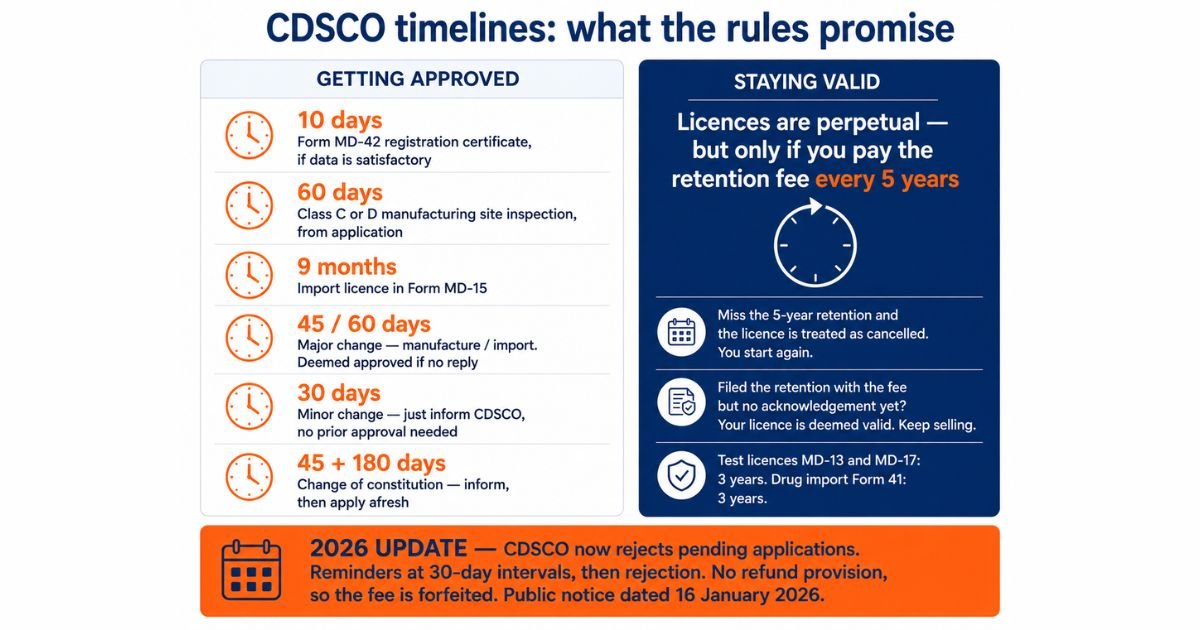
Two sets of numbers matter: what the rules promise, and what actually happens. Both are below.
| Stage | Statutory position | Practical range |
| Registration Certificate in Form MD-42 (sale and distribution) | Within 10 days of application if data is satisfactory | 2 to 6 weeks |
| Class C or D manufacturing inspection | Inspection within 60 days of application if data is satisfactory | Varies by state and officer availability |
| Import licence in Form MD-15 | Nine months, provided documents are satisfactory | 6 to 12 months |
| Major change, manufacture | 45 days, deemed approved if no decision communicated | 45 days upward |
| Major change, import | 60 days, deemed approved if no decision communicated | 60 days upward |
| Minor change | No prior approval needed; inform CDSCO within 30 days of the change | Immediate |
| Change of constitution | Inform within 45 days, apply afresh within 180 days | Hard deadline |
| Class A non-sterile non-measuring registration | No statutory timeline; number is system generated | Same day to a few days |
The deemed approval rule on major changes is genuinely useful and rarely mentioned. If the licensing authority does not communicate a decision within 45 days for manufacture or 60 days for import, the approval is deemed granted.
Validity, Retention and What "Perpetual" Really Means
Import licences, manufacturing licences and registration certificates under the Medical Devices Rules, 2017 are perpetual. They do not expire on a date. But perpetual is conditional: you must pay a licence or registration retention fee every five years, before the five year mark, or the licence is treated as cancelled and you start again from scratch.
Three practical notes:
- If you have filed the retention application with the fee and CDSCO has not yet acknowledged it, your licence is deemed valid and you may continue to market the product. Many licensees stop shipping unnecessarily while waiting.
- Retention of an endorsement licence is filed after retention of the base licence. The endorsement licence is valid only up to the validity of its base licence.
- Proof of retention is the acknowledgement email from the licensing authority's official email ID. Keep it.
Two exceptions to the perpetual rule. Test licences in Form MD-13 and MD-17 are valid for three years from issue. A drug import Registration Certificate in Form 41 is valid for three years.
2026 Update: CDSCO Is Now Rejecting Pending Applications
This is the single most important operational change for anyone with a live file, and almost no service page mentions it.
Through a public notice dated 16 January 2026, CDSCO announced it would dispose of and reject long-pending applications on the SUGAM portal where applicants had not responded to regulatory queries. The mechanism now runs like this: a first reminder for an unanswered query, then a second and third reminder at 30-day intervals, and rejection if no satisfactory response follows. CDSCO's own website has carried the notice "Disposal / Rejection of Long-Pending Applications on Sugam Portal Awaiting Query Response" with a stated last date of 30 June 2026.
The consequence, read together with the no-refund provision in the Medical Devices Rules, is blunt: an unanswered query does not merely stall your file. It ends it, and the fee is forfeited. Applications across new drugs, biologics, cosmetics and medical devices are covered.
If you have a file sitting on SUGAM from an earlier attempt, log in and check for open queries before you do anything else.
Why CDSCO Applications Get Rejected or Delayed
In our experience, and reading CDSCO's own clarifications, these repeat:
- Wrong risk class. Self-classified, not confirmed with the Central Licensing Authority. Everything downstream, including the fee, then sits under the wrong head.
- Wrong authority. A Class B manufacturer filing centrally instead of with the state, or a distributor applying for a manufacturing licence when MD-41 was all that was needed.
- Wrong portal. Test licence applications filed on the MD Online portal instead of NSWS.
- Free Sale Certificate defects. Missing the actual manufacturer's name and address, or a Certificate of Exportability submitted in its place.
- Power of Attorney not authenticated by a Magistrate of the First Class, the Indian Embassy or apostille.
- Fee shortfall. One fee paid where a separate fee was due for each brand or each distinct device.
- BIS standard ignored. Where a BIS standard exists for the device, meeting it is mandatory. ISO or IEC conformity alone does not substitute. Only where no BIS standard exists do ISO, IEC, pharmacopoeial or validated manufacturer standards apply.
- Shelf life claimed without data. Real-time ageing data is expected. Accelerated data is accepted only alongside an ongoing real-time study that you commit to complete.
- Import through a non-notified port. Devices can only be imported through ports notified under the Drugs Rules, 1945.
- Queries left unanswered. Now fatal, as set out above.
Certificates You Can Get After the Licence
Once licensed, tender and export requirements often demand additional certificates. These are issued by the licensing authority that granted your licence.
| Certificate | Used for | Validity |
| Free Sale Certificate | Export, foreign registration | Up to the validity of the manufacturing licence |
| Market Standing Certificate | Government tenders, procurement | One year from issue |
| Non-Conviction Certificate | Tenders, export documentation | As issued |
| Neutral code or special code number | Export where the consignee requires unbranded labelling | Approved by the Central Licensing Authority |
Applications for these go through the Medical Devices online portal to the concerned licensing authority. Note that WHO GMP certificates are not issued for medical devices. Under the Medical Devices Rules, the requirement is compliance with a Quality Management System, not GMP certification in the pharma sense.
Related Approvals You May Also Need
CDSCO approval rarely stands alone. Depending on your product and business model, you may also need:
- ISO 13485 certification for your quality management system, which strengthens a device dossier and is often demanded by overseas partners. See our ISO certification page for how accreditation works and what to check in a certification body.
- Import Export Code before you can import or export commercially.
- Legal Metrology registration where your product is pre-packaged or has a measuring function.
- Company registration and GST registration if the applicant entity does not yet exist. CDSCO applications are filed by legal entities with constitution documents.
How EfilingCompany Helps
We do not sell a single "CDSCO registration package", because there is no such thing. What we do:
- Confirm which approval you actually need, and whether it comes from CDSCO or your state drug controller, before you pay anything
- Get the risk classification confirmed with the Central Licensing Authority where your device is not on the published list
- Prepare the Device Master File, Plant Master File and Fifth Schedule undertakings
- Set up your portal account and, for foreign manufacturers, structure the Indian Authorised Agent arrangement and Power of Attorney correctly
- Calculate the exact government fee across sites, devices and brands so there is no shortfall query
- Track your file and respond to queries inside the reminder windows
- Handle retention filings before the five year mark, and Free Sale or Market Standing Certificates when tenders demand them
Call +919953004880 or email info@efilingcompany.com with your product name, whether you manufacture or import, and the country of origin. That is enough for us to tell you the pathway and a realistic cost.