ISO 9001 Certification A Complete Guide
This is the world's most recognised Quality Management System standard — and for Indian businesses, it has become non-negotiable. It is mandatory for Central Government tenders under GFR 2017, required for GeM portal listings, and the minimum entry barrier for export contracts in the EU, GCC, and USA.


2000
Happy Clients

1500
Expert Advisors

2+
Branch Offices
Free Consultation by Expert
.png)


.png)
.png)
ISO 9001 Certification Complete Guide for Businesses
Whether you run a manufacturing unit, an IT company, a service firm, or a small business, you need to know: what ISO 9001 means, who needs it, what the requirements are, how much it costs in India, and exactly how to get ISO certified.
ISO 9001 certification is the world's most widely adopted quality management standard, and for Indian businesses it has become the single most important credential for winning government tenders, accessing export markets, and building trust with enterprise clients.
Expertise in ISO 9001 Certification A Complete Guide

Enquiry Form
Among Asia Top
100
Consulting Firm

Get Consultation
Lowest Fees
100,000 + Clients.

Service Delivery
4.9 Customers Rating
50+ Offices
Contact us today to schedule your appointment.
You can call us on +919953004880 or write to us at info@efilingcompany.com
ISO 9001 Certification
ISO 9001:2015 is the international standard that defines the requirements for a Quality Management System or QMS. When your business is certified to ISO 9001, it means an independent, accredited Certification Body has audited your operations and confirmed that your quality systems, processes, and customer service commitments meet the requirements set by the International Organization for Standardization.
The standard is built around seven quality management principles: customer focus, leadership, engagement of people, process approach, improvement, evidence-based decision making, and relationship management. Implementing ISO 9001 means embedding these principles into your everyday business operations, not just creating a manual that sits on a shelf.
ISO 9001 is sector-neutral, which means it applies equally to a 5-person IT startup, a 500-worker manufacturing plant, a hospital, a logistics company, or a government contractor. The standard is used in over 170 countries and is the most recognised quality credential in international trade and procurement.
What ISO 9001 IS
- A Quality Management System standard
- Issued by an accredited Certification Body
- Valid for 3 years with annual audits
- Recognised globally in 170+ countries
- Applicable to any industry or business size
- Required for government tenders and exports
What ISO 9001 is NOT
- Not a product quality certification
- Not issued by the government or ISO itself
- Not the same as BIS certification
- Not a one-time process with no follow-up
- Not only for large companies
- Not valid from non-accredited bodies
ISO 9001 Meaning, Full Form and ISO 9001:2015 Explained
Standard Number 9001
ISO 9001:2015 is the fifth and current edition of the ISO 9001 standard. The ":2015" refers to the year it was published. Previous versions were ISO 9001:2008, ISO 9001:2000, and ISO 9001:1994. All businesses certified to ISO 9001:2008 have already transitioned to the 2015 version. There is no separate ISO 9001:2015 certification, it is simply called ISO 9001 certification and the certificate will state "ISO 9001:2015."
The 2015 version introduced two major changes from the 2008 version: a stronger emphasis on risk-based thinking (identifying and addressing risks before they become problems) and a context of the organisation requirement (understanding external and internal factors that affect your QMS). These changes made ISO 9001 more practical and more aligned with how modern businesses actually operate.
Who Needs ISO 9001 Certification in India?
ISO 9001 is not legally mandatory for most businesses, but it is effectively required in four major commercial situations. If your business falls into any of the categories below, getting certified is not optional, it is a commercial necessity.
Government Tender Bidders
Under General Financial Rules 2017, ISO 9001 is mandatory for contractors in many Central and State Government procurement categories. GeM portal also requires it for several product and service listings. Without it, your bid is disqualified at the first stage.
Exporters and International Traders
Buyers in the EU, GCC, USA, UK, and ASEAN countries require ISO 9001 as a minimum supplier qualification. Engineering goods, IT services, pharma, textiles, and food exporters from India routinely list ISO 9001 as a condition of supply contracts.
Enterprise Vendor Aspirants
Tata, L&T, Infosys, BHEL, Mahindra, Wipro, and most large Indian corporates require ISO 9001 certification from their vendors and sub-contractors before on-boarding. Without it, you cannot enter their supply chain, regardless of your price or capability.
MSMEs Seeking Subsidies and Loans
ISO 9001 certified MSMEs qualify for cost reimbursement under the NSIC Subsidy Scheme and ZED Programme. Banks and NBFCs also view ISO certification as a credibility signal for CGTMSE-backed MSME loans, often reducing collateral requirements.
ISO 9001 Certification Requirements
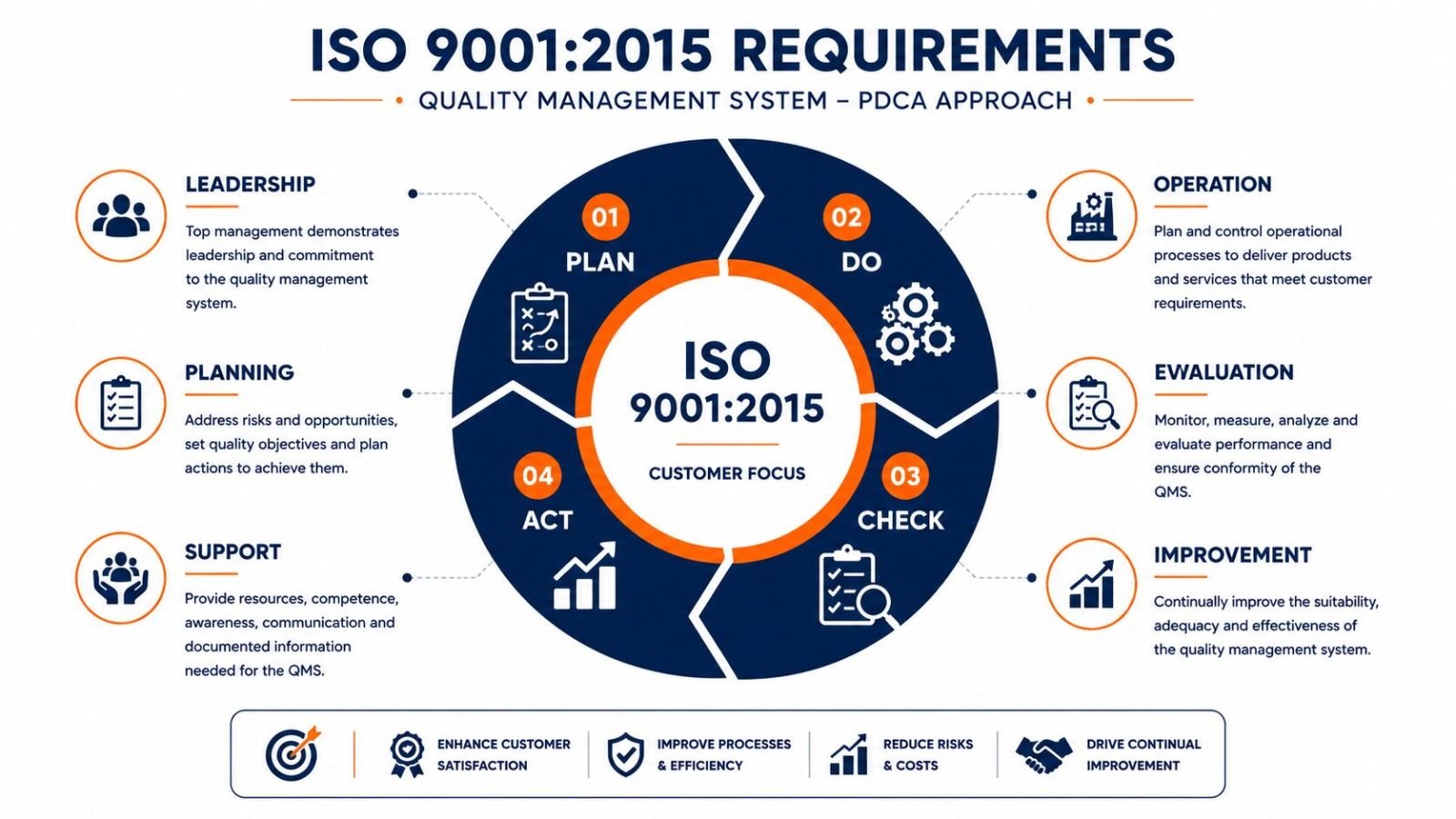
ISO 9001:2015 is organised into 10 clauses. Clauses 1 to 3 are introductory. The actual requirements that your organisation must meet are in Clauses 4 to 10. Here is what each clause requires in plain language:
| Clause | Title | What It Requires |
|---|---|---|
| Clause 4 | Context of the Organisation | Understand your business environment, internal and external issues, interested parties, and define the scope of your QMS. |
| Clause 5 | Leadership | Top management must demonstrate commitment to the QMS, establish a quality policy, and assign roles and responsibilities. |
| Clause 6 | Planning | Identify risks and opportunities, set quality objectives, and plan how to achieve them and deal with changes. |
| Clause 7 | Support | Provide resources, ensure staff competence, create awareness, establish communication channels, and control documented information. |
| Clause 8 | Operation | Plan and control production or service delivery processes, manage customer requirements, control external providers, manage nonconforming outputs. |
| Clause 9 | Performance Evaluation | Monitor and measure processes, conduct customer satisfaction surveys, perform internal audits, and management reviews. |
| Clause 10 | Improvement | Identify nonconformities, take corrective actions, and continually improve the QMS. This is the foundation of the PDCA cycle. |
Cost
ISO 9001 Certification Cost in India
ISO 9001 certification cost in India depends on three factors: your company size, the Certification Body you choose, and whether you use a consultant. Below is a realistic, transparent cost breakdown for 2025. All figures are for NABCB or IAF-accredited certification.
| Company Size | CB Audit Fee | Consultant Fee | Total Range |
|---|---|---|---|
| Micro or Startup 1 to 10 employees |
Rs.12,000 to Rs.20,000 | Rs.10,000 to Rs.18,000 | Rs.25,000 to Rs.40,000 |
| Small Business 11 to 50 employees |
Rs.20,000 to Rs.40,000 | Rs.18,000 to Rs.28,000 | Rs.40,000 to Rs.70,000 |
| Medium Business 51 to 200 employees |
Rs.40,000 to Rs.80,000 | Rs.28,000 to Rs.40,000 | Rs.70,000 to Rs.1,20,000 |
| Annual Surveillance Audit Year 1 and Year 2 |
Rs.8,000 to Rs.20,000 per year | Mandatory | |
| MSME Subsidy Available | Up to 75% reimbursement under NSIC and ZED Scheme | ||
Costs include CB audit fees and consultant or documentation support. Actual fees vary by CB and audit man-days. GST applicable. Above figures are for ISO 9001 only and exclude multisite or integrated system certifications.
ISO 9001 Cost: What is Included
- Free gap analysis and consultation
- QMS documentation preparation
- Quality manual writing
- SOPs for all key processes
- Risk register preparation
- Internal audit support
- CB selection and scheduling
- Stage 1 and Stage 2 audit support
- Certificate delivery
- MSME subsidy filing assistance
One fixed fee. No hidden charges. eFilingCompany.
How to Get ISO 9001 Certification in India: Step by Step
The ISO 9001 certification process in India follows a structured path. With eFilingCompany, most businesses complete this in 3 to 6 weeks. Here is the complete process explained in plain language.
Free Gap Analysis and Standard Confirmation
Our ISO 9001 expert reviews your current business processes, existing documentation, and operational setup against the requirements of ISO 9001:2015. We identify exactly what is in place and what needs to be built or improved. This analysis is free and takes 1 to 2 working days.
QMS Documentation Preparation
We prepare your complete QMS documentation: Quality Manual covering all 10 clauses, SOPs for every key process, Quality Policy, Quality Objectives, Risk Register, Interested Party Analysis, Internal Audit procedure, and all mandatory records. Completion in 7 to 15 working days.
Implementation and Employee Training
We train your team on the QMS requirements and their responsibilities. Employees need to understand the quality policy, their process responsibilities, and what to do when something goes wrong. This stage takes 3 to 7 days.
Internal Audit and Management Review
Before the CB audit, we conduct a full internal audit against all ISO 9001 clauses to identify and resolve any non-conformities. The Management Review Meeting is also conducted and documented. These are mandatory prerequisites for the certification audit.
Stage 1 Audit: Document Review
The accredited Certification Body conducts a Stage 1 audit, which is primarily a review of your QMS documentation. The auditor checks that your documents meet all requirements and that you are ready for the on-site Stage 2 audit. This can often be done remotely.
Stage 2 Audit: On-Site Certification Audit
The CB auditor visits your premises to verify that your QMS is actually being implemented as documented. They interview staff, review records, and observe operations. eFilingCompany attends alongside you. Non-conformities raised must be resolved before the certificate is issued.
Certificate Issuance and Ongoing Compliance
Once all non-conformities are closed, the CB issues your ISO 9001:2015 certificate. Valid for 3 years. Annual surveillance audits in Year 1 and Year 2 maintain its validity. Recertification audit in Year 3 renews it. eFilingCompany sends reminders and supports you through every surveillance audit.
Timeline Guide
Apply Online Now
Start your ISO 9001 certification online. Our consultant will call you within 2 working hours.
Get ISO 9001 Certified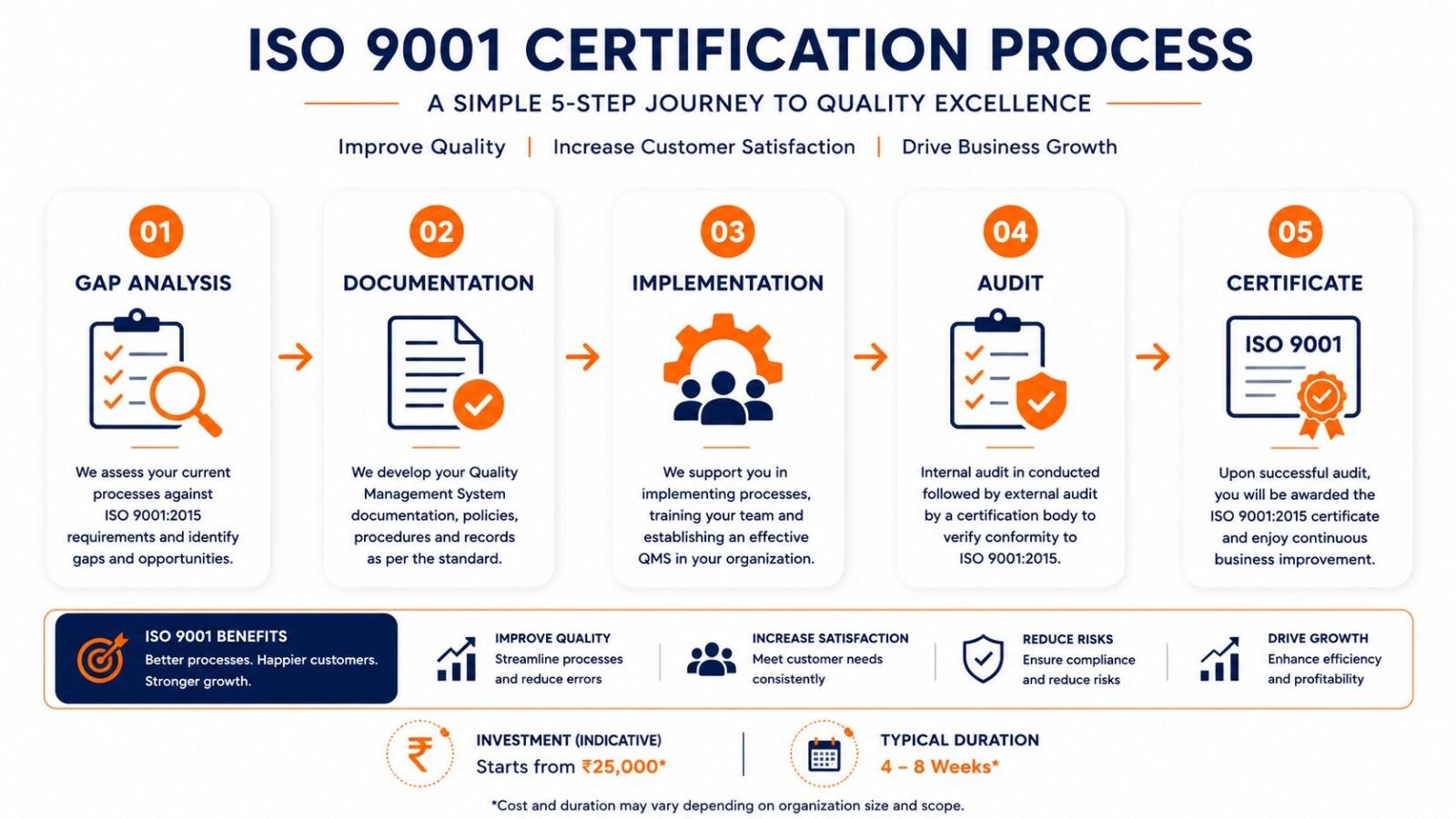
How to Verify ISO 9001 Certificate Online
ISO 9001 certificate verification is important before you accept a supplier's certificate, or before you submit your own certificate to a client. Many fake ISO certificates exist in the market, especially from non-accredited bodies. Here is how to check and verify ISO 9001 certification status online.
IAF CertSearch
The official global database for accredited ISO certifications. Go to iafcertsearch.org and search by company name or certificate number. If the certificate is from an IAF-accredited body, it will appear here.
NABCB Database
For certificates issued by India-based CBs accredited by NABCB, check the National Accreditation Board for Certification Bodies database at nabcb.qci.org.in to verify the CB's accreditation status.
CB's Own Registry
Most large CBs like Bureau Veritas, TUV SUD, DNV, and SGS have their own online certificate verification portals. The certificate number on the document can be checked directly on the issuing CB's website.
Use the CB name from the certificate
Benefits and Advantages of ISO 9001 Certification
ISO 9001 certification delivers both immediate commercial benefits and long-term operational improvements. Here are the most significant advantages for Indian businesses.
Win Government Tenders
Mandatory for Central Government tenders under GFR 2017. Opens access to GeM portal listings, CPWD, Railways, BSNL, BHEL, and all major PSU procurement categories worth billions annually.
Unlock Export Markets
ISO 9001 is the minimum qualification for supplying to buyers in EU, GCC, USA, and ASEAN markets. Required for engineering exports, IT services, food, pharma, and textile supply chains.
Reduce Operational Errors
ISO 9001 implementation forces you to document and standardise your processes. Businesses typically see 20 to 35% reduction in errors, rework, and customer complaints within 6 to 12 months of certification.
Build Customer Trust
ISO 9001 is a third-party verified quality guarantee. It signals to customers that your quality standards are independently audited, not self-declared. It is the most credible quality statement a business can make.
MSME Subsidies
MSME registered businesses can claim up to 75% reimbursement on ISO 9001 certification fees under the NSIC Subsidy Scheme and ZED Programme. Certification also strengthens CGTMSE loan applications.
Enterprise Vendor Access
Tata, Infosys, L&T, Mahindra, Wipro, BHEL require ISO 9001 from vendors. Without it, you cannot participate in their procurement. With it, you enter supply chains that were previously inaccessible.
ISO 9001 vs ISO 9000 vs ISO 14001 vs ISO 45001
Many businesses get confused by the different ISO standard numbers. Here is a clear comparison to help you understand the difference and choose what is right for your business.
| Standard | Focus | Who Needs It | Relationship to ISO 9001 |
|---|---|---|---|
| ISO 9001:2015 | Quality Management System | Any business in any industry | This is the certification standard |
| ISO 9000:2015 | QMS Fundamentals and Vocabulary | Reference document, not for certification | Defines terms used in ISO 9001. You cannot get certified to ISO 9000. |
| ISO 14001:2015 | Environmental Management System | Manufacturers, exporters, construction | Separate standard. Can be combined with ISO 9001 in an Integrated Management System. |
| ISO 45001:2018 | Occupational Health and Safety | Construction, manufacturing, mining | Separate standard, often integrated with ISO 9001 for contractor bids. |
| ISO 9001 + 14001 + 45001 | Integrated Management System (IMS) | Large manufacturers, infrastructure contractors | All three audited together. Cost savings of 20 to 30% vs separate certifications. |
ISO 9001 Certification Across India - City by City
eFilingCompany provides ISO 9001 certification support across every major city and industrial cluster in India. Our auditor and consultant network covers all states and Union Territories.
Get Your ISO 9001 Certification Today
Join 5,000+ businesses certified by eFilingCompany. Fast, affordable, NABCB and IAF accredited. All industries. All states and countries.
Start ISO 9001 CertificationOr call us at +919953004880 | Email: info@efilingcompany.com | Response within 5 working hours