ISO 20000 Certification
ISO 20000 (ISO/IEC 20000-1) is the leading global standard for IT Service Management (ITSM). It provides organisations with a structured framework to plan, establish, implement, operate, monitor, and continually improve their IT services. eFilingCompany helps IT departments, managed service providers, cloud companies, and businesses across India


2000
Happy Clients

1500
Expert Advisors

2+
Branch Offices
Free Consultation by Expert
.png)


.png)
.png)
ISO 20000 Certification, IT Service Management System Standard
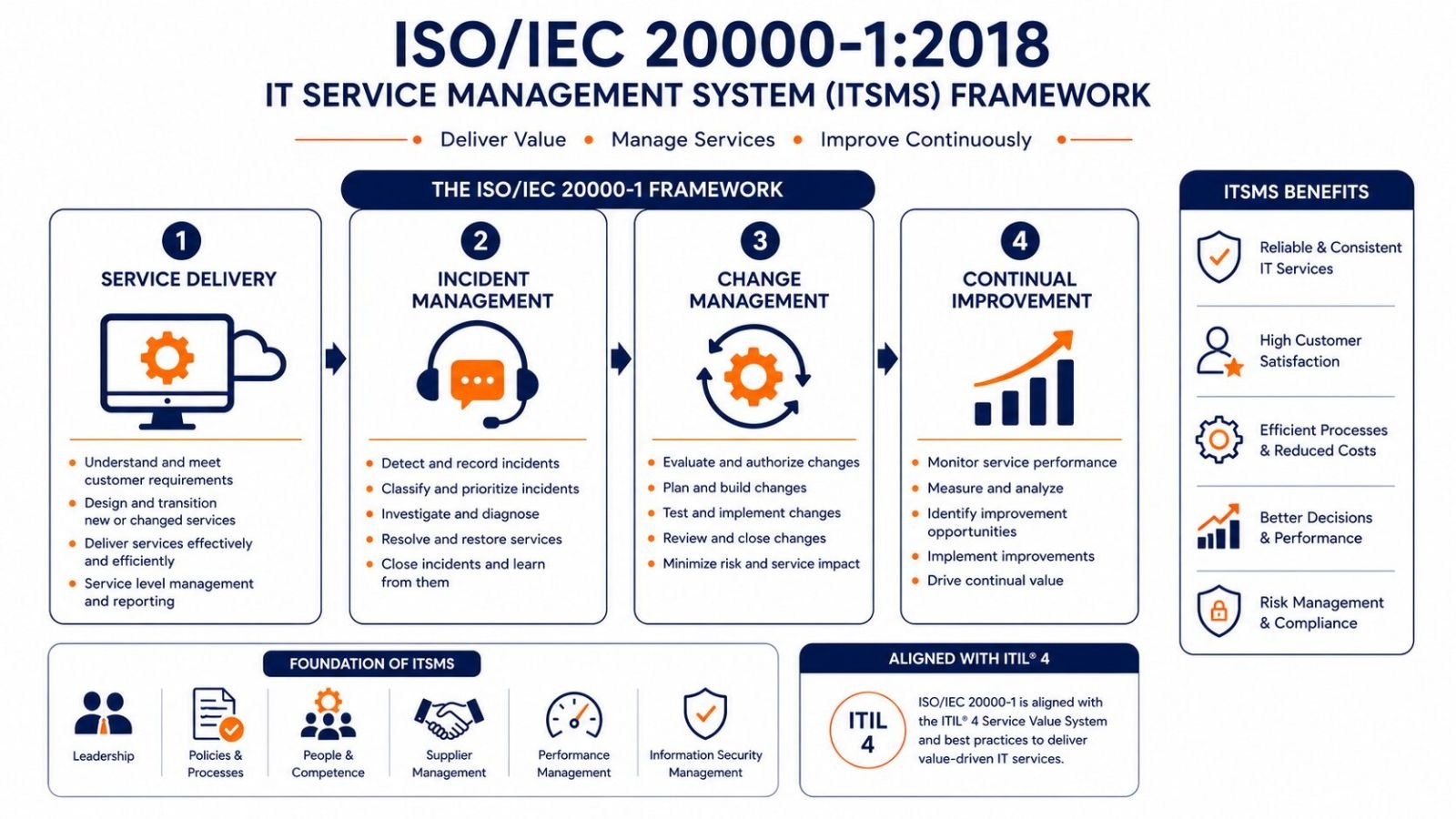
ISO/IEC 20000-1:2018 is the leading international IT service management system standard, with the objective to ensure the quality of the IT services your organisation delivers. It outlines requirements for setting up the Service Management System (SMS) and best practices for managing a company's IT service.
ISO/IEC 20000-1 is a Type A management system standard that sets out the minimum requirements for an organisation to establish, implement, maintain, and continually improve a service management system. An effective SMS consists of policies, processes, objectives, and plans, with documented information that are put together and coordinated to achieve the objectives of the organisation.
The current version is ISO/IEC 20000-1:2018, published jointly by ISO and IEC. The standard was originally published in 2005 and subsequently updated in 2011 and 2018. According to the ISO Survey, there are more than 7,000 certificates issued to organisations complying with ISO/IEC 20000-1 worldwide.
.jpg)
Expertise in ISO 20000 Certification

Enquiry Form
Among Asia Top
100
Consulting Firm

Get Consultation
Lowest Fees
100,000 + Clients.

Service Delivery
4.9 Customers Rating
50+ Offices
Contact us today to schedule your appointment.
You can call us on +919953004880 or write to us at info@efilingcompany.com
| Important: ISO 20001 Does Not Exist — The Correct Standard is ISO/IEC 20000-1 |
"ISO 20001 certification" is a common misspelling and does not refer to any existing standard. The correct standard is ISO/IEC 20000-1:2018 — IT Service Management System Requirements. If you have been searching for "ISO 20001 certification," you are looking for ISO/IEC 20000-1. Always use the correct standard name when engaging with certification bodies and auditors.
| ISO 20000 vs ITIL — Key Differences |
| Aspect | ISO/IEC 20000-1:2018 | ITIL |
| Type | Certifiable international management system standard | Best practice framework and guidance |
| Who it applies to | The entire organisation can be certified | Certifications normally apply to individuals only |
| Purpose | Sets minimum requirements for establishing, implementing, and maintaining an SMS | Describes best practices for achieving the service quality level required by ISO/IEC 20000 |
| Relationship | ITIL can be used as an implementation guide to help achieve ISO/IEC 20000-1 certification | ITIL-aligned organisations are well-positioned to achieve ISO/IEC 20000-1 certification |
| Output | Formal ISO certificate issued to the organisation by an accredited certification body | Individual ITIL credential for the professional |
| ISO 20000 vs ISO 9001 vs ISO 27001 — At a Glance |
| Aspect | ISO/IEC 20000-1 | ISO 9001 | ISO/IEC 27001 |
| Focus | IT Service Management System | Quality Management System (all industries) | Information Security Management System |
| Applicable To | IT infrastructure and IT service delivery | All organisations and all industries | All organisations handling information assets |
| Addresses | Quality, reliability, and delivery of IT services | Product/service quality and customer satisfaction | Cyber threats, data breaches, information risk |
| Integration | Closely aligned with ISO 9001, ISO 27001, ISO 22301 | Can be integrated with ISO 20000, ISO 14001, ISO 45001 | Can be extended with ISO 27701 for privacy management |
| Benefits of ISO/IEC 20000-1 Certification |
| Service Reliability ISO/IEC 20000-1 dramatically reduces system downtime through structured change management. It establishes processes that ensure IT services are delivered consistently and reliably, meeting agreed service levels. |
SLA Compliance Ensures your team consistently meets or exceeds client service expectations. ISO/IEC 20000-1 provides the framework for defining, monitoring, and reporting on Service Level Agreements with internal and external customers. |
| Integrated Security Aligns IT services with data protection protocols for better risk management. ISO/IEC 20000-1 is closely aligned with ISO/IEC 27001, enabling organisations to integrate security controls within their service management framework. |
Operational Clarity Clearly defines roles and responsibilities within the IT service team. ISO/IEC 20000-1 improves understanding of roles and responsibilities and improves relationships with suppliers and other relevant interested parties. |
| Scalability Allows the IT department to grow without a drop in service quality. ISO/IEC 20000-1 provides a scalable service framework that supports rapid growth while maintaining consistent service delivery standards. |
Cost Efficiency Optimises IT delivery and reduces operational spending through avoidance of recurring errors and incidents, improved knowledge management, and reduced costs caused by inefficiencies in IT service processes. |
| Who Should Pursue ISO/IEC 20000-1 Certification? |
ISO/IEC 20000-1 is specifically applicable to IT infrastructure and IT service management. However, the standard can also be used for various other services including finance, cloud, and business process outsourcing. Organisations that should pursue ISO/IEC 20000-1 certification include:
| IT departments providing internal IT services to the business | Managed service providers (MSPs) delivering IT services to external clients |
| Cloud service providers and cloud-based IT companies | E-government services standardising IT support for public-sector portals and databases |
| Financial IT departments ensuring high-reliability systems for banking and insurance | Tech startups building a scalable service framework to support rapid growth |
| Business process outsourcing companies delivering IT-enabled services | Organisations seeking objective, impartial evidence of the quality of their IT service |
| ISO 20000 Certification Process — Step by Step |
| 1 | Request a Proposal — The organisation provides the Certification Body with information on the number of people in scope, main lines of business, and scope of the SMS. The Certification Body calculates the number of days required and sends a proposal with the price |
| 2 | Certification Audit — Phase 1 (Documentation Review) — The audit team prepares an Audit Plan, reviews all documentation of ISO/IEC 20000 processes and the PDCA and operational implementation. The outcome is an Audit Report reflecting all ISO/IEC 20000 processes and detected deviations. The purpose is to check whether the documentation is compliant with ISO/IEC 20000 |
| 3 | Certification Audit — Phase 2 (Main Audit) — The audit team reviews everything from Phase 1, plus all processes not treated in Phase 1. The Main Audit Report is the final report on the audit — it checks whether all processes in the company are compliant with the standard and with documentation, and whether the Service Management System works |
| 4 | Certificate Issuance — If the organisation addresses all deviations from the audit report, the Certification Body releases a Decision Evaluation Report and finally approves the granting of the certificate. The ISO certificate is valid for 3 years |
| 5 | Surveillance Visits — The certificate is valid for 3 years, during which surveillance visits are conducted. After the first certification audit, the organisation will face further audits in the next 2 years to ensure continued compliance |
| 6 | Recertification Audit — After 3 years when the certificate expires, the organisation faces a recertification audit to maintain the certificate |
| ISO 20000 Professional Certification Levels for Individuals |
| Level | Duration | Description |
| Foundation | 1–2 days | Provides foundational knowledge and understanding of ISO/IEC 20000 and the Service Management System requirements |
| Practitioner | Up to 5 days total | Demonstrates understanding of ISO/IEC 20000 and ability to apply it in a work environment; learn and manage risk, set measurable objectives and improve IT service delivery and performance |
| Lead Implementer | 5 days | Equips professionals with competencies to establish, implement, maintain, and continually improve an SMS based on ISO/IEC 20000-1; includes guidance from ISO/IEC 20000-1 and several international standards and good practices |
| Lead Auditor | 5 days | Equips professionals with competencies to perform and manage SMS audits using ISO 19011 guidelines and ISO/IEC 17021-1 certification audit principles; five-day training course that enables obtaining the Lead Auditor certification |
| Consultant | Varies | For professionals providing consultancy advice on implementation of ISO/IEC 20000-1 within organisations |
| ISO 20000 Lead Auditor Certification — Exam Details |
| Exam Detail | Information |
| Question Format | Multiple choice, objective type |
| Number of Questions | 50 questions |
| Passing Score | 70% (35 out of 50 correct) |
| Exam Syllabus Coverage | Fundamentals of ITSM, ISO/IEC 20000 standard and related standards, Planning for the SMS, ITSM System Audit, Audit principles procedures and techniques, Documentation of ISO/IEC 20000 standard audit, Conducting ISO/IEC 20000 audit, Managing audit programmes |