ISO Certification in Oman
ISO Certification in Oman


2000
Happy Clients

1500
Expert Advisors

2+
Branch Offices
Free Consultation by Expert
.png)


.png)
.png)
What Is ISO Certification in Oman?
Oman is formal, independent confirmation that an organisation's management system — for quality, environment, safety, information security or food safety — meets the requirements of a standard published by the International Organization for Standardization (ISO). A certificate is issued only after an accredited certification body audits your processes and confirms they comply with the chosen standard.
For businesses across the Sultanate — from Muscat's financial and IT sector to the industrial hubs of Sohar and Duqm — ISO certification has become a recognised benchmark of credibility. It is frequently required to bid on government and oil & gas tenders, and it supports the national quality-infrastructure goals set out under Oman Vision 2040. This guide explains what ISO certification involves in Oman, the main standards, the step-by-step process, typical costs, requirements and benefits.

Expertise in ISO Certification in Oman

Enquiry Form
Among Asia Top
100
Consulting Firm

Get Consultation
Lowest Fees
100,000 + Clients.

Service Delivery
4.9 Customers Rating
50+ Offices
Contact us today to schedule your appointment.
You can call us on +919953004880 or write to us at info@efilingcompany.com
Who Oversees Standards and Accreditation in Oman?
Oman's national quality infrastructure is led by the Directorate General for Standards and Metrology (DGSM), which operates under the Ministry of Commerce, Industry and Investment Promotion (MoCIIP). DGSM is Oman's national standards body and is responsible for adopting standards, regulating conformity assessment, and accrediting laboratories, inspection bodies and certification bodies operating in the Sultanate.
As part of Oman Vision 2040 and the national standardisation strategy for 2026–2030, Oman is strengthening this framework — including the establishment of the Oman Accreditation Centre and continued development of the Omani Quality Mark. For management-system certificates such as ISO 9001, the practical mark of credibility is accreditation under the International Accreditation Forum (IAF), often via the GCC Accreditation Center (GAC). A certificate issued by an IAF-accredited body is the kind recognised by government entities and international clients.
Main ISO Standards Used in Oman
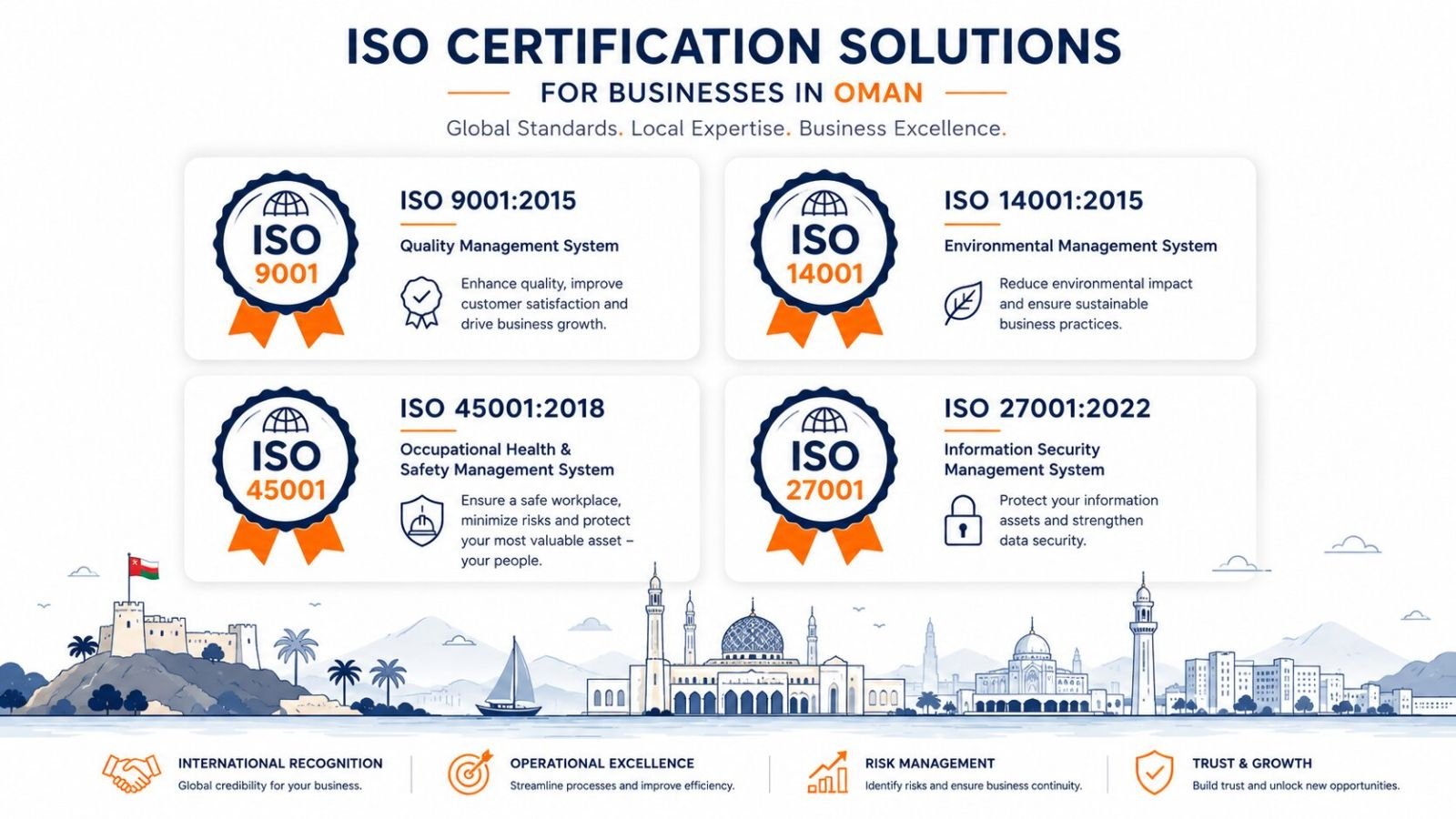
ISO 9001 Certification in Oman (Quality Management)
ISO 9001 certification in Oman is the most widely adopted standard. It certifies a Quality Management System (QMS) and demonstrates that an organisation can consistently deliver products and services that meet customer, statutory and regulatory requirements. For most Omani businesses, ISO 9001 is the starting point and the standard most often requested in tenders and contracts.
ISO 45001 (Occupational Health & Safety)
ISO 45001 certifies an Occupational Health & Safety Management System. In Oman's oil & gas, construction and heavy-industry sectors — particularly around Sohar and Duqm — it is often a prerequisite for project work and helps organisations reduce workplace incidents and meet safety obligations.
ISO 14001 (Environmental Management)
ISO 14001 certifies an Environmental Management System, helping organisations reduce environmental impact and use resources responsibly. It is widely sought by industrial, energy and construction firms operating under Oman's environmental regulations and supports the sustainability goals of Vision 2040.
ISO 27001 (Information Security)
ISO 27001 certifies an Information Security Management System (ISMS). As Omani banks, telecom operators, fintech and IT firms accelerate digital transformation, ISO 27001 has become important for protecting sensitive data, managing cyber risk and meeting client security requirements.
ISO 22000 & HACCP (Food Safety)
ISO 22000 and HACCP certify food safety across the supply chain. For Oman's food importers, processors, restaurants and hospitality businesses, these standards ensure compliance with food-safety regulations and build consumer confidence.
ISO Certification Process in Oman: Step by Step
The certification process in Oman follows a structured, internationally consistent path. Understanding each stage helps you plan timelines and avoid surprises during the audit.
Gap Analysis
Your current processes are assessed against the chosen ISO standard to identify what already complies and what needs to be developed or improved.
Documentation
The required policies, procedures and manuals are prepared, tailored to how your organisation actually operates rather than generic templates.
Implementation & Training
The new system is rolled out and staff are trained on their roles, so the management system is genuinely embedded before the audit.
Internal Audit & Review
An internal audit and management review test the system, identify non-conformities, and confirm readiness for the external certification audit.
Certification Audit (Stage 1 & Stage 2)
An accredited certification body conducts a two-stage audit: Stage 1 reviews your documentation and readiness, and Stage 2 assesses how effectively the system works in practice.
Issuance & Surveillance
On success, your certificate is issued for three years. Annual surveillance audits confirm ongoing compliance, and a recertification audit renews it at the end of the cycle.
ISO Certification Cost in Oman: What Affects the Price
There is no single fixed price for ISO certification in Oman. The cost depends on the factors below, which is why reputable providers give a quote only after a short assessment of your organisation:
Organisation Size & Sites
More employees, multiple locations, or operations running across several shifts increase audit days and therefore cost.
Choice of Standard
ISO 9001 is generally the most economical. Complex standards such as ISO 27001 require more implementation effort and cost more.
Current Readiness
If good processes are already in place, less work is needed to close gaps, which lowers the overall cost.
Accreditation Level
IAF-accredited certificates cost slightly more but are recognised for tenders and exports. Non-accredited certificates are cheaper but often rejected.
The total cost typically includes consultancy support, the certification body's audit fee, and ongoing surveillance audits over the three-year cycle. For an accurate figure, request a quote based on your specific size, standard and number of sites.
ISO Certification Requirements in Oman
To achieve and maintain ISO certification in Oman, an organisation generally needs to demonstrate the following:
A management system that follows the requirements of the chosen ISO standard.
Documented policies, procedures and records that reflect how the organisation actually operates.
Evidence that customer, statutory and regulatory requirements are being met.
Internal audits and management reviews that drive continual improvement.
Benefits of ISO Certification in Oman
Beyond compliance, ISO certification delivers practical advantages for Omani organisations:
Eligibility for Tenders
Many government and oil & gas tenders require certifications like ISO 9001 and ISO 45001, making certification a gateway to major contracts.
Greater Credibility & Trust
An internationally recognised certificate signals reliability to clients, partners and regulators in Oman's competitive market.
Efficiency & Lower Costs
Standardised processes reduce errors and waste, improving consistency and lowering operational costs over time.
Access to Export Markets
Globally recognised certification helps Omani businesses take products and services into international supply chains.
Where ISO Certification Is in Demand Across Oman
Demand for certification reflects Oman's regional economy and the priorities of Vision 2040:
Muscat
The financial and administrative capital: banking, IT, telecom and government drive demand for ISO 9001, ISO 27001 and ISO 22301.
Sohar & Al Batinah
A heavy-industry and port hub: metallurgy, petrochemicals and logistics rely on ISO 9001, 14001 and 45001.
Duqm (SEZAD)
The special economic zone for energy and petrochemicals: large projects require rigorous safety and environmental standards.
Salalah & Dhofar
A maritime and transshipment gateway: logistics, free-zone manufacturing and agribusiness drive food-safety and quality standards.
Thinking About ISO Certification for Your Business in Oman?
We help organisations across Oman choose the right standard and achieve certification with IAF-accredited bodies. Get a free consultation to understand the process, timeline and cost for your specific situation.
Get a Free Consultation