ISO 37001 Certification
ISO 37001 is the internationally recognised standard for Anti-Bribery Management Systems (ABMS). The latest version is ISO 37001:2025. It provides a structured framework to help organisations prevent, detect, and address bribery risks. eFilingCompany helps organisations across India achieve ISO 37001 certification efficiently.


2000
Happy Clients

1500
Expert Advisors

2+
Branch Offices
Free Consultation by Expert
.png)


.png)
.png)
ISO 37001 Certification — Anti-Bribery Management System Standard for Organisations in India
ISO 37001 is the internationally recognised standard for Anti-Bribery Management Systems (ABMS). The latest version is ISO 37001:2025, published by the International Organisation for Standardisation (ISO). It provides a structured framework to help organisations prevent, detect, and address bribery and corruption risks.
Think of this standard as the highest level of proof that your business is operating legitimately, uncorrupted and adhering to every commercial law that regulates anti-bribery. With ISO 37001 certification, organisations around the world can trust your brand knowing that you are working to the highest standards set by the accreditation body.
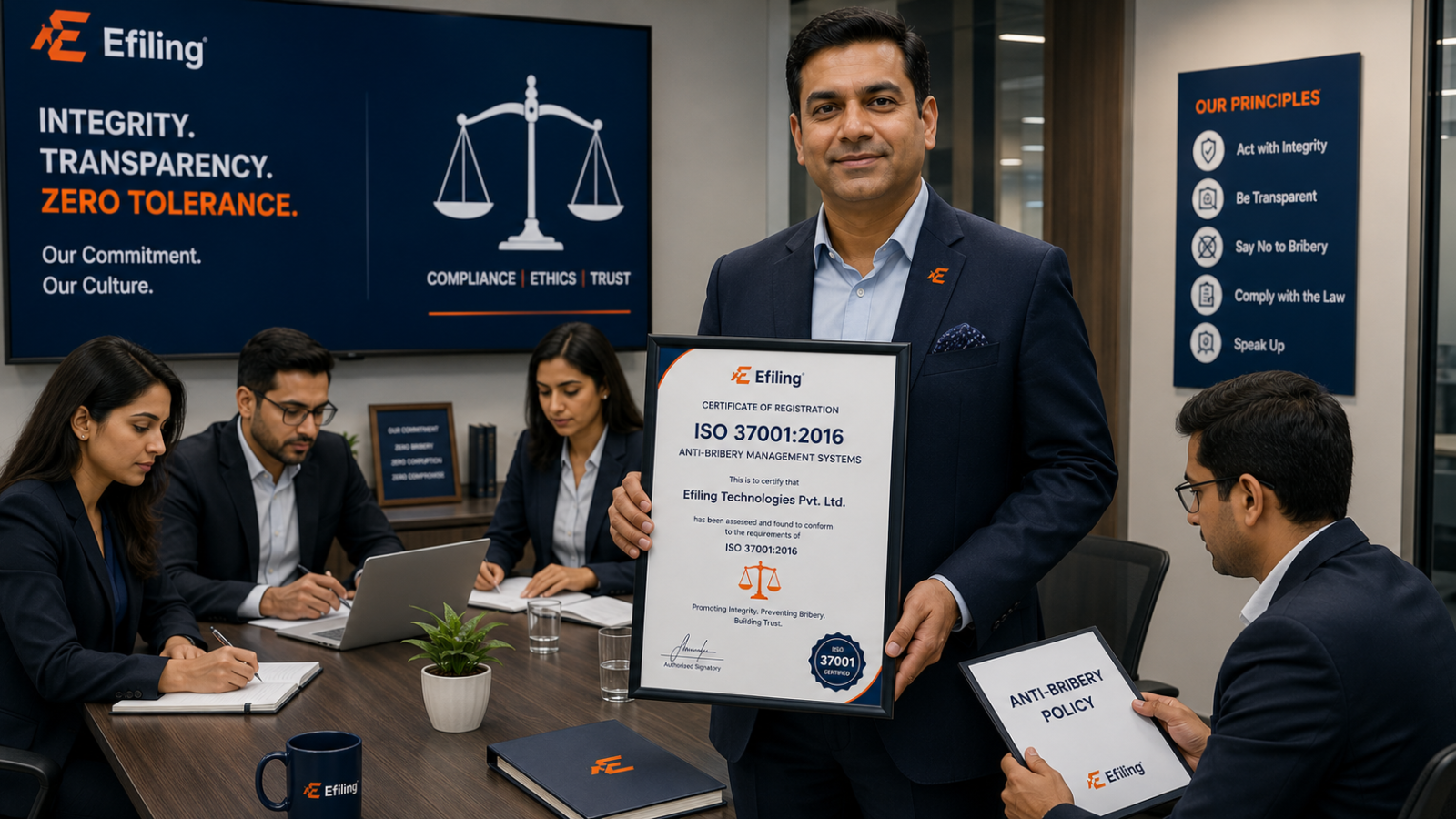

Expertise in ISO 37001 Certification

Enquiry Form
Among Asia Top
100
Consulting Firm

Get Consultation
Lowest Fees
100,000 + Clients.

Service Delivery
4.9 Customers Rating
50+ Offices
Contact us today to schedule your appointment.
You can call us on +919953004880 or write to us at info@efilingcompany.com
ISO 37001 is applicable to organisations of all types and sizes — public, private, and non-profit. It is a cross-industry standard and covers bribery risks in the following scenarios:
| Bribery directly by the organisation |
| Bribery by employees acting on the organisation's behalf |
| Bribery conducted through intermediaries |
| Bribery of the organisation by third parties |
| Bribery of the organisation's employees by third parties |
Important: ISO 37001 focuses specifically on bribery risks. It does not address other forms of corruption such as fraud or money laundering.
| ISO 37001:2025 — Latest Version Update |
The current version is ISO 37001:2025, which updates and replaces ISO 37001:2016. Key enhancements in the 2025 version include:
| Strengthened governance requirements — clearer leadership and accountability obligations for top management |
| Expanded due diligence processes — more comprehensive guidance on assessing bribery risks with third parties and supply chain |
| Improved whistleblower protections — stronger requirements for safe reporting channels that protect individuals who raise concerns |
| Integration of modern risk management strategies — addresses new challenges in corporate governance and environmental sustainability |
| Transition requirement: Organisations certified to ISO 37001:2016 must transition to ISO 37001:2025 within the given timeline to maintain certification validity |
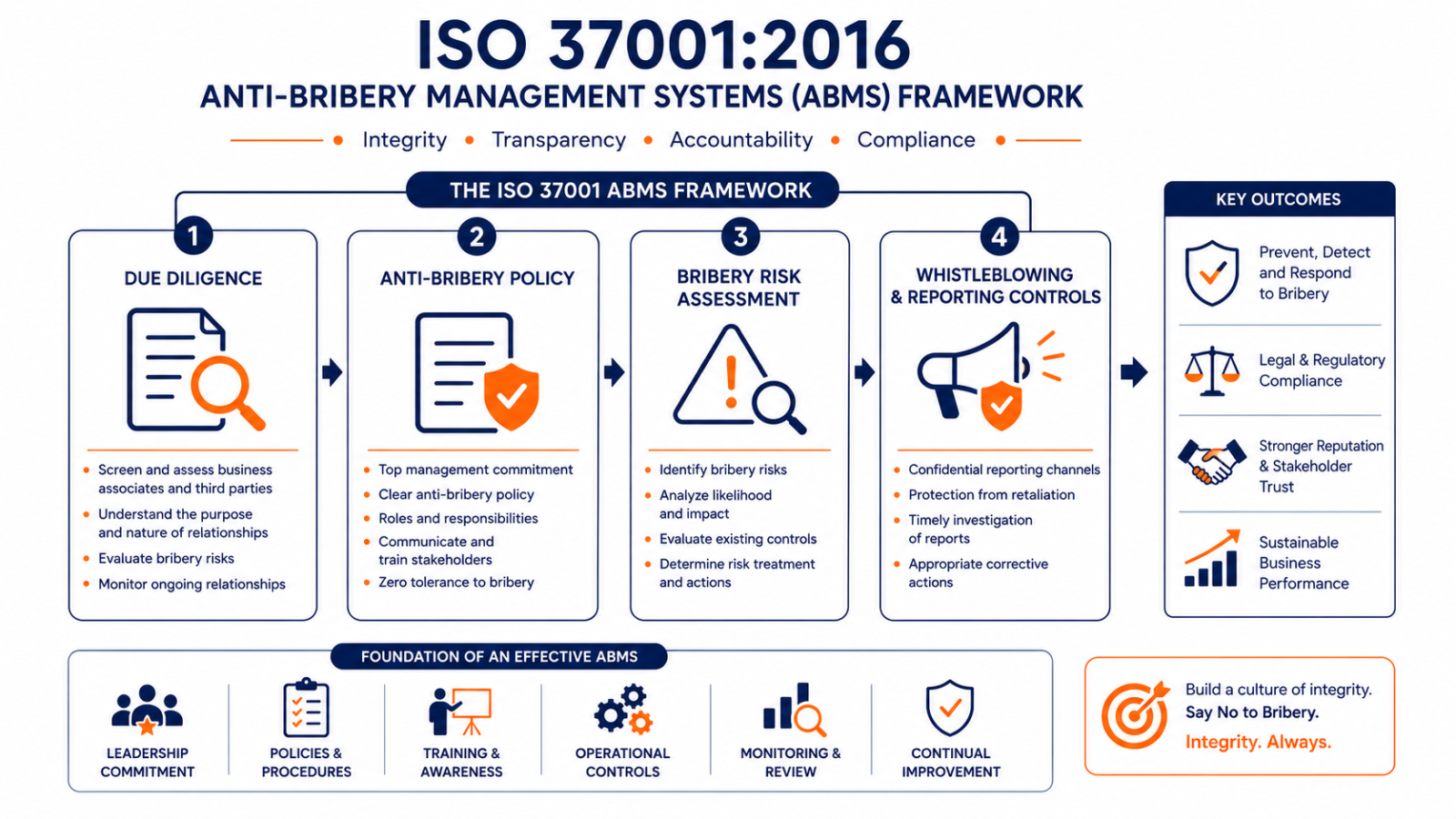
| Structure of ISO 37001 — Clause by Clause |
ISO 37001 is built on the Harmonised Structure (Annex SL) — the same common framework used by ISO 9001, ISO 14001, ISO 27001, and ISO 45001. This makes it easier to integrate with existing certified management systems.
| Clause | Section | What it Covers |
| 4 | Context | Understanding the organisation and its context, identifying interested parties, defining scope of ABMS |
| 5 | Leadership | Top management commitment, anti-bribery policy, roles and responsibilities, compliance function |
| 6 | Planning | Actions to address risks and opportunities, anti-bribery objectives and plans |
| 7 | Support | Resources, competence, awareness, communication, documented information |
| 8 | Operation | Due diligence, financial and non-financial controls, anti-bribery commitments, gifts and hospitality, raising concerns, investigating bribery |
| 9 | Performance Evaluation | Monitoring, measurement, analysis, internal audit, management review, compliance function review |
| 10 | Improvement | Nonconformity and corrective action, continual improvement of the ABMS |
| Benefits of ISO 37001 Certification |
| Legal Compliance Ensures alignment with global anti-corruption laws including the UK Bribery Act 2010 and the US Foreign Corrupt Practices Act (FCPA). Helps reduce legal exposure and potential penalties associated with bribery violations. |
Stakeholder Trust Strengthens confidence among investors and partners in your organisation's financial governance. ISO 37001 certification signals that your organisation operates with transparency and integrity. |
| Reduced Financial Risk Prevents the heavy fines and legal costs associated with bribery scandals. Developing internal processes that regularly monitor key challenges, control risks, and costs related to bribery cuts investigation time to a minimum. |
Competitive Edge Differentiates your firm in tenders where ethical conduct is a key metric. Organisations that achieve ISO 37001 certification can demonstrate to procurement teams and clients that they maintain robust anti-bribery controls. |
| Internal Accountability Empowers employees to act transparently through established reporting channels. Improved whistleblower protections under ISO 37001:2025 help ensure that individuals can raise concerns without fear of retaliation. |
Evidence of Due Diligence For legal purposes, the standard demonstrates that your organisation has taken due diligence preventative measures in case evidence of bribery emerges — which may help reduce fines and demonstrate good faith to regulatory authorities. |
| Who Should Get ISO 37001 Certified? |
ISO 37001 is applicable to any organisation regardless of size or industry. It is particularly relevant for organisations where bribery is a known risk factor:
| Banking and Finance — strengthening systems against fraud, money laundering, and financial crime | Oil, Gas and Mining — ensuring transparency in extraction licences and international trade |
| Healthcare — governing interactions between medical professionals and procurement teams | Government Entities — ensuring public sector procurement and contracting processes are free of bribery |
| NGOs and Non-Profits — demonstrating ethical use of funds and donor accountability | Financial Institutions — managing financial transactions and investor relations ethically |
| Energy Sector — compliance with anti-bribery requirements in regulated energy markets | Procurement Departments — controlling and monitoring bribery risks in procurement processes |
| ISO 37001 Certification Process — Step by Step |
| 1 | Gap Analysis — Assess your current anti-bribery practices and processes against ISO 37001 requirements. Identify areas where improvements are required to meet the standard's criteria |
| 2 | Preparation and Documentation — Develop the required documentation including anti-bribery policy (Clause 5.2), risk assessment report (Clause 4.5), due diligence records (Clause 8.2), and documented ABMS processes. Management system must be operational for a minimum of three months before certification audit |
| 3 | Employee Training and Awareness — Train all staff on ISO 37001 requirements, anti-bribery policies, and reporting procedures. Training records must be maintained per Clause 7.2 and 7.3 |
| 4 | Implementation — Implement the ABMS including financial controls, non-financial controls, due diligence, safe reporting channels, and controls for gifts, hospitality, and donations |
| 5 | Internal Audit — Conduct an internal audit (per Clause 8.8) to evaluate compliance and identify non-conformances. The management system must have been subject to a full cycle of internal audit before the certification audit |
| 6 | Management Review — Top management reviews ABMS performance, suitability, adequacy, and effectiveness; management review records maintained per Clause 9.3 |
| 7 | Certification Audit — Stage 1 (Documentation Review) — The accredited certification body reviews your ABMS documentation to verify it meets ISO 37001 requirements |
| 8 | Certification Audit — Stage 2 (On-site Audit) — The certification body verifies that all ABMS processes are fully implemented and effective on-site |
| 9 | Certificate Issuance — Upon successful completion, the ISO 37001 certificate is granted for a period of 3 years with annual surveillance visits to maintain certification validity |
| Documents Required for ISO 37001 Certification |
| Document | ISO 37001 Clause Reference |
| Anti-bribery policy | Clause 5.2 |
| Scope of the Anti-Bribery Management System | Clause 4.3 |
| Top management statement of commitment | Clause 5.1 |
| Risk assessment report | Clause 4.5 |
| Due diligence records | Clause 8.2 |
| Training records | Clause 7.2 and 7.3 |
| Internal audit report | Clause 8.8 |
| Management review records | Clause 9.3 |
| Records of anti-bribery controls | Clause 8.7 |
| ISO 37001 Integration with Other ISO Standards |
Because ISO 37001 uses the Harmonised Structure (Annex SL), it integrates readily with other ISO management system standards that your organisation may already hold:
| ISO 9001:2015 | Quality Management System — shared process approach and documentation framework |
| ISO 14001:2015 | Environmental Management System — shared Annex SL structure and risk-based thinking |
| ISO 45001:2018 | Occupational Health and Safety — shared leadership and operational control requirements |
| ISO/IEC 27001:2022 | Information Security Management — shared Annex SL structure and management review requirements |
| ISO 31000:2018 | Risk Management — complementary risk assessment and treatment framework |
| ISO 37301 | Compliance Management Systems — ISO 37001 addresses bribery specifically; ISO 37301 covers compliance management more broadly |
| ISO 37001 Professional Certification Tracks for Individuals |
| Track | Description |
| Foundation | Provides foundational knowledge and understanding of ISO 37001 and Anti-Bribery Management System requirements |
| Lead Implementer | Equips professionals with competencies to establish, implement, maintain, and improve an ABMS based on ISO 37001 within an organisation |
| Lead Auditor | Equips professionals with competencies to perform and manage ABMS audits using ISO 19011 guidelines and ISO/IEC 17021-1 certification audit principles |
| ISO 37001:2025 Transition | For professionals and organisations transitioning from ISO 37001:2016 to the new ISO 37001:2025 version of the standard |