ISO Certification in Dubai
IGet ISO Certified in Dubai — For Trade, Tourism, Free Zone Companies & Every Sector of the UAE Economy. ISO 9001, 14001, 45001, 27001 & More — Accredited ISO Certification Services in Dubai, UAE


2000
Happy Clients

1500
Expert Advisors

2+
Branch Offices
Free Consultation by Expert
.png)


.png)
.png)
ISO Certification in Dubai
Dubai stands at the centre of the UAE's economy — a global hub for trade, logistics, tourism, technology, and financial services, anchored by an extensive network of free zones including DMCC, JAFZA, DAFZA, Dubai Internet City, and DIFC, and driven by ambitious government initiatives such as the Dubai Economic Agenda D33. For businesses operating in this environment, ISO certification in Dubai has become essential — whether you are bidding for a government tender, registering as a supplier to a major corporate, demonstrating data security to enterprise clients, or building guest trust in Dubai's competitive hospitality market. Whether you need ISO 9001 certification in Dubai as your first step toward quality management recognition, ISO 27001 for an IT company in Dubai Internet City, or ISO 22000 for a hotel kitchen, our ISO certification services in Dubai cover every standard, every sector, and every free zone.

Expertise in ISO Certification in Dubai

Enquiry Form
Among Asia Top
100
Consulting Firm

Get Consultation
Lowest Fees
100,000 + Clients.

Service Delivery
4.9 Customers Rating
50+ Offices
Contact us today to schedule your appointment.
You can call us on +919953004880 or write to us at info@efilingcompany.com
ISO 9001 Certification in Dubai — Your First Step Toward ISO Compliance
ISO 9001 certification in Dubai is the most widely adopted and most frequently required ISO standard across the emirate. It is the foundational Quality Management System standard, applicable to virtually any business — from a small trading company in Deira to a large hotel group in Jumeirah, a logistics operator in JAFZA, or a professional services firm in DIFC. ISO 9001 certification is the standard most commonly requested in government tender documentation, supplier registration forms, and free zone corporate vendor lists. For most Dubai businesses, ISO 9001 is the natural starting point — establishing a documented quality management system that can later be expanded into an Integrated Management System with ISO 14001 (Environmental) and ISO 45001 (Health and Safety) as the business grows.
Key benefits of ISO 9001 certification in Dubai include: improved eligibility for government and semi-government tenders, recognition as a qualified supplier within free zone vendor networks, demonstrable commitment to consistent service or product quality for enterprise clients, and a foundation for adding further ISO standards as your business expands across the UAE.
Why ISO Certification Matters for Dubai Businesses
| Business Driver | How ISO Certification Helps in Dubai |
| Government & Semi-Government Tenders | ISO 9001 is frequently a mandatory or strongly preferred requirement for Dubai government, construction, facilities management, IT, and logistics tenders |
| Free Zone Vendor Registration | Free zone authorities such as DMCC, JAFZA, DAFZA, and Dubai Internet City often expect ISO 9001 or ISO 27001 from companies seeking corporate contracts within the free zone |
| Tourism & Hospitality Standards | Hotels and restaurants pursue ISO 22000 (food safety), ISO 9001 (service quality), and ISO 14001 (sustainability) to align with Dubai Municipality food safety requirements and DTCM classification standards |
| Data Security for IT & Fintech | Companies in Dubai Internet City, DIFC, and other tech-focused free zones pursue ISO/IEC 27001 to demonstrate information security to enterprise and BFSI clients |
| Logistics & Trade Operations | Companies operating through JAFZA, Jebel Ali Port, and Dubai's extensive logistics corridors pursue ISO 9001 and ISO 45001 for operational quality and workforce safety |
| Dubai Economic Agenda D33 | Dubai's economic growth strategy emphasises quality, sustainability, and global competitiveness — ISO certification aligns businesses with these strategic priorities |
ISO Certification Standards We Offer in Dubai
| ISO Standard | What It Covers | Best For (Dubai Sectors) |
| ISO 9001:2015 | Quality Management System | All industries — government tenders, free zone vendor registration, trading companies, hospitality, professional services |
| ISO 14001:2015 | Environmental Management System | Hospitality (sustainability initiatives), manufacturing, construction, logistics |
| ISO 45001:2018 | Occupational Health & Safety | Construction, logistics, manufacturing, large hotels and resorts with significant workforces |
| ISO/IEC 27001:2022 | Information Security Management | IT companies, fintech firms, SaaS platforms, and businesses in Dubai Internet City, DIFC, and tech free zones |
| ISO 22000:2018 | Food Safety Management | Hotels, restaurants, catering companies, food manufacturers — Dubai Municipality alignment |
| ISO 22301:2019 | Business Continuity Management | Banks, logistics operators, IT companies requiring continuity frameworks |
| ISO 37001:2016 | Anti-Bribery Management System | Companies engaged in government contracts and corporate governance-focused organisations |
| ISO 50001:2018 | Energy Management System | Hotels, large facilities, and energy-intensive operations pursuing sustainability goals |
| ISO 13485:2016 | Medical Devices Quality Management | Medical device manufacturers and healthcare suppliers operating in Dubai |
ISO 9001 vs ISO 14001 vs ISO 45001 vs ISO 27001 — Which Does Your Dubai Business Need?
This is one of the most common questions from Dubai businesses beginning their ISO journey. Here is how the four most-requested standards compare:
| ISO 9001:2015 | ISO 14001:2015 | ISO 45001:2018 | ISO 27001:2022 | |
| Focus Area | Quality management | Environmental impact | Worker health & safety | Information security |
| Who Needs It | All businesses — especially tender bidders | Manufacturing, construction, hospitality (sustainability) | Construction, logistics, manufacturing, hospitality | IT, fintech, SaaS, free zone tech companies |
| Typical Starting Cost (AED) | From AED 4,500 | From AED 6,000 | From AED 6,000 | From AED 7,500 |
| Dubai Relevance | Government tenders, free zone vendor lists, supplier registration | Dubai Green Economy initiatives, sustainability credentials | Construction site safety, hotel and logistics workforce protection | Dubai Internet City, DIFC, enterprise client data security requirements |
| Can Be Combined? | Yes — ISO 9001 is typically the foundation. ISO 14001 + 45001 can be added as an Integrated Management System; ISO 27001 is usually pursued separately for IT-focused organisations | |||
ISO Certification Process in Dubai — Step by Step
Our ISO certification process in Dubai follows five clear phases:
| Step | Phase | What Happens |
| 1 | Identify the Required Standard | We assess your business activity, whether you operate in a Dubai free zone or mainland, and your tender/client requirements to recommend the right ISO standard — ISO 9001, ISO 27001, ISO 45001, or ISO 14001. |
| 2 | Gap Analysis & Documentation | Our consultant reviews your current processes against the standard's requirements and begins preparing your quality manual, policies, and procedures. This phase typically takes 2 to 3 weeks. |
| 3 | Implementation & Internal Audit | We support your team in implementing the documented processes and conduct an internal audit to verify readiness before the external audit. This phase typically takes 1 to 2 weeks. |
| 4 | Management Review | We facilitate a management review meeting to confirm leadership involvement and readiness for certification — an explicit requirement of every ISO management system standard. |
| 5 | Certification Audit | An accredited certification body — ideally DAC-accredited or recognised under another IAF MLA signatory — conducts the certification audit, typically taking around 1 week. Upon success, your ISO certificate is issued, valid for 3 years with annual surveillance audits. |
For small and medium Dubai businesses pursuing a single standard, the total timeline is typically 3 to 6 weeks. Larger organisations, hotels, or businesses pursuing multiple standards as an Integrated Management System may take 2 to 8 months.
The Dubai Accreditation Center (DAC) — What Dubai Businesses Need to Know
One of the most important — and least explained — topics for businesses pursuing ISO certification in Dubai is the Dubai Accreditation Center (DAC). DAC is Dubai's own accreditation body, operating under the Dubai Government, and is internationally recognised as a signatory to the IAF (International Accreditation Forum) Multilateral Recognition Arrangement and a member of ILAC (International Laboratory Accreditation Cooperation).
In practical terms, DAC accredits the certification bodies, testing laboratories, and inspection bodies that operate in Dubai. When a certification body is accredited by DAC — or by another IAF MLA signatory such as UKAS (UK) or QCI-NABCB (India) — the ISO certificates it issues are:
- Recognised by Dubai government entities for tender qualification
- Accepted by free zone authorities including DMCC, JAFZA, and Dubai Internet City for vendor registration
- Internationally valid and accepted by enterprise clients and trading partners worldwide
Before engaging any ISO certification provider in Dubai, ask whether the certification body holds DAC accreditation or accreditation from another IAF MLA signatory. Certificates from non-accredited bodies — while sometimes cheaper — may be rejected during government tender evaluation or free zone vendor onboarding, resulting in wasted time and cost. We work exclusively with certification bodies holding DAC or other IAF MLA accreditation, ensuring your ISO certificate is valid wherever you need to use it in Dubai and beyond.
ISO Certification for Dubai's Free Zones
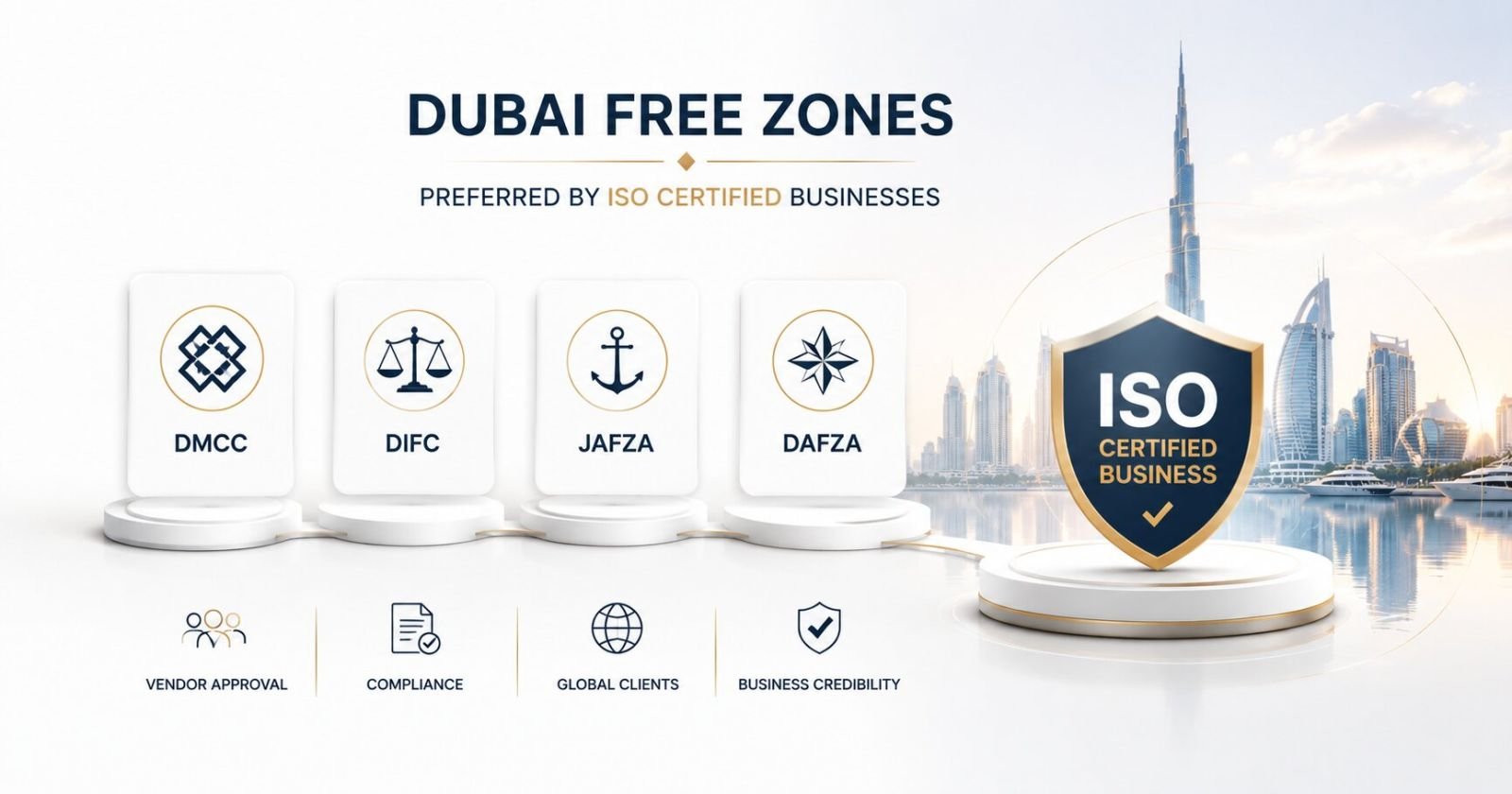
Dubai's economy is built around an extensive network of free zones, each with its own regulatory authority and corporate ecosystem. ISO certification is increasingly relevant across all of them:
| Free Zone | Primary Sector Focus | Relevant ISO Standards |
| DMCC (Dubai Multi Commodities Centre) | Trading — commodities, gold, diamonds, general trade | ISO 9001 for vendor registration and trade quality assurance |
| JAFZA (Jebel Ali Free Zone) | Logistics, manufacturing, trade — adjacent to Jebel Ali Port | ISO 9001, ISO 45001 (warehouse and logistics safety), ISO 14001 |
| DAFZA (Dubai Airport Free Zone) | Aviation-linked logistics, trade, technology | ISO 9001, ISO 28000 (supply chain security) |
| Dubai Internet City | IT, software, technology companies | ISO/IEC 27001 for information security, ISO 9001 |
| DIFC (Dubai International Financial Centre) | Banking, financial services, fintech | ISO/IEC 27001, ISO 22301 (business continuity), ISO 9001 |
| Dubai Media City | Media, advertising, creative services | ISO 9001, ISO/IEC 27001 (for digital media data handling) |
Companies operating from any of these free zones — and seeking corporate contracts with vendors registered there — frequently find ISO 9001 (and ISO 27001 for technology and finance-focused zones) to be a practical requirement for serious business development.
ISO Certification for Dubai's Tourism & Hospitality Sector
Dubai's tourism and hospitality industry is one of the emirate's most visible economic pillars, and ISO certification plays a direct role in guest trust, regulatory compliance, and operational efficiency:
| ISO Standard | Application in Hotels & Restaurants | Local Regulatory Alignment |
| ISO 9001 | Ensures consistent guest service quality across check-in, housekeeping, dining, and concierge services | Supports DTCM (Dubai Tourism) classification and quality benchmarking |
| ISO 22000 | Covers the entire food chain — from sourcing to serving — across kitchens and F&B outlets | Aligns with Dubai Municipality food safety inspection requirements |
| ISO 14001 | Manages energy, water, and waste across hotel operations | Supports Dubai's sustainability and Green Economy initiatives |
| ISO 45001 | Protects staff across housekeeping, kitchens, and back-of-house operations | Aligns with UAE labour and workplace safety regulations |
For Dubai hospitality businesses, ISO certification timelines typically range from 2 to 8 months depending on the size of the operation — from small restaurants and cafes (faster, often single-standard) to medium hotels (50-200 rooms) and large multi-location resort groups (longer, often pursuing multiple standards as an Integrated Management System).
Common Mistakes Dubai Businesses Make During ISO Certification
- Using generic documentation templates — Off-the-shelf templates that don't reflect your actual Dubai business operations, free zone requirements, or DAC accreditation expectations often fail audits or require costly rework.
- Choosing a certification body without verifying DAC or IAF accreditation — A lower upfront price from a non-accredited body can result in a certificate that is rejected during government tender evaluation.
- Treating certification as a one-time project — ISO certification requires ongoing surveillance audits every year for 3 years; businesses that don't maintain the system risk losing certification at renewal.
- Insufficient staff training — Employees who don't understand the documented processes create non-conformities during audits, regardless of how well the documentation is written.
- Ignoring sector-specific requirements — Hospitality businesses need ISO 22000 alignment with Dubai Municipality requirements; IT companies need ISO 27001 alignment with free zone data protection expectations. Generic implementation misses these nuances.