Home Get ISO Certification in India Fast & Reliable Process ISO 14001 Certification

ISO 14001 Certification

India's most comprehensive guide to ISO 14001 certification — what it means, who needs it, what it costs, and how to get certified fast with NABCB-accredited partners.

Call Now googlereview    trustpilot

2000 + Happy Customer

2000

Happy Clients

1500 + Expert Advisors

1500

Expert Advisors

2 + Branch Offices

2+

Branch Offices

Free Consultation by Expert

What is ISO 14001 Certification?

ISO 14001:2015 is the internationally recognised standard for Environmental Management Systems (EMS). It specifies what an organisation must do to systematically manage and reduce its environmental impact, achieve compliance with applicable environmental laws, and continuously improve environmental performance.

When your organisation is certified to ISO 14001, an independent, accredited Certification Body has audited your EMS and confirmed it meets all requirements of the standard. The certificate is your verifiable proof — to clients, regulators, supply chain partners, and export market buyers — that your organisation manages its environmental responsibilities in a structured, auditable way.

The current version is ISO 14001:2015, published in September 2015. It replaced the previous ISO 14001:2004 version. All organisations previously certified to the 2004 version have already transitioned. ISO is now developing ISO 14001:2026, which will strengthen requirements around climate change and biodiversity — organisations certified now will be guided through the transition when that version is published.

What ISO 14001 IS

  • An internationally recognised Environmental Management System standard
  • Applies to organisations of any size, industry, or sector
  • Issued by NABCB or IAF-accredited Certification Bodies
  • Valid for 3 years with annual surveillance audits
  • Required for tenders, EU exports (CBAM), and GCC vendor registration
  • Built on PDCA — Plan, Do, Check, Act — for continuous improvement

What ISO 14001 is NOT

  • Not a product eco-label or green marketing badge
  • Not issued by ISO itself or the Government of India
  • Not a one-time checkbox exercise — continuous improvement is mandatory
  • Not only for large enterprises or multinationals
  • Not the same as ISO 14000 (which is the parent family name, not certifiable)
  • Not valid if issued by a non-accredited body — verify on iafcertsearch.org
 
01
Tax Service Icon

Expertise in ISO 14001 Certification



02
Team icon

Enquiry Form

Among Asia Top
100 Consulting Firm

03
Secure Pay Icon

Get Consultation

Lowest Fees
100,000 + Clients.

04
Support Icon

Service Delivery

4.9 Customers Rating
50+ Offices

Contact us today to schedule your appointment.
You can call us on +919953004880 or write to us at info@efilingcompany.com

Meaning

ISO 14001 Meaning, Full Form and ISO 14001:2015 Explained

Full Form

International Organization for Standardization — Environmental Management System Standard 14001

Current Version

ISO 14001:2015

Published September 2015

Focus Area

Environmental Management System (EMS)

Certificate Validity

3 Years

Annual audits mandatory

ISO 14001:2015 provides a framework that any organisation can use to enhance environmental performance through more efficient use of resources and reduction of waste, gaining a competitive advantage and the trust of stakeholders. The standard is built around the same Annex SL high-level structure as ISO 9001 and ISO 45001, making integration into a combined management system straightforward and cost-effective.

Key Changes: ISO 14001:2004 vs ISO 14001:2015

What Changed ISO 14001:2004 ISO 14001:2015 (Current)
Structure Standalone structure Annex SL — aligns with ISO 9001, ISO 45001, ISO 27001
Context of Organisation Not required Mandatory — must understand internal/external issues and interested parties
Leadership Role Management Representative required Top management must be directly accountable — no single representative
Life Cycle Thinking Not required New requirement — consider environmental impact across product/service life cycle
Risk-Based Thinking Not explicitly required Embedded — risks and opportunities must be identified and addressed
Supply Chain / Outsourced Processes Limited coverage Extended — must control environmental aspects in outsourced processes

Who Needs It

Who Needs ISO 14001 Certification in India?

ISO 14001 is not legally mandatory for all businesses, but it is commercially required for organisations operating in environmentally sensitive industries or serving regulated clients. If your business falls into any of these categories, ISO 14001 is effectively non-negotiable.

Manufacturing & Auto Components

OEM supply chain qualification for Tata, L&T, Mahindra, BHEL, and Hyundai vendor approval requires ISO 14001. Peenya, Pune, Chennai, and Manesar auto clusters mandate it for Tier-1 and Tier-2 suppliers.

Chemicals & Pharmaceuticals

Pollution Control Board compliance, EU REACH requirements, and export to regulated markets all require a documented EMS. Ankleshwar, Vapi, and Hyderabad pharma clusters commonly require it.

EU & GCC Exporters

EU's Carbon Border Adjustment Mechanism (CBAM) requires environmental data from Indian steel, aluminium, cement, and fertiliser exporters. GCC buyer contracts increasingly mandate it.

Construction & Infrastructure

CPWD, NHAI, metro rail projects, and state PWD tenders include ISO 14001 in environmental qualification criteria. Real estate developers pursuing IGBC/LEED ratings need it.

Textiles & Apparel

EU buyers (H&M, Zara, Primark, M&S) require ISO 14001 from Indian garment and textile suppliers. Tirupur and Surat exporters increasingly need it for buyer compliance.

ISO 14001 for Small Businesses: A common misconception is that ISO 14001 is only for large factories or MNCs. Small manufacturers, chemical processors, and construction contractors with as few as 5 employees can and do get ISO 14001 certified. eFilingCompany has certified organisations with as few as 3 employees. Cost starts from ₹25,000 for micro organisations. The EMS scope can be limited to the most significant environmental activities of your business.


Requirements

ISO 14001 Certification Requirements and Controls

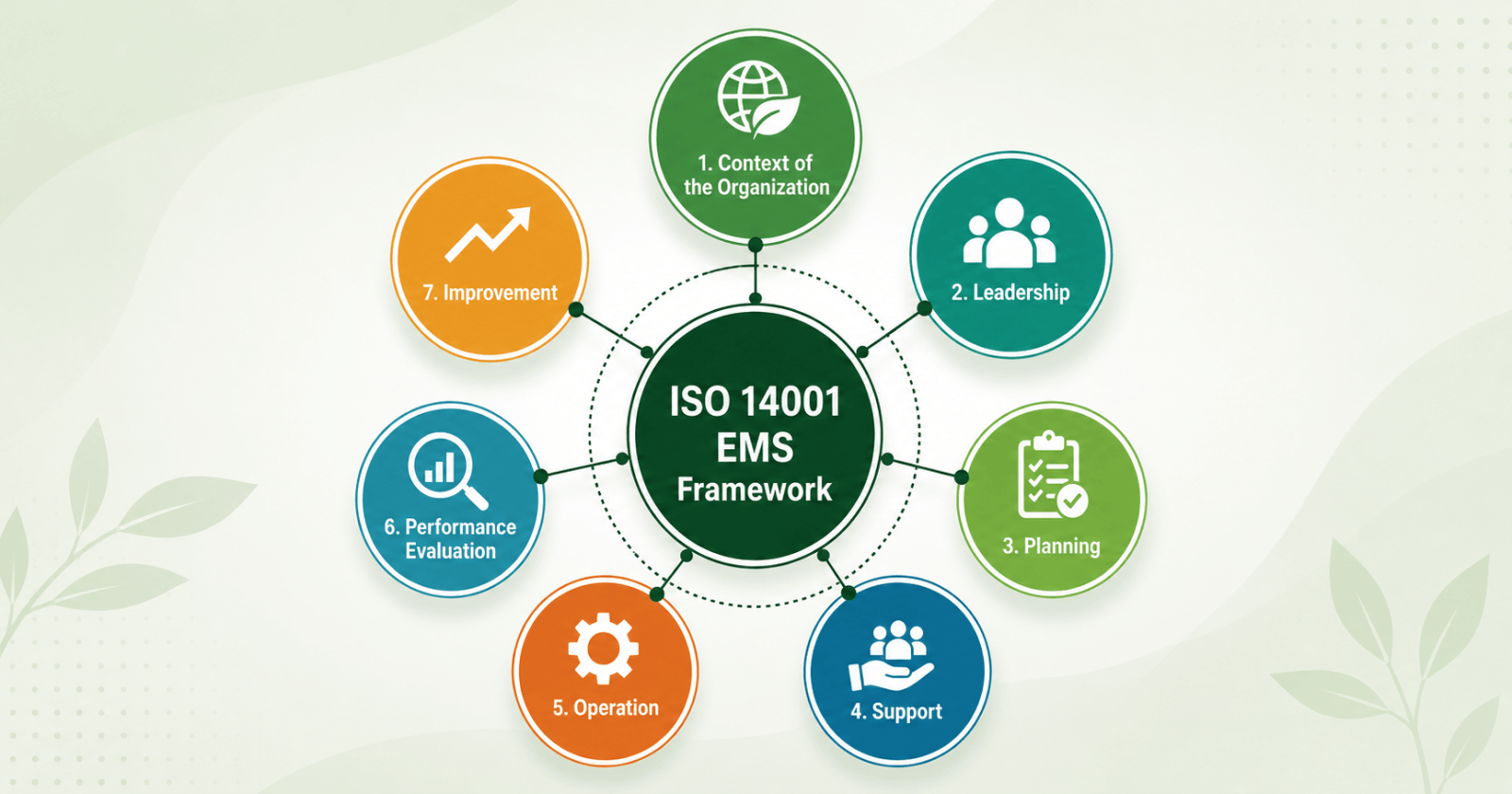
ISO 14001:2015 requirements are structured around 10 clauses. Clauses 4 to 10 are mandatory for all organisations seeking certification. Here is a plain-language breakdown of what each clause requires:

Mandatory Clauses (4 to 10) — All Required

Clause Title What It Requires
Clause 4 Context Understand your organisation's context, identify interested parties, define EMS scope
Clause 5 Leadership Top management must commit to environmental protection, establish environmental policy
Clause 6 Planning Identify environmental aspects and impacts, assess risks and opportunities, define objectives and legal compliance register
Clause 7 Support Provide resources, ensure competence, create awareness, control documented information
Clause 8 Operation Implement operational controls, manage outsourced processes, emergency preparedness and response
Clause 9 Evaluation Monitor and measure environmental performance, conduct internal audits and management reviews
Clause 10 Improvement Address nonconformities, take corrective actions, continually improve the EMS

Key EMS Documentation Required — ISO 14001:2015

Environmental Policy

Signed statement of top management's commitment to environmental protection, compliance, and continual improvement.

Mandatory document

Aspects & Impacts Register

Identifies all environmental aspects of your operations (waste, emissions, water, energy) and evaluates their significance.

Mandatory document

Legal Compliance Register

Complete register of all applicable environmental laws, regulations, permits, and industry codes with compliance evaluation.

Mandatory document

Emergency Response Plans

Documented procedures for environmental incidents — spills, leaks, fires, air emissions. Must be tested through drills.

Mandatory document

Important: You only need to document and control the environmental aspects that are significant to your operations. A small garment manufacturer does not need the same level of documentation as a chemical plant. eFilingCompany's consultants identify exactly which requirements apply to your organisation during the gap analysis, so you are not over-engineering your EMS.


Cost

ISO 14001 Certification Cost in India (2025)

ISO 14001 certification cost in India varies based on company size, number of employees, scope of the EMS, number of sites, and the Certification Body chosen. Below is a transparent cost breakdown for Indian organisations in 2025.

Company Size CB Audit Fee Consultant Fee Total Range
Micro or Startup1 to 10 employees Rs. 8,000 to Rs. 15,000 Rs. 17,000 to Rs. 25,000 Rs. 25,000 to Rs. 40,000
Small Business11 to 50 employees Rs. 15,000 to Rs. 28,000 Rs. 25,000 to Rs. 42,000 Rs. 40,000 to Rs. 70,000
Medium Business51 to 200 employees Rs. 28,000 to Rs. 55,000 Rs. 42,000 to Rs. 65,000 Rs. 70,000 to Rs. 1,20,000
Annual Surveillance Audit Rs. 10,000 to Rs. 25,000 per year Mandatory
MSME Subsidy Up to 75% reimbursement under NSIC and ZED Scheme

Costs include NABCB or IAF-accredited CB audit fees plus consultant and documentation support. Actual fees vary by CB, audit man-days, and EMS scope. GST applicable.

What is Included in Our Fee

  • Free gap analysis and scoping
  • Environmental aspects and impacts assessment
  • EMS policy and procedure writing
  • Legal compliance register preparation
  • Objectives and targets documentation
  • Employee EMS awareness training
  • Internal audit support
  • CB selection and scheduling
  • Stage 1 and Stage 2 audit support
  • Non-conformity resolution
  • Certificate delivery
  • MSME subsidy filing assistance

One fixed fee. No hidden charges. All inclusive.

ISO 14001 Cost for Company vs Individual: Companies get certified to ISO 14001 as an organisation. Individuals cannot hold an ISO 14001 certificate. Individual professionals can get certified as an ISO 14001 Lead Auditor or Environmental Management Lead Implementer — which is a training-based personal certification starting from Rs. 20,000 to Rs. 55,000 depending on the training provider and course format.


Process

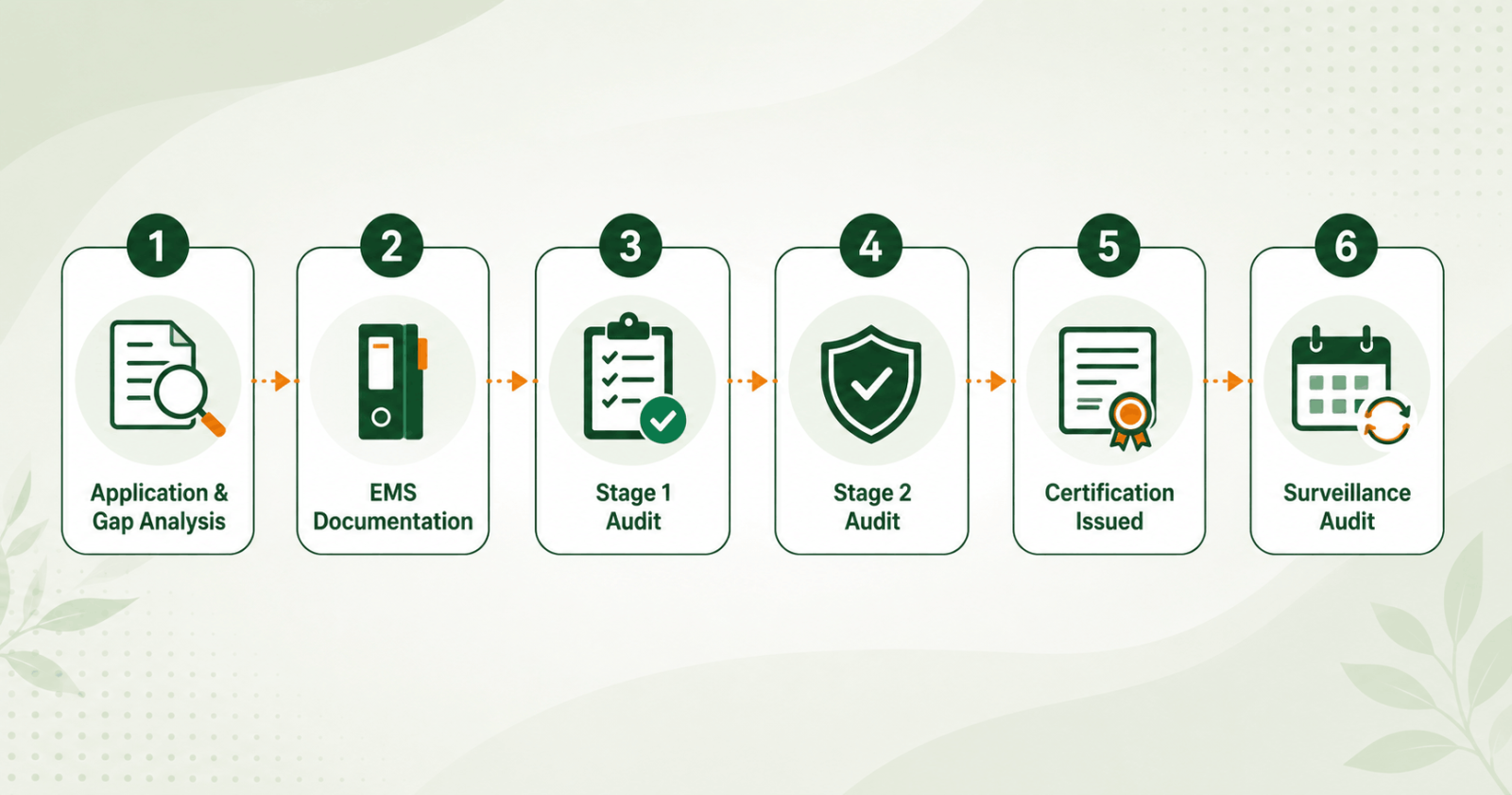
How to Get ISO 14001 Certified in India: Step by Step

The ISO 14001 certification process typically takes 6 to 16 weeks depending on your organisation's size and current EMS readiness. With eFilingCompany, most organisations complete the full process in 4 to 8 weeks.

1

Scoping and Gap Analysis

Define the boundary of your EMS: which operations, processes, and sites are in scope. Conduct a gap analysis against ISO 14001:2015 requirements. Identify what is already in place and what needs to be built. Free with eFilingCompany.

2

Environmental Aspects and Impacts Assessment

Identify all environmental aspects of your operations — inputs, outputs, by-products, emissions, waste, and energy use. Assess the significance of each impact under normal, abnormal, and emergency conditions. This is the foundation of your EMS.

3

EMS Documentation and Implementation

Prepare all mandatory EMS documents: Environmental Policy, Aspects Register, Legal Compliance Register, Objectives and Targets, Operational Control Procedures, Emergency Response Plans, and Internal Audit Programme. eFilingCompany prepares all of these in 7 to 15 days.

4

Employee EMS Training

All employees must be trained on the environmental policy, their individual responsibilities, and what to do in an environmental emergency. Training must be documented. This is a mandatory requirement under Clause 7.3 of ISO 14001:2015.

5

Internal Audit and Management Review

Conduct a full internal audit of the EMS against all ISO 14001 clauses. Resolve non-conformities. Hold a Management Review Meeting with documented output covering environmental performance, objectives progress, and continual improvement actions. Both are prerequisites before the CB audit.

6

Stage 1 Audit: Document Review

The accredited Certification Body reviews your EMS documentation, Aspects and Impacts Register, Legal Compliance Register, and key procedures. Confirms your readiness for the Stage 2 on-site audit. Can be conducted remotely for most organisations.

7

Stage 2 Audit and Certificate Issuance

CB auditors conduct on-site verification of your implemented EMS. They interview staff, inspect operational controls, review monitoring records, and verify environmental performance. Once all non-conformities are resolved, your ISO 14001:2015 certificate is issued. Valid for 3 years with annual surveillance audits.

Timeline Guide

Gap Analysis 1 to 3 days
Aspects Assessment 3 to 5 days
Documentation 7 to 15 days
Training 1 to 2 days
Internal Audit & MRM 2 to 3 days
Stage 1 CB Audit 1 day
Stage 2 CB Audit 1 to 2 days

Total Average 4 to 8 Weeks

Apply Online Now

Our ISO 14001 consultant will call you within 2 working hours of your application.

Get ISO 14001 Certified

Individual Certifications

ISO 14001 Lead Auditor and Lead Implementer Certification

Alongside the organisational ISO 14001 certification, there are individual professional certifications for people who want to build a career in environmental management. These are training-based certifications for individuals and are completely separate from the organisational certification process.

For Individuals

ISO 14001 Lead Auditor

A professional qualification for individuals who conduct ISO 14001 certification audits on behalf of Certification Bodies. Covers audit planning, conducting, reporting, and follow-up. Typically a 5-day course.

Cost in India: Rs. 20,000 to Rs. 55,000

Key providers: PECB, BSI, IRCA, Bureau Veritas, Exemplar Global

For Individuals

ISO 14001 Lead Implementer

A professional qualification for individuals who manage ISO 14001 EMS implementation projects within organisations. Covers EMS design, implementation, management, and continual improvement. Typically a 5-day course.

Cost in India: Rs. 18,000 to Rs. 50,000

Key providers: PECB, GSDC, BSI, IRCA

For Organisations

ISO 14001 Company Certification

The organisational certification that your company holds and shows on your website, proposals, and tender submissions. Issued by an accredited CB after a formal audit of your EMS. This is what eFilingCompany provides.

Cost in India: Rs. 25,000 to Rs. 1,20,000

Valid for: 3 years with annual audits

ISO 14001 Lead Auditor Course Fees in India: Most ISO 14001 Lead Auditor and Lead Implementer training programmes include a closed-book or open-book exam at the end. The exam fee is usually included in the training course fee. Standalone exam-only options through PECB cost approximately Rs. 8,000 to Rs. 15,000. For the organisational ISO 14001 certificate, there is no exam — the Stage 1 and Stage 2 audit by the CB is the assessment.


Accreditation

IAF vs Non-IAF ISO 14001 Certification: Critical Difference

This is the single most important thing to understand before getting ISO 14001 certified. There are two types of ISO 14001 certificates being sold in India: accredited and non-accredited. Only one has any real value.

VALID

IAF-Accredited Certificate

  • CB is accredited by NABCB, UKAS, DAkkS or another IAF-member body
  • Verifiable on iafcertsearch.org
  • Accepted for government contracts, enterprise RFPs, and export
  • Accepted by PCB, CPCB, and regulatory bodies
  • Recognised in 60+ IAF member countries
  • Costs Rs. 25,000 and above
NOT VALID

Non-IAF Certificate

  • CB has no recognised accreditation
  • Cannot be verified on iafcertsearch.org
  • Not accepted for government or enterprise contracts
  • Not recognised by PCB, regulators, or EU/GCC buyers
  • Usually costs Rs. 999 to Rs. 5,000 with no real audit
  • Can expose your business to legal risk if used in tenders

Warning: Hundreds of companies in India offer ISO 14001 certificates for Rs. 999 to Rs. 5,000 with instant issuance and no audit. These have zero legal or commercial value and can result in tender disqualification or contract cancellation if discovered. Always verify the CB name on iafcertsearch.org before paying anything. eFilingCompany works exclusively with NABCB and IAF-accredited CBs.


Benefits

Benefits of ISO 14001 Certification for Indian Businesses

Win Tenders and Supply Chain Contracts

OEM buyers and government procurement authorities require ISO 14001 before vendor on-boarding. CPWD, NHAI, Tata, L&T, BHEL, and Mahindra mandate it. Without it, your bid is disqualified at the first stage.

CBAM and EU Export Compliance

EU's Carbon Border Adjustment Mechanism requires environmental data from Indian steel, aluminium, cement, and chemical exporters. ISO 14001 provides the management system foundation for credible environmental reporting and CBAM compliance.

Reduce Operating Costs

EMS implementation systematically reduces energy consumption, water use, and waste generation. Organisations with ISO 14001 typically reduce environmental operating costs by 5 to 15 percent within the first year of implementation.

ESG and Global Market Access

Private equity, FDI investors, and stock market ESG scoring increasingly require EMS certification. EU, GCC, and ASEAN buyers demand it from Indian vendors. ISO 14001 is the essential environmental credential for global market access.

Regulatory Risk Reduction

A documented legal compliance register and operational controls reduce the risk of Pollution Control Board notices, environmental fines, and legal liability from environmental incidents. ISO 14001 demonstrates due diligence in environmental compliance.

Build Stakeholder and Client Trust

ISO 14001 is independently audited and verifiable on iafcertsearch.org. It converts your environmental claims into audited proof — the most credible statement to clients, regulators, and the public that your organisation manages its environmental impact responsibly.


Standards Comparison

ISO 14001 vs ISO 14000 vs ISO 14064 — What is the Difference?

There is frequent confusion between ISO 14001, ISO 14000, and ISO 14064 — especially since all three appear in searches related to environmental certification. Here is a clear breakdown of the ISO 14000 standards family:

Standard What It Covers Certifiable? Who Needs It
ISO 14001:2015 Environmental Management System (EMS) — the main certification standard Yes — main cert All industries, all sizes
ISO 14000 Series Parent family name for all environmental management standards. ISO 14001 is part of this family. No — family name Reference term only
ISO 14004:2016 Implementation guidelines for ISO 14001 — detailed guidance, not requirements No — guidance only EMS implementation teams
ISO 14064:2018 Greenhouse gas (GHG) accounting and verification — quantifying Scope 1, 2, 3 emissions Yes — GHG verification CBAM, carbon credits, green bonds, ESG reporting
ISO 14067:2018 Carbon footprint of products — GHG emissions across a product's life cycle Partial — product claims Manufacturers making carbon-neutral claims
ISO 14044:2006 Life Cycle Assessment (LCA) — evaluating environmental impact across a product's full life cycle No — method standard Product sustainability reporting

Quick Answer: If you need an environmental management certification recognised by buyers, tenders, and regulators — that is ISO 14001:2015. If you need to verify and report your greenhouse gas emissions for CBAM compliance, carbon credits, or green bond issuance — that is ISO 14064. Both can and often are implemented together for comprehensive environmental compliance.


City Coverage

ISO 14001 Certification Across India

eFilingCompany provides ISO 14001 certification support across all major industrial and commercial cities in India. Our consultants and auditor network covers every state and Union Territory.

Also serving Coimbatore, Kochi, Bhubaneswar, Indore, Jaipur, Lucknow, Patna, Nagpur, Kolkata, Chandigarh, Visakhapatnam, and all Tier 2 and Tier 3 cities across India.

Get Your ISO 14001 Certification Today

Join India's fastest-growing manufacturers and exporters securing government tenders and global markets with ISO 14001. NABCB and IAF accredited. All states covered.

Starts from Rs. 25,000.

Start ISO 14001 Certification

Or call us at +919953004880 | Email: info@efilingcompany.com | Response within 6 working hours

General Frequently Asked Questions

What is ISO 14001 certification for?

ISO 14001 certification is for organisations that want to demonstrate they have a structured Environmental Management System (EMS) in place. It proves to clients, regulators, and partners that your organisation has a documented, implemented, and independently audited system to manage and reduce environmental impact. In India, it is required for government tenders, EU export compliance under CBAM, GCC country vendor registration (Saudi Aramco, ADNOC, Kuwait Oil Company), and OEM supply chain qualification.

  How much does ISO 14001 certification cost in India?

ISO 14001 certification cost in India ranges from Rs. 25,000 for micro businesses with 1 to 10 employees to Rs. 1,20,000 and above for large enterprises with 200 or more employees. This includes gap analysis, documentation, consultant support, and the Stage 1 and Stage 2 certification audits. Annual surveillance audits cost Rs. 10,000 to Rs. 25,000 per year additionally. Avoid certificates priced below Rs. 8,000 — these are from non-accredited bodies and will not be accepted by government or international buyers.

  How can I get ISO 14001 certified?

To get ISO 14001 certified: (1) Contact eFilingCompany for a free gap analysis and scoping, (2) Our consultant develops all required EMS documentation — Environmental Policy, Aspects Register, Legal Compliance Register, Objectives, Operational Procedures, (3) Conduct employee training and internal audit, (4) Schedule Stage 1 and Stage 2 audits with a NABCB or IAF-accredited Certification Body, (5) Resolve any non-conformities, (6) Receive your ISO 14001:2015 certificate. Total process: 4 to 8 weeks for most organisations.

  What is the difference between IAF and non-IAF ISO 14001 certification?

An IAF-accredited ISO 14001 certificate is issued by a Certification Body accredited by a recognised accreditation authority (NABCB, UKAS, DAkkS, etc.). It is verifiable on iafcertsearch.org and accepted by government tenders, EU buyers, GCC contracts, and Pollution Control Boards. A non-IAF certificate is issued by an unaccredited body — typically for Rs. 999 to Rs. 5,000 with no real audit. It has zero commercial or legal value and can result in tender disqualification. Always verify the CB name on iafcertsearch.org before applying.

  What is ISO 14001 meaning and definition?

ISO 14001 is an international standard published by the International Organization for Standardization (ISO) that specifies requirements for an Environmental Management System (EMS). The number 14001 is simply the standard's designation within the ISO 14000 family of environmental management standards. "Certification" to ISO 14001 means an accredited, independent Certification Body has audited your organisation's EMS and confirmed it meets all requirements of the standard. The current version in force is ISO 14001:2015.

  What are ISO 14001 certification requirements?

The core requirements are: (1) Define your EMS scope and organisational context, (2) Establish an Environmental Policy signed by top management, (3) Identify environmental aspects and assess their impacts, (4) Maintain a Legal Compliance Register, (5) Set environmental objectives and targets, (6) Implement operational controls for significant aspects, (7) Establish emergency preparedness and response procedures, (8) Conduct monitoring, measurement, and internal audits, (9) Conduct a Management Review, (10) Take corrective actions and pursue continual improvement. eFilingCompany guides you through all of these requirements.

  What is ISO 14001 Lead Auditor certification cost in India?

ISO 14001 Lead Auditor certification (personal qualification for individuals) costs Rs. 20,000 to Rs. 55,000 in India depending on the training provider and format (classroom vs online). Key providers include PECB, BSI, IRCA, Bureau Veritas, and Exemplar Global. The exam fee is typically included in the course fee. Note: this is a personal qualification for individuals — separate from the organisational ISO 14001 certification for your company which costs Rs. 25,000 to Rs. 1,20,000.

  How long does ISO 14001 certification take in India?

ISO 14001 certification typically takes 4 to 8 weeks for small and medium businesses and 8 to 16 weeks for large enterprises or multi-site organisations. With eFilingCompany, the documentation phase takes 7 to 15 days. A fast-track 30-day certification option is available for organisations with urgent tender or buyer deadlines. The timeline depends on your current EMS maturity, number of sites, and industry complexity.

  Can a small business get ISO 14001 certification?

Yes. ISO 14001 applies to organisations of any size. Small manufacturers, chemical processors, construction contractors, and exporters with as few as 3 to 5 employees can get ISO 14001 certified. eFilingCompany has certified organisations with as few as 3 employees. Cost starts from Rs. 25,000 for micro organisations. The EMS scope is defined to match your actual operations — you are not required to build a system designed for a large factory if you are a small business.


Contact us today to schedule your appointment. You can call us on +919953004880 or write to us at info@efilingcompany.com


General frequently asked questions

ISO 14001 certification is for organizations that want to demonstrate they have a structured Environmental Management System (EMS) in place. It shows clients, regulators, and supply chain partners that your organization actively manages and reduces its environmental impact in an auditable, systematic way. In India, it is increasingly required for government tenders, EU export compliance under CBAM, and GCC country vendor registration such as Saudi Aramco and ADNOC.

ISO 14001 certification cost in India ranges from ?25,000 for micro businesses (1–10 employees) to ?1,20,000+ for large enterprises (200+ employees). This includes gap analysis, documentation support, consultant guidance, and the Stage 1 and Stage 2 certification audits. Annual surveillance audits cost ?15,000–?30,000 per year additionally. Be cautious of certificates priced below ?8,000 — these are typically from non-accredited bodies and will not be accepted by government or international buyers.

ISO 14001 covers Environmental Management Systems (EMS) — how your organization manages its impact on the external environment: waste, air emissions, water discharge, energy use, and land contamination. ISO 45001 covers Occupational Health and Safety Management Systems (OHSMS) — protecting the health and safety of your own workers inside the organization. Both share a common Annex SL structure and are frequently implemented together as an Integrated Management System (IMS).

ISO 14001 is not universally mandatory by law, but it is commercially essential in several situations: CPWD and state PWD tenders in construction, EU export requirements under CBAM, GCC country vendor registration (Saudi Aramco, ADNOC, Kuwait Oil Company, PDO Oman), Tier-1 OEM supply chain qualification (Tata, L&T, BHEL, Mahindra), and ESG compliance for PE/FDI investors. For these businesses, not having ISO 14001 means losing contracts.

ISO 14001 certification is valid for 3 years. During this 3-year cycle, annual surveillance audits are conducted by the certification body (typically in Year 1 and Year 2) to ensure the EMS remains effective and compliant. At the end of 3 years, a recertification audit (similar in scope to the initial certification) is required to renew the certificate for another 3-year cycle.

Yes. ISO 14001 is explicitly designed to apply to organizations of all sizes and all sectors. For small businesses with 1–50 employees, certification typically costs ?25,000–?70,000 and takes 30–60 days. The EMS scope can be limited to the most significant environmental aspects of the business, making implementation manageable. Many small auto component manufacturers, chemical processors, and textile units in India are ISO 14001 certified.

ISO 14001:2015 is the current valid standard. ISO 14001:2026 is under development and expected to include strengthened requirements for climate change risk assessment, biodiversity impact, and supply chain environmental responsibility. Organizations certified to ISO 14001:2015 will have a transition period (typically 3 years from publication date) to upgrade. Getting certified now under the 2015 standard is the right move — your certificate remains valid, and we will guide you through the transition when 2026 is published.

India has over 35,000 valid ISO 14001 certificates, according to the ISO Survey of Management System Standard Certifications. This makes India one of the top 10 countries globally for EMS certification. The sectors with the highest concentration are automotive components, chemicals, pharmaceuticals, textiles, and IT parks. You can verify any organization's certificate validity at the IAF CertSearch global database (iafcertsearch.org).

Contact us today to schedule your appointment.
You can call us on +919953004880 or write to us at info@efilingcompany.com

We offer our ISO 14001 Certification service in this areas