HIPAA Certification What It Really Means
here is no government HIPAA certificate. Here is what HIPAA certification actually is for individuals and organizations, what it costs in 2026, and whether it applies to Indian companies.


2000
Happy Clients

1500
Expert Advisors

2+
Branch Offices
Free Consultation by Expert
.png)


.png)
.png)
HIPAA Certification What It Really Means
If you have searched for "HIPAA certification," you have probably seen dozens of companies selling badges, seals, and certificates. So here is the honest answer first, before anything else: there is no official, government-issued HIPAA certification. The U.S. Department of Health and Human Services (HHS) does not create, issue, endorse, or recognize any HIPAA certificate for a person or a company.
That does not mean the word is useless. "HIPAA certification" is real language used in the market, and it points to two genuine things: a training certificate that an individual earns after passing a HIPAA course, and a compliance attestation that an organization gets after a third-party audit. This page explains both plainly, what each one is worth, what it costs, and what an Indian company working with U.S. healthcare data actually needs. We answer the questions first and talk about our services second.
Is HIPAA Certification a Real Government Credential?
No. This is the single most important thing to understand, and it is where most vendor websites are misleading.
HHS itself has stated this in writing. In its own official guidance, HHS says that it does not endorse or recognize private organizations' certifications regarding the HIPAA Privacy Rule or Security Rule, and that such certifications do not remove a covered entity's legal obligations under those rules. In plain words: a certificate on your wall does not make you compliant, and it will not protect you if the Office for Civil Rights (OCR) investigates you.
This is different from other standards you may know. PCI DSS has formal certification levels. ISO 27001 has accredited certification bodies that issue a recognized certificate. HIPAA was simply never built that way. There is no federal body that audits you and stamps you "HIPAA certified." So when a vendor says it is "HIPAA certified," what it really means is that a private company sold it a certificate. That certificate may still have some value as evidence of effort, but it has no legal standing on its own.
| The claim you hear | What is actually true |
| "We are HIPAA certified by the government." | Not possible. HHS issues no such certificate to anyone. |
| "This certificate proves we are compliant." | No. Compliance is proven by your risk analysis, safeguards, policies, training records, and signed agreements, not by a certificate. |
| "Once certified, we are covered forever." | No. HIPAA compliance is an ongoing obligation, not a one-time result. |
| "Our vendor is certified, so we are covered." | No. You still need a signed Business Associate Agreement (BAA) and your own safeguards. |
So why do so many people search for it? Because the phrase is everywhere. Job seekers want it on a resume. Companies want to show partners they take patient data seriously. Vendors want to look trustworthy. All of those are reasonable goals. You just need to know what you are actually buying.
The Two Real Meanings of "HIPAA Certification"
When someone says "HIPAA certification," they almost always mean one of these two things. They are very different, and mixing them up is where organizations get into trouble.
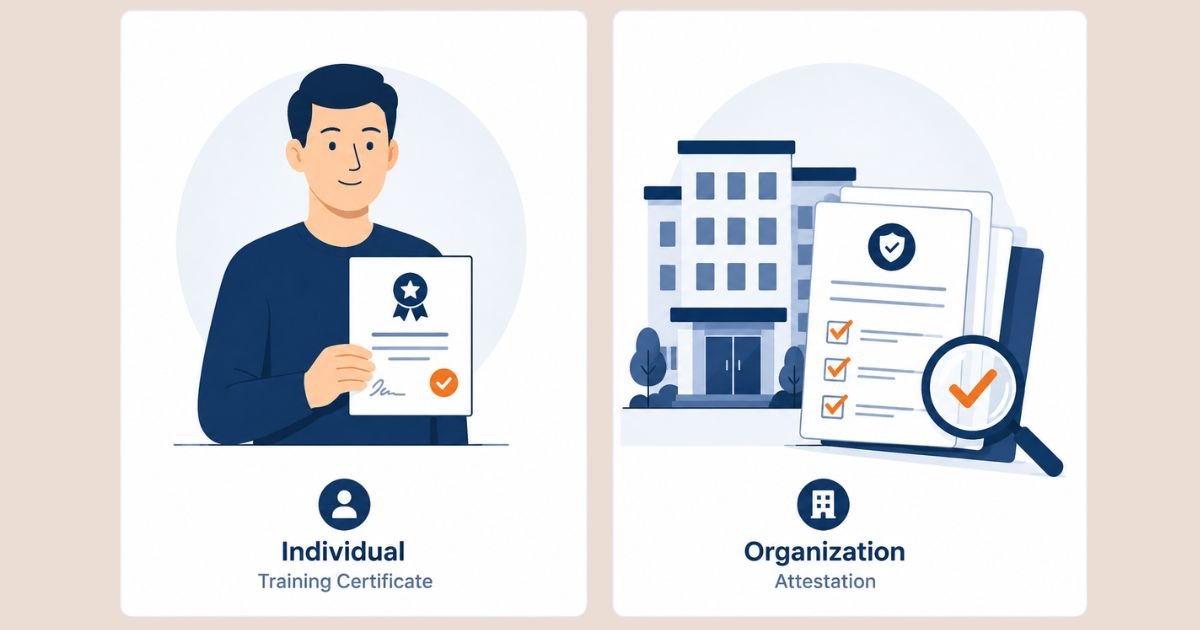
1. HIPAA Training Certification for Individuals
This is a certificate of completion. A person takes a HIPAA course, passes a short exam, and receives a certificate showing they understand the rules. This is real and often required. Under the HIPAA Privacy Rule (45 CFR 164.530), covered entities must train all workforce members on their policies and procedures. Training certificates are the standard proof that this training happened.
Who typically needs this: doctors, nurses, front-desk and admin staff, billing and coding teams, IT and security staff, and any employee who can see or handle protected health information (PHI). For an Indian company, this means your medical billing agents, your BPO staff, your support team, and your developers who touch U.S. patient data.
What it proves: that the individual has been trained. That is genuinely useful and often contractually required. What it does not prove: that the organization as a whole is compliant.
2. HIPAA Compliance Attestation for Organizations
This is the organization-level version, and it is the one people confuse with a government seal. An organization completes a documented process, a third party reviews it, and the organization receives an attestation or a "certificate of compliance." Again, this is a private document, not an HHS credential, but it is the credible way to show partners and clients that you have done the work.
The real work behind it includes a security risk analysis (the single most important document OCR looks for), written policies and procedures, administrative, physical, and technical safeguards, workforce training, signed Business Associate Agreements, and breach notification procedures. A third party can review all of this and issue a report. That report has value with clients. It still does not make you legally "certified" in the eyes of HHS.
| Individual training certificate | Organization attestation | |
| Who gets it | A single employee | The whole company |
| How it is earned | Complete a course, pass an exam | Risk analysis, safeguards, third-party review |
| Proves | The person was trained | The company can show evidence of compliance |
| Issued by government? | No | No |
| Typical validity | Often renewed yearly | Reviewed yearly, not a fixed expiry |
What Is the Use of HIPAA Certification?
If it is not a government credential, why bother? Because it still does real work, as long as you are honest about what that work is.
For individuals, a training certificate helps with employment. Many U.S. healthcare employers and outsourcing clients require staff to have completed HIPAA training before they touch patient data. It demonstrates competence and reduces the employer's risk. For someone in India applying to work with a U.S. healthcare account, it is often a checkbox you must tick to be considered.
For organizations, an attestation builds trust and wins contracts. U.S. healthcare clients frequently ask their vendors and offshore partners to show a HIPAA compliance report before signing. It does not replace the Business Associate Agreement, but it supports it. It also creates internal discipline, because the process of preparing for review forces you to actually fix gaps.
There is one more benefit that matters a great deal: reduced penalty exposure. A 2021 amendment to the HITECH Act requires HHS to consider an organization's recognized security practices when deciding penalties. Organizations that can demonstrate genuine, documented, ongoing compliance efforts may be treated more favorably during enforcement. So the work behind certification is not just for show; it can lower your real financial risk if something goes wrong.
How Much Does HIPAA Certification Cost?
Cost is one of the most searched questions on this topic, and the honest answer is that it depends entirely on which of the two things you mean. We will not quote a single fake number, because there is no single price. Here are realistic ranges based on how the market actually works.
| What you are buying | Typical cost range | Notes |
| Individual HIPAA training + certificate | Free to around $100 per person | Some providers offer free courses; paid ones add tracking and support |
| Team or organization training (per seat) | Lower per-seat rates, volume based | Group discounts common for larger teams |
| Organization risk analysis and gap review | Varies widely by size and scope | Depends on data volume, systems, and complexity |
| Third-party compliance attestation | Priced per engagement | Scope of review drives the cost, not a fixed fee |
A few honest points on pricing. First, a cheap or free training certificate is fine for individual training, but it does not make your organization compliant. Second, be careful of any vendor charging a large fee and promising "instant" or "guaranteed" certification, because a real organizational review cannot be instant. Third, there is no government fee involved anywhere, because there is no government certificate. If you want a clear, itemized estimate for your specific situation, our team can walk you through it; details are at the end of this page.
Which HIPAA Certification Is Best?
There is no single "best" certificate, because there is no official one to rank against. Instead of chasing a brand name, judge a provider on a few practical points. For individual training, look for a course that is current for 2026 (HIPAA rules and penalty amounts change), covers the Privacy Rule, Security Rule, and Breach Notification Rule, and gives you a certificate you can actually show an employer. For organizational work, the "best" option is the one that produces a real risk analysis and documented safeguards, because that is what OCR and your clients actually care about, not the logo on the certificate.
In short: the best certification is the one backed by real work. A pretty certificate with nothing behind it is worse than useless, because it creates false confidence.
Is HIPAA Valid in India?
This is the question that matters most for many of our readers, and almost no other page answers it clearly. Here is the straight answer.
HIPAA is a United States federal law. It does not directly apply to Indian companies the way Indian laws do, and no Indian regulator enforces it. But that is not the end of the story, and assuming HIPAA is "not your problem" is a common and costly mistake for Indian businesses.
HIPAA reaches Indian companies through contract. If your company in India handles protected health information on behalf of a U.S. healthcare provider or health plan, for example through medical billing, medical transcription, coding, healthcare BPO, telehealth support, or building healthcare software, then you are almost certainly a Business Associate under HIPAA. Your U.S. client is legally required to sign a Business Associate Agreement (BAA) with you, and that BAA contractually binds you to follow HIPAA's Privacy and Security Rules. Break it, and your client faces penalties and can hold you responsible under the contract.
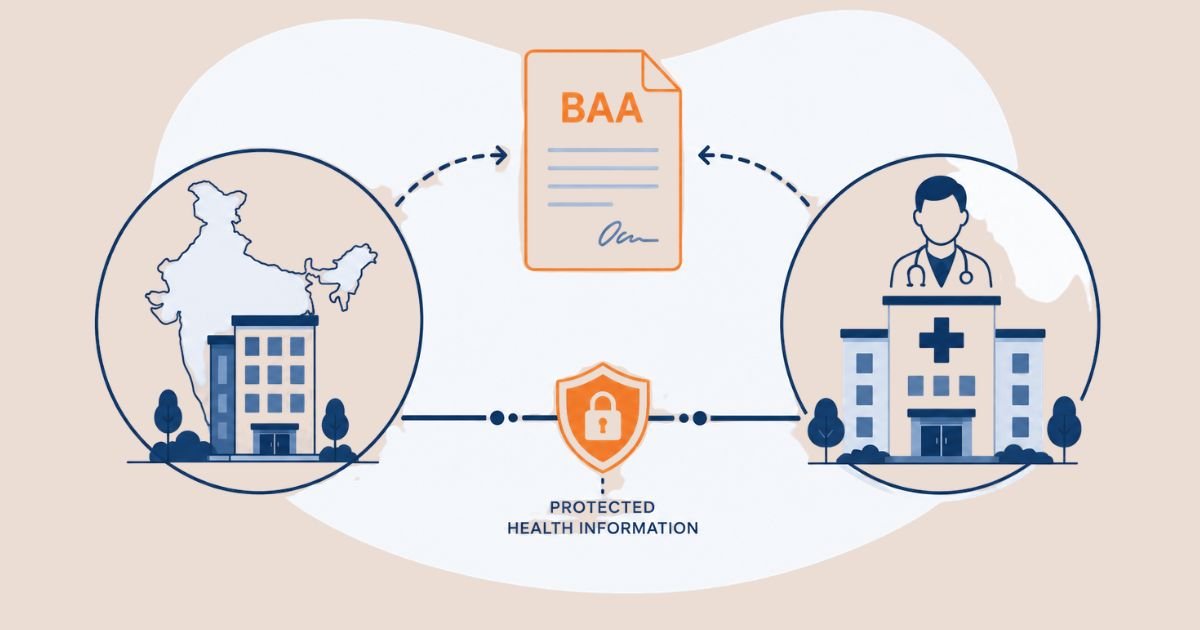
So while no Indian authority will fine you under HIPAA, your U.S. clients absolutely can and will require compliance, cut off contracts, or claim damages if you fail. For a growing number of Indian IT, BPO, and SaaS companies, HIPAA compliance is not optional; it is the price of doing business with U.S. healthcare.
| Common belief in India | Reality |
| "HIPAA is a U.S. law, so it does not apply to us." | True in theory, but your U.S. client contract makes it apply to you. |
| "There is no Indian penalty, so there is no risk." | The risk is lost contracts and breach-of-contract claims from clients. |
| "We just need a certificate to show clients." | Clients want a signed BAA plus real safeguards, not only a certificate. |
If you run an Indian company that touches U.S. healthcare data and you are not sure where you stand, this is exactly the kind of thing we help with. See the contact details below.
HIPAA Certification for Compliance Officers and Specific Roles
Some roles need deeper training than general staff awareness. A HIPAA Compliance Officer, sometimes called a Privacy Officer or Security Officer, is the person responsible for building and running the compliance program. Role-focused training exists for this position and is genuinely useful, because this person needs to understand risk analysis, policy writing, breach response, and workforce training, not just the basics.
The same logic applies to billing and coding staff, IT and security teams, and anyone in a healthcare-adjacent job. The certificate itself is still a completion certificate, not a government license, but role-specific training makes the person far more effective at keeping the organization out of trouble.
What Actually Keeps You Compliant (Instead of a Certificate)
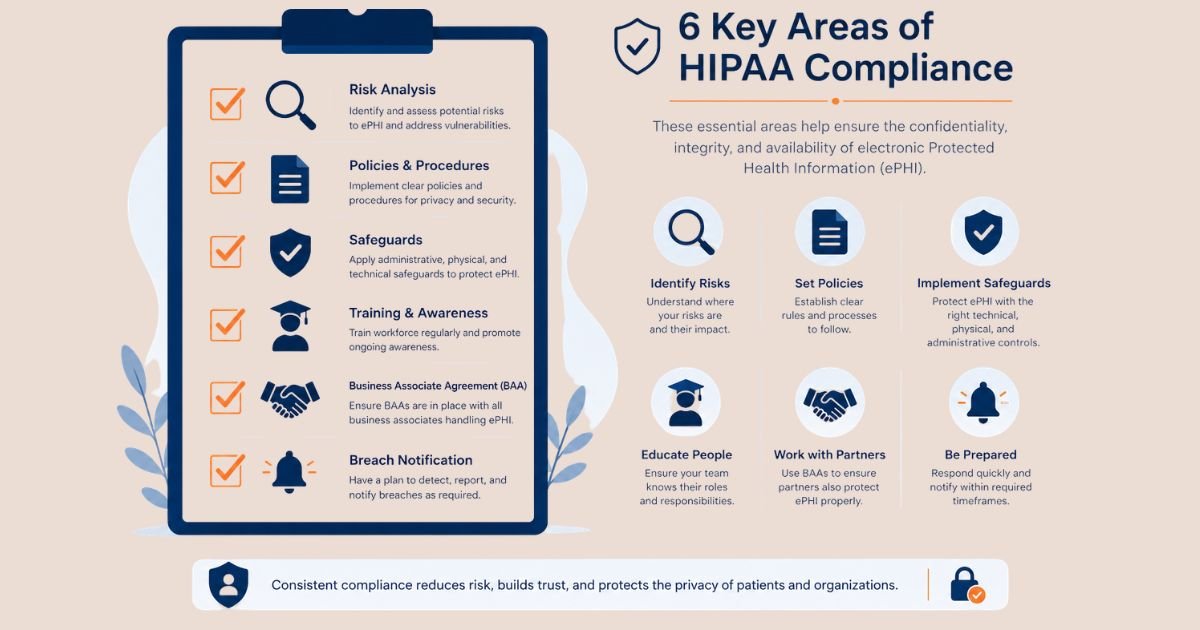
Since a certificate alone does not protect you, here is what OCR actually looks at during an investigation or audit. This is the real checklist, and it is what your effort and budget should go toward.
| What OCR evaluates | Why it matters |
| Security Risk Analysis | The single most important document; its absence is a top cause of penalties |
| Written policies and procedures | Shows how you actually handle PHI day to day |
| Administrative, physical, technical safeguards | The concrete protections around your data |
| Workforce training records | Proof that staff were trained, as the Privacy Rule requires |
| Business Associate Agreements | Required contracts with every vendor that touches PHI |
| Breach notification procedures | Tested steps to follow when something goes wrong |
What Happens If You Get It Wrong: 2026 Penalties
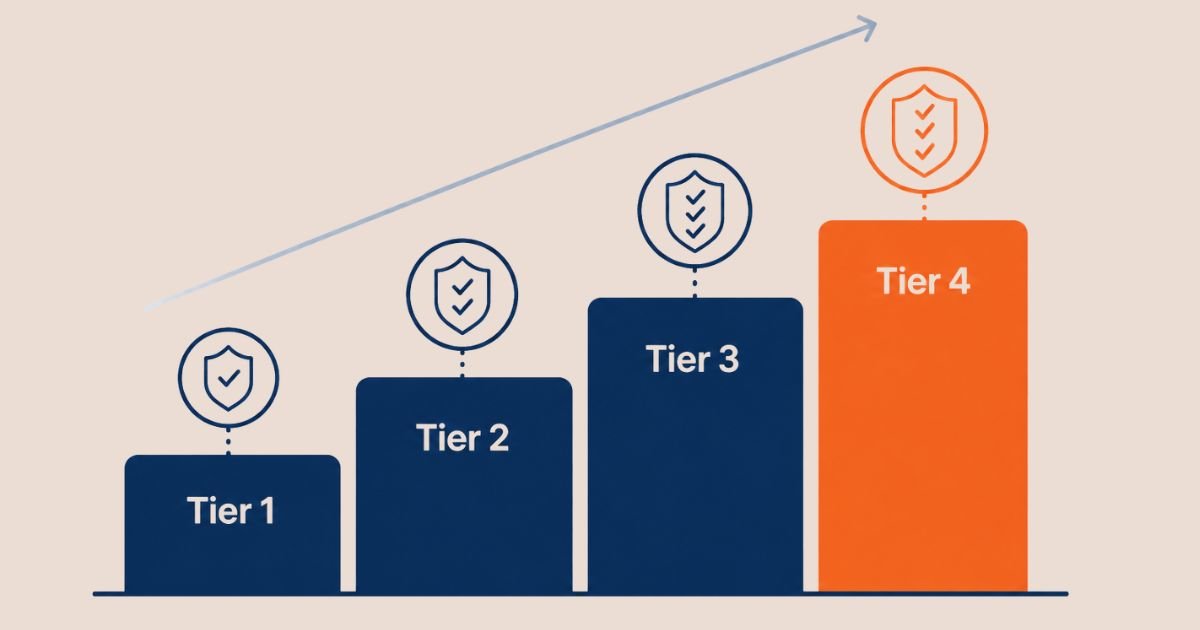
HIPAA penalties are real and they increased on January 28, 2026. HHS adjusts these amounts every year for inflation. The current civil monetary penalty tiers depend on how culpable you were, and they are charged per violation, which is how a single breach can add up to millions.
| Tier (level of culpability) | Per violation (2026) | Annual cap (2026) |
| Tier 1 – Did not know | $145 to $73,011 | $2,190,294 |
| Tier 2 – Reasonable cause | $1,461 to $73,011 | $2,190,294 |
| Tier 3 – Willful neglect, corrected | $14,602 to $73,011 | $2,190,294 |
| Tier 4 – Willful neglect, not corrected | $73,011 to $2,190,294 | $2,190,294 |
Two things to note. First, OCR has, since 2019, used its discretion to apply lower annual caps for Tiers 1 through 3 in practice, even though the published figures above show the same cap across all tiers. Second, these penalties apply to violations on or after November 2, 2015; older violations may fall under earlier amounts. The takeaway is simple: the cost of doing the compliance work is far smaller than the cost of a penalty, and a certificate alone will not save you from either.
HIPAA Certification vs SOC 2 and ISO 27001
People often ask how HIPAA fits with other frameworks. The short version: HIPAA is a legal requirement (if it applies to you), while SOC 2 and ISO 27001 are voluntary standards that produce a recognized report or certificate. Many companies that handle U.S. health data pursue SOC 2 or ISO 27001 alongside HIPAA compliance, because those give clients a formal, third-party document that HIPAA itself does not offer. If your clients are asking for a formal security report, SOC 2 is often the practical answer, and we cover that separately.