ISO Certification for Auditors and Professionals
Professionals who want to audit companies vs. professionals who want to implement ISO systems. Hook: "ISO certification for professionals is not the same as ISO certification for a company. This guide covers everything you need to know about becoming a certified ISO auditor or qualified ISO professional in India.


2000
Happy Clients

1500
Expert Advisors

2+
Branch Offices
Free Consultation by Expert
.png)


.png)
.png)
ISO Certification for Individuals?
There are two very different things people mean when they say "ISO certification":
- Company ISO certification — your business gets certified to ISO 9001, ISO 27001, etc.
- Individual ISO auditor/professional certification — you personally get certified to audit, implement, or manage ISO systems.
This guide covers the second one in full: what certifications exist, which bodies offer them in India, how much they cost, and exactly how to get certified.
ISO certification for individuals is a formal credential that proves you have the knowledge, skills, and experience to audit or implement an ISO management system. These certifications are issued by internationally recognised bodies such as CQI-IRCA, PECB, BSI, and GAQM — not by ISO itself.
ISO (the International Organization for Standardization) publishes the standards. Certification bodies assess and certify people and organisations against those standards. When a professional holds an ISO auditor credential, it means they have:
- Completed an accredited training course (typically 3–5 days)
- Passed a formal examination
- Met minimum education and work experience requirements
- In some cases, logged verified audit experience hours
These credentials are recognised globally and carry significant weight in industries such as manufacturing, IT, healthcare, food processing, and defence.
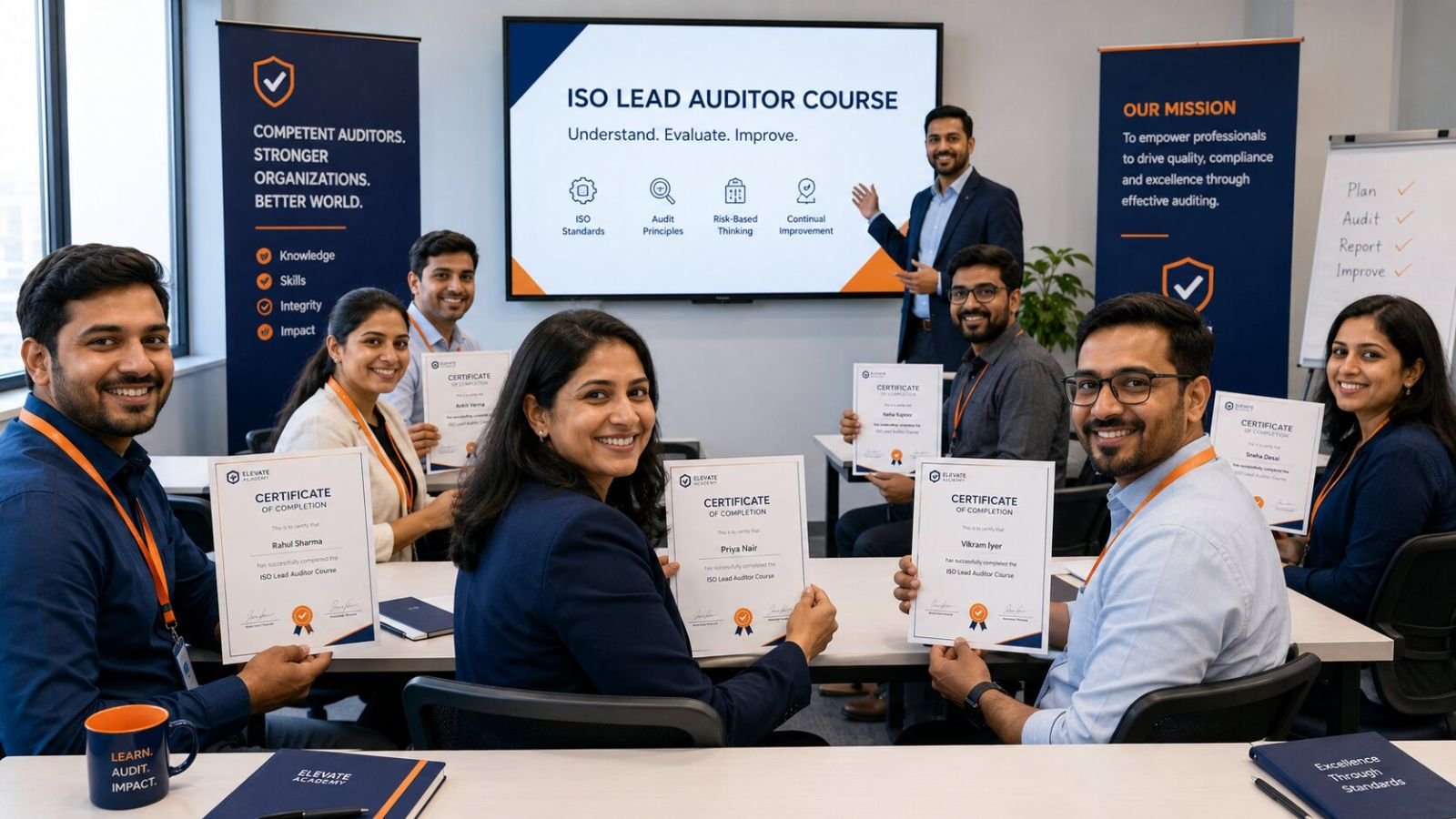
Expertise in ISO Certification for Auditors and Professionals

Enquiry Form
Among Asia Top
100
Consulting Firm

Get Consultation
Lowest Fees
100,000 + Clients.

Service Delivery
4.9 Customers Rating
50+ Offices
Contact us today to schedule your appointment.
You can call us on +919953004880 or write to us at info@efilingcompany.com
Types of ISO Auditor Certifications
There are three core certification levels for individuals. Understanding the difference will save you time and money — and ensure you pursue the right credential for your career stage.
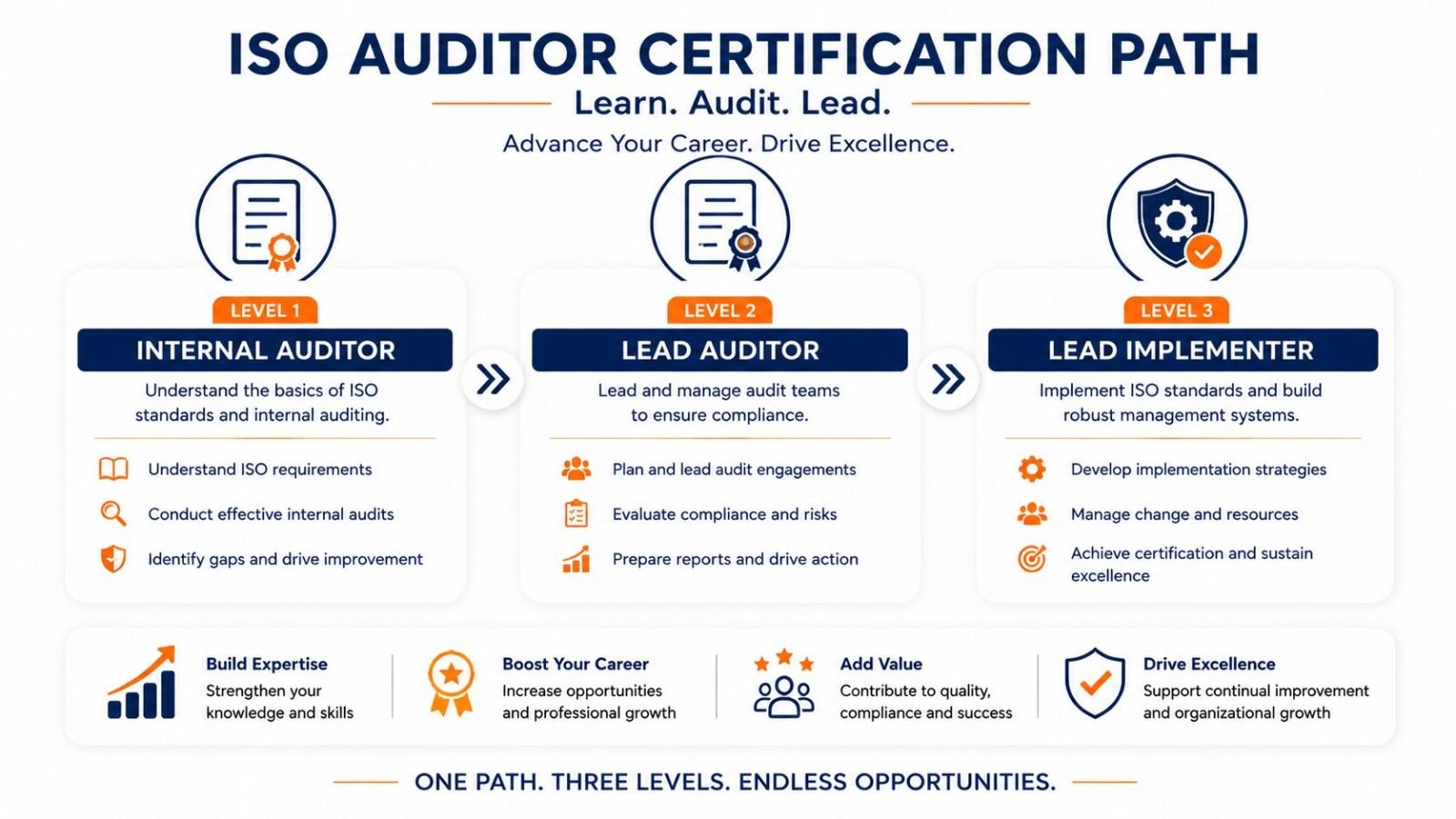
ISO Internal Auditor Certification
An internal auditor works inside an organisation to verify that the management system is functioning correctly and meeting the requirements of the chosen ISO standard. This role is mandatory — ISO 9001, ISO 14001, ISO 45001, and most other management system standards require internal audits to be performed regularly.
If you are a quality manager, EHS coordinator, IT security officer, or operations lead, an ISO internal auditor certification directly enhances your ability to do your job and increases your value to your employer.
Best suited for: Employees who manage or participate in their organisation's ISO programme.
ISO Lead Auditor Certification
A lead auditor heads audit teams conducting external, third-party audits — the formal audits that certification bodies use to assess whether a company qualifies for ISO certification. This is the most prestigious individual ISO credential and is required to work as an auditor for bodies like Bureau Veritas, TÜV SÜD, SGS, or DNV.
In India, ISO lead auditors are also in high demand as independent consultants helping companies prepare for and pass their certification audits.
Best suited for: Consultants, freelance auditors, certification body employees, and senior professionals wanting external audit capability.
ISO Lead Implementer Certification
A lead implementer is trained to design, build, and implement an ISO management system from scratch inside an organisation. This is distinct from auditing — implementers build the system, while auditors verify it.
Best suited for: Management consultants, IT security architects (especially for ISO 27001), and professionals leading ISO implementation projects.
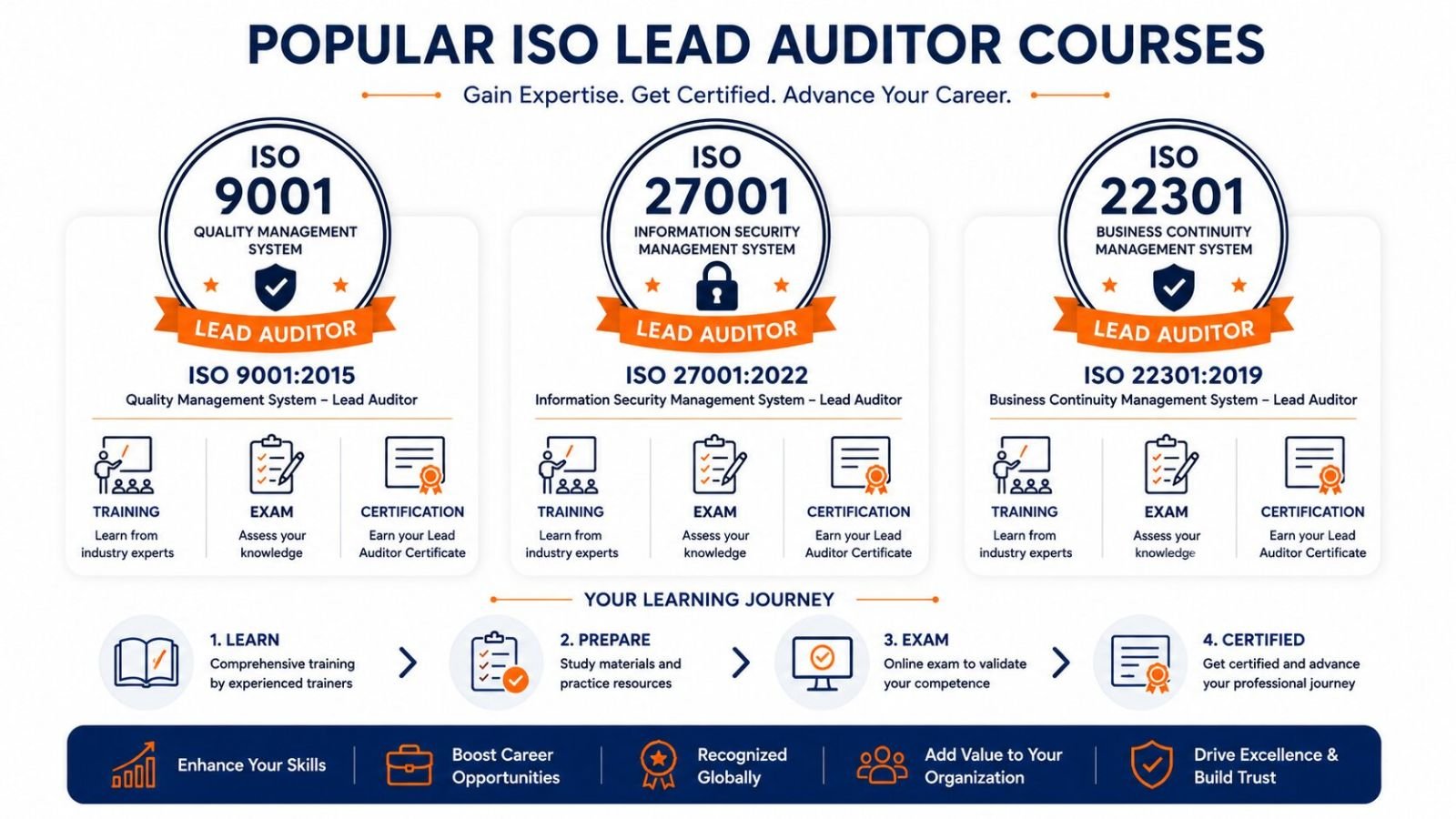
ISO Auditor Certifications by Standard
Each major ISO standard has its own auditor certification pathway. Here is a guide to the most important ones in India, including typical costs in INR.
Internal Auditor vs. Lead Auditor: Which Should You Choose?
This is the question most professionals get wrong — they pursue a lead auditor certification when an internal auditor certification would serve them better (or vice versa). Use this table to decide.
Rule of thumb: If you work inside a company and want to manage your employer's ISO programme → get the Internal Auditor certification. If you want to consult, join a certification body, or audit externally → get the Lead Auditor certification.
Top Certification Bodies for ISO Auditor Training in India
These are the globally recognised bodies whose credentials carry weight with employers and certification bodies in India and internationally.
CQI-IRCA (Chartered Quality Institute — International Register of Certificated Auditors)
The most prestigious registration body for ISO 9001 lead auditors. An IRCA-registered certificate is the benchmark for anyone wanting to work as a third-party auditor or join a major certification body in India.
Prestige Level
⭐⭐⭐⭐⭐
PECB (Professional Evaluation and Certification Board)
Globally recognised for ISO 27001, ISO 42001, ISO 22301, and ISO 13485. Their online exam model makes them accessible across India without travel — a major advantage for professionals outside metro cities.
Prestige Level
⭐⭐⭐⭐⭐
BSI Group India (British Standards Institution)
One of the oldest and most respected standards bodies globally. Recognised by UK and European clients — ideal if your customers or employers have UK/European connections.
Prestige Level
⭐⭐⭐⭐⭐
TÜV SÜD India
German certification powerhouse with strong presence in India. ISO 9001 Lead Auditor (QMS) courses are especially well-regarded in manufacturing and automotive sectors.
Prestige Level
⭐⭐⭐⭐
GAQM
Exam-only model — most affordable option. Good for entry-level ISO credentials or certifying across multiple standards. Less prestigious than IRCA/PECB for external auditing.
✓ Online · No classroom needed · Budget-friendly
ASQ (American Society for Quality)
ISO 9001:2015 Certified Lead Auditor credential widely respected in North American markets. Ideal for Indian professionals serving US-headquartered clients.
✓ Virtual live classes · US market recognition
How to Become a Certified ISO Lead Auditor in India: Step-by-Step
Choose Your Standard
Start with the standard most relevant to your industry. ISO 9001 is the most universally applicable. ISO 27001 is most commercially valuable in IT. ISO 14001 and 45001 are essential in manufacturing and construction.
Complete Foundation Training (Recommended)
Most providers recommend a Foundation or Awareness course before the Lead Auditor programme. This gives you the necessary grounding in the standard's requirements and makes the Lead Auditor course far more productive.
Attend an Accredited Lead Auditor Training Course
The Lead Auditor course runs 4–5 days and combines classroom instruction with audit simulations, case studies, and role plays. For CQI-IRCA courses, verify your provider is listed on the official IRCA course register.
Pass the Examination
Lead auditor exams combine multiple-choice questions with scenario-based written responses. Passing marks typically range from 65%–70%. Most providers allow a re-sit within a set period if needed.
Submit Your Audit Experience (where required)
CQI-IRCA requires candidates to log verified audit experience to attain Lead Auditor grade. Fresh candidates typically start at Provisional Auditor grade and progress as they accumulate experience.
Register and Maintain Your Credential
Register with your chosen body (IRCA, PECB, etc.) and maintain your credential through Continuing Professional Development (CPD). Most bodies require evidence of ongoing learning and audit activity annually.
ISO Auditor Certification Cost in India — Full Comparison
Typical market rates as of 2025. Costs vary by provider, city, batch size, and delivery mode (in-person vs. online).
* Costs include training and exam fees where applicable. Exam re-sit fees (if required) are typically ₹3,000–₹8,000 additional.
ISO Training Certification vs. ISO Auditor Certification — What Is the Difference?
ISO Training Certificate
Issued by a training provider after completing a course. Confirms you attended. Does not require passing an exam. Not a registration with any professional body. Moderate employer value.
ISO Auditor Certification
Formal professional credential registered with a body like CQI-IRCA or PECB. Requires passing an exam, meeting prerequisites, and (for lead auditor grades) demonstrating audit experience. High employer value.
If you plan to work as a professional auditor or consultant, always pursue the formal certification, not just a training certificate.
Career Benefits of ISO Auditor Certification in India
Salary and Earning Potential
ISO Internal Auditor
₹4L–₹9L
per year · Industry roles
ISO 9001 / 14001 / 45001
ISO Lead Auditor (QMS)
₹7L–₹15L
per year · CB or Consultancy
ISO 9001 Lead Auditor
ISO 27001 Lead Auditor
₹8L–₹18L
per year · IT & BFSI sectors
Highest demand in India
Freelance Consultant
₹80K–₹2.5L
per audit project
Depending on org size & scope
Industries Hiring ISO-Certified Auditors in India
🏭
Manufacturing
Auto components, pharma, chemicals, FMCG — ISO 9001, 14001, 45001
💻
Information Technology
Software, IT services, BPO, cloud — ISO 27001, 9001
🏥
Healthcare & Medical
Medical devices, pharma equipment — ISO 13485, 9001
🏦
Financial Services
BFSI, FinTech — ISO 27001, ISO 22301
🏛️
Government & Defence
PSU vendor qualification often requires certified auditors
Freelance and Consulting Opportunities
India has a large and growing market for independent ISO consultants. SMEs frequently hire freelance ISO consultants to: