ISO CERTIFICATION

ISO Certification Quickly and Easily. Entire process online! Get your certificate on the same day! We will take care of all the paperwork and filing, so you can focus on your business.

Call Now googlereview    trustpilot

Free Consultation by Expert

ISO CERTIFICATION

ISO CERTIFICATION

ISO Certification is a process of getting your business certified to an international standard. It is a way of demonstrating that your business meets the highest standards of quality, safety, and efficiency.

There are many different types of ISO certifications available, each of which focuses on a different aspect of your business. Some of the most popular ISO certifications include:

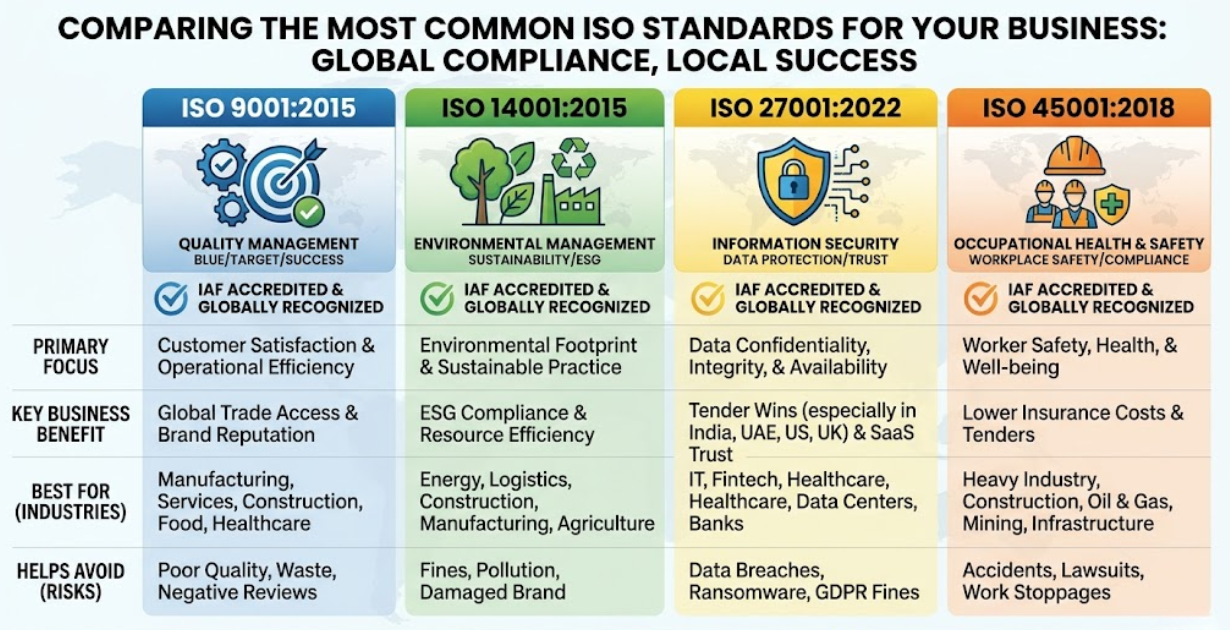
  • ISO 9001:2015 - Quality Management Systems
  • ISO 14001:2015 - Environmental Management Systems
  • ISO 45001:2018 - Occupational Health and Safety Management Systems
  • ISO 27001:2013 - Information Security Management Systems
Get Started Today


PROCESS

Procedure for ISO Certification

ONLINE REGISTRATION

Get your ISO Certificate Registered by our Expert Team

Complete your ISO Certificate Registration process within 2-3 working days.

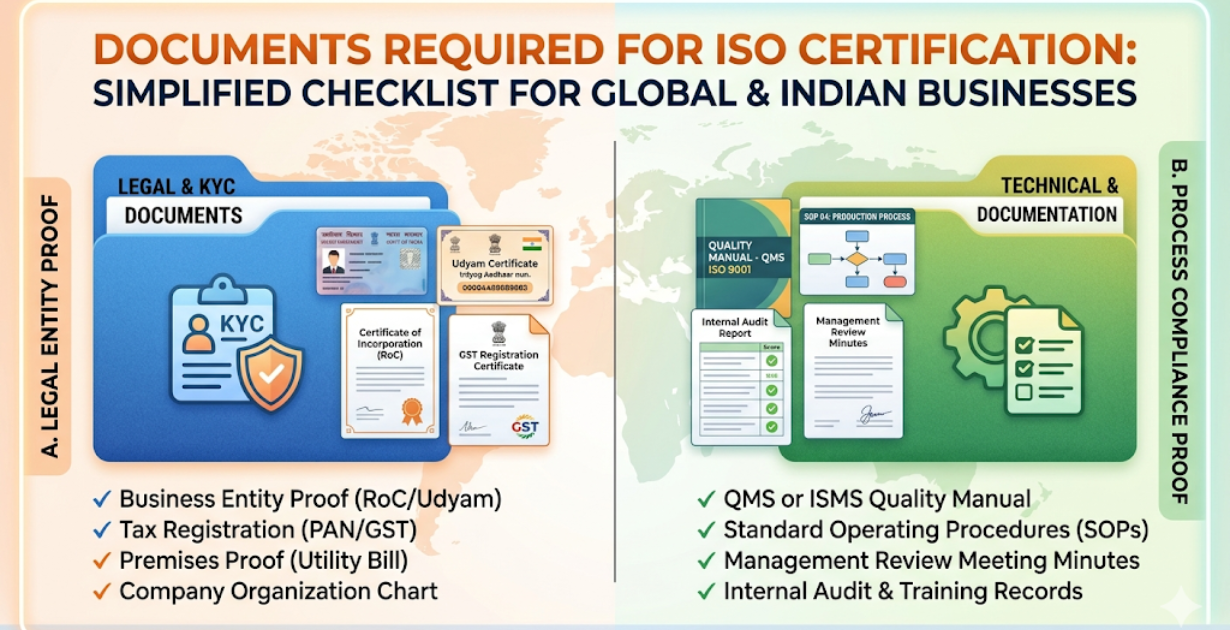
Required Documents

  • PAN Card
  • Aadhaar Card or Voter ID Card
  • Passport Size Photo
  • Two Copies of Sales Bill/Purchase Bill
THE PROCESS

Procedure for ISO Certification

One of our experts will collect all the required documents for the ISO Certification Registration process.

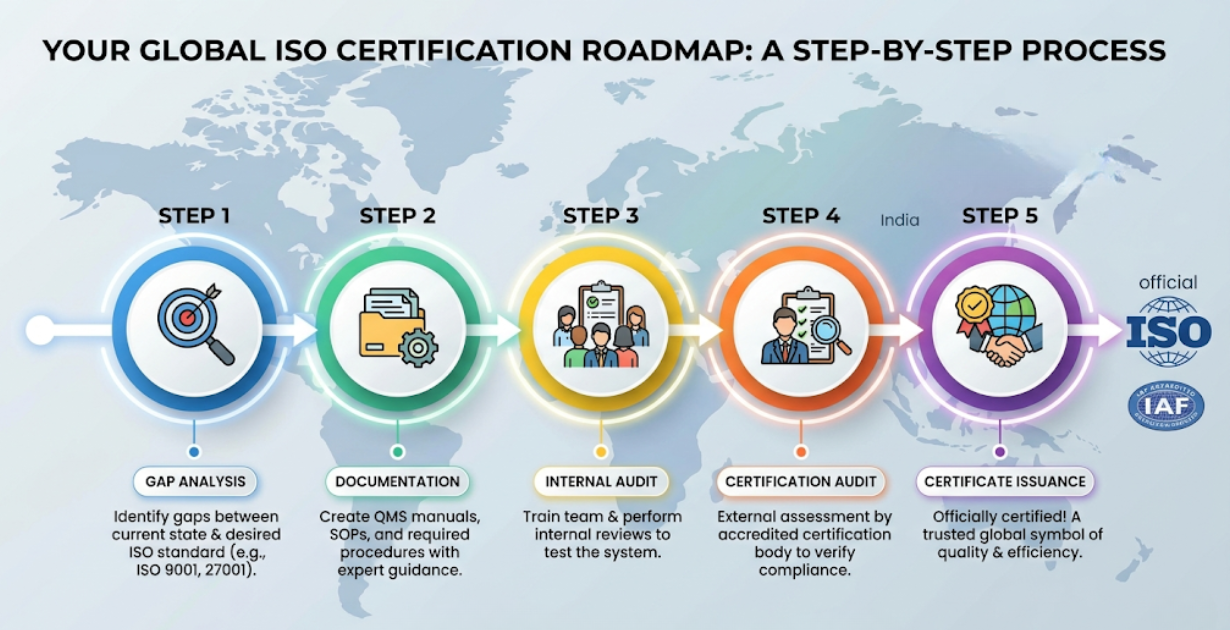
ISO Certification Procedure
  • Filling of the Application for ISO Certificate: Begin by completing the necessary forms to apply for ISO certification.
  • Applying and Submitting the Application to an Independent Body: The application is submitted to a recognized independent body that provides ISO Certification.
  • Audit to Check Company's Quality Management System (QMS): A single auditor conducts an audit to assess the company's QMS.
  • Creation of a Report by Auditor: After reviewing the QMS, the auditor prepares a detailed report.
  • If the report is positive, the ISO Certificate is granted.

Detailed Audit Stages for ISO Certification

  • Stage I Audit: Auditors examine the changes made within your organization to meet ISO requirements. This stage ensures all adjustments align with the standards.
  • Stage II Audit: In this final stage, the auditor conducts a comprehensive review to verify that all ISO standards are fully implemented and adhered to, paving the way for certification approval.

By understanding and preparing for each stage of the audit, organizations can streamline their path to achieving ISO certification, ensuring both compliance and quality enhancement.


BENEFITS

ISO CERTIFICATION | ISO 9001 | ISO 27001

  • ISO 9001: 2015

Get Free Consultation on ISO 9001:2015 Quality Management System

  • SITRA Certification

Get Free Consultation on SITRA Certification

  • ISO 22609 & ISO 16603

We provide free consultancy regarding the applicability of relevant ISO certificate. Recently due to COVID/CORONA, organizations are looking for ISO 22609 and ISO 16603

  • CE Marking

We provide certificate issuance services with regard to all kind of ISO certificates, CE Mark, HALAL Food, HACCP (Hazard analysis critical control point), GMP ( Good Manufacturing Practices)

  • Fast processing of documents

After document submission, we could issue ISO certificate within 2 days.

  • Competitive Pricing

We offer ISO Certificate starting from INR 3000 only


DOCUMENTS REQUIRED

DOCUMENTS REQUIRED FOR ISO Certification

Meat Processing Unit

Passport Size Photo


COMPARE RELATED SERVICES

ISO Certificate

Standard/Certification Description Applicability
ISO 45001:2018 ISO 45001:2018 is the international standard for Occupational Health and Safety Management Systems (OHSMS). It provides a framework for organizations to manage and improve their occupational health and safety performance. - Applicable to organizations of all sizes and industries.
- Helps organizations reduce workplace injuries and illnesses.
ISO 9001:2015 ISO 9001:2015 is the international standard for Quality Management Systems (QMS). It sets out the criteria for a quality management system and is based on a number of quality management principles including a strong customer focus, the involvement of top management, a process approach, and continual improvement. - Applicable to organizations of all types and sizes, irrespective of their products or services.
- Enhances customer satisfaction and product quality.
CE Mark The CE Marking, also known as the CE mark, is a mandatory conformity marking for certain products sold within the European Economic Area (EEA). It indicates that the product complies with essential requirements regarding safety, health, and environmental protection. - Mandatory for products sold in the EEA.
- Demonstrates compliance with EEA regulations.
GMP (Good Manufacturing Practice) GMP, or Good Manufacturing Practice, is a system for ensuring that products are consistently produced and controlled according to quality standards. It is designed to minimize the risks involved in any pharmaceutical production. - Essential for pharmaceutical manufacturers and related industries.
- Ensures the quality and safety of pharmaceutical products.
ISO 13485:2016 ISO 13485:2016 is the international standard for Quality Management Systems for Medical Devices (QMS-MD). It outlines specific requirements for organizations involved in the design, production, installation, and servicing of medical devices. - Applicable to manufacturers of medical devices and related services.
- Ensures compliance with regulatory requirements.
FDA Compliance FDA compliance refers to meeting the regulations and standards set by the U.S. Food and Drug Administration (FDA) for the manufacturing and distribution of food, drugs, medical devices, and other products. - Mandatory for organizations dealing with food, drugs, and medical devices in the United States.
- Ensures product safety and regulatory compliance.
WHO-GMP (World Health Organization - Good Manufacturing Practices) WHO-GMP, or World Health Organization - Good Manufacturing Practices, are guidelines for pharmaceutical manufacturers to ensure the quality and safety of pharmaceutical products. Compliance is essential for exporting medicines to international markets. - Essential for pharmaceutical manufacturers aiming to export to international markets.
- Ensures the quality and safety of pharmaceutical products.
FCC Compliance FCC compliance refers to meeting the regulations set by the Federal Communications Commission (FCC) in the United States. It applies to electronic and telecommunications equipment to ensure electromagnetic compatibility. - Mandatory for manufacturers of electronic and telecommunications equipment in the United States.
- Ensures electromagnetic compatibility and compliance with FCC regulations.
ISO 14001:2015 ISO 14001:2015 is the international standard for Environmental Management Systems (EMS). It provides a framework for organizations to manage their environmental responsibilities and reduce their environmental impact. - Applicable to organizations of all types and sizes seeking to improve their environmental performance.
- Helps organizations reduce their environmental footprint.
ISO 27001:2013 ISO 27001:2013 is the international standard for Information Security Management Systems (ISMS). It provides a systematic approach for managing sensitive information and ensuring data security. - Applicable to organizations of all types and sizes that handle sensitive information.
- Enhances information security and data protection.
HACCP (Hazard Analysis and Critical Control Points) HACCP, or Hazard Analysis and Critical Control Points, is a systematic preventive approach to food safety. It identifies, evaluates, and controls hazards in food production processes. - Essential for businesses in the food industry to ensure food safety.
- Prevents foodborne hazards and contamination.
HALAL Halal certification ensures that products and services comply with Islamic dietary laws and regulations. It is essential for businesses producing and selling Halal food and consumer products. - Relevant for businesses producing Halal food and consumer products.
- Certifies compliance with Islamic dietary laws.
Kosher Compliance Kosher compliance certifies that food products comply with Jewish dietary laws and regulations. It is necessary for businesses producing Kosher food. - Relevant for businesses producing Kosher food products.
- Certifies compliance with Jewish dietary laws.
RoHS Compliance RoHS compliance, or Restriction of Hazardous Substances compliance, restricts the use of specific hazardous materials in electronic and electrical equipment. - Mandatory for manufacturers of electronic and electrical equipment in various regions.
- Ensures the restriction of hazardous substances in products.
HALAL Compliance Halal compliance certifies that products and services comply with Islamic dietary laws and regulations. It is essential for businesses producing and selling Halal food and consumer products. - Relevant for businesses producing Halal food and consumer products.
- Certifies compliance with Islamic dietary laws.
ISO/IEC 17025:2017 ISO/IEC 17025:2017 is the international standard for testing and calibration laboratories. It sets out the general requirements for the competence, impartiality, and consistent operation of laboratories. - Applicable to testing and calibration laboratories of all types and sizes.
- Ensures the reliability and accuracy of laboratory results.
GOTS Compliance (Global Organic Textile Standard) GOTS Compliance (Global Organic Textile Standard) is the worldwide leading textile processing standard for organic fibers. It ensures the organic status of textiles and covers the entire production chain. - Relevant for businesses involved in the production and processing of organic textiles.
- Certifies compliance with global organic textile standards.
ISO 20000-1:2018 ISO 20000-1:2018 is the international standard for Information Technology - Service Management System (ITSM). It specifies requirements for establishing, implementing, maintaining, and continually improving an IT service management system. - Applicable to organizations providing IT services.
- Ensures effective IT service management and delivery.
ISO 22000:2018 ISO 22000:2018 is the international standard for Food Safety Management Systems (FSMS). It sets out the requirements for a food safety management system and can be used by any organization, regardless of its size or position in the food chain. - Applicable to organizations in the food industry to ensure food safety.
- Prevents foodborne hazards and contamination.
ISO 22301:2019 ISO 22301:2019 is the international standard for Business Continuity Management Systems (BCMS). It provides a framework for organizations to develop, implement, and improve strategies for business continuity and disaster recovery. - Applicable to organizations of all types and sizes to ensure business continuity.
- Minimizes the impact of disruptions on business operations.
ISO 21001:2018 ISO 21001:2018 is the international standard for Educational Organizations Management Systems (EOMS). It specifies requirements for educational organizations to establish, implement, maintain, and continually improve an educational management system. - Applicable to educational institutions to enhance the quality of education and learning.
- Focuses on student satisfaction and educational effectiveness.
ISO 55001:2014 ISO 55001:2014 is the international standard for Asset Management Systems (AMS). It sets out the requirements for an effective asset management system that can be adapted to any organization and its changing needs. - Applicable to organizations of all sizes and industries that manage assets.
- Optimizes asset performance and reduces risks.
ISO 41001:2018 ISO 41001:2018 is the international standard for Facility Management (FM) Systems. It specifies the requirements for the establishment, implementation, maintenance, and improvement of an FM system to maximize the efficiency of an organization's workplace. - Relevant for organizations looking to improve facility management.
- Enhances workplace efficiency and sustainability.
ISO 37001:2016 ISO 37001:2016 is the international standard for Anti-Bribery Management Systems (ABMS). It provides a framework for organizations to prevent, detect, and address bribery and corruption. - Applicable to organizations of all types and sizes to combat bribery and corruption.
- Helps build a culture of integrity and transparency.
GDP (Good Distribution Practices) GDP, or Good Distribution Practices, is a quality system for warehouse and distribution centers dedicated to medicines. It ensures that pharmaceutical products are consistently stored, transported, and handled under suitable conditions. - Essential for pharmaceutical distributors and suppliers.
- Ensures the quality and integrity of pharmaceutical products during distribution.
ISO 39001:2012 ISO 39001:2012 is the international standard for Road Traffic Safety Management Systems (RTSMS). It provides a framework for organizations to reduce road traffic accidents and improve road safety. - Applicable to organizations involved in road traffic and transportation.
- Reduces the risk of accidents and improves road safety.
ISO 21898:2004 ISO 21898:2004 is the international standard for Hot Gas Tests for Evaluating the Ignition Resistance of Materials. It specifies a method for evaluating the ignition behavior of materials. - Relevant for industries and applications requiring materials with specific ignition resistance.
- Ensures materials meet ignition resistance standards.
ISO 27018:2004 ISO 27018:2004 is the international standard for Information Technology - Security Techniques - Code of Practice for Protection of Personally Identifiable Information (PII) in Public Clouds Acting as PII Processors. - Applicable to organizations using public clouds for processing PII.
- Ensures the protection of PII in cloud environments.
ISO 22483:2020 ISO 22483:2020 is the international standard for Pneumatic Fluid Power - Electro-pneumatic Converters - Performance Testing. - Relevant for manufacturers and users of electro-pneumatic converters.
- Ensures performance testing in pneumatic fluid power systems.
ISO 50001:2018 ISO 50001:2018 is the international standard for Energy Management Systems (EnMS). It provides a systematic approach for organizations to improve energy performance, reduce energy consumption, and lower energy costs. - Applicable to organizations of all sizes and industries seeking to enhance energy efficiency.
- Focuses on continuous improvement in energy management and sustainability.
- Helps identify and implement energy-saving opportunities.


ISO CERTIFICATION

What is ISO Certification?

In today's competitive business world, customers buy not just product or service, but trust. And this trust is built only when you give assurance of quality, safety and reliability. This assurance is given by ISO Certification. ISO (International Organization for Standardization) is a global body that sets quality standards for different industries. If your business follows these standards and passes the audit, you get ISO certification.

Advantages of ISO Certificate Registration

  • Suitable for both small and large organizations.
  • Better internal management and less wastage.
  • Improved in efficiency, productivity and profit.
  • Improved customer retention and acquisition.
  • Consistent outcomes, measured and monitored.
  • Globally recognized standard.
 

Why Efiling Company for ISO Certification?

See, getting an ISO certificate is a professional process that can be tough without expert guidance. Efiling Company offers you full support:

Guidance in choosing the right ISO standard

  • Documentation & policy drafting
  • Training for Internal audits
  • Tie-up with Accredited bodies for certification
  • Fast & cost-effective solutions

PACKAGES FOR

Charges for ISO Certification

STARTER
INR 1499
Per Registration
  • 30-minute consultation with ISO expert
  • ISO Standard Selection Guidance (9001, 14001, 45001, etc.)
  • Document checklist guidance
  • Application form assistance
  • Submission to certification body
  • Email & phone support
  • No hidden charges


STANDARD
INR 6499
Per Registration
  • Everything in Basic Plan, plus:
  • Complete ISO documentation preparation (Manuals, SOPs, Policies)
  • Assistance in implementing ISO documentation in business processes
  • Pre-certification readiness check
  • Unlimited email & phone support until certification is granted
  • Detailed Documentation


PREMIUM
INR 14999
Per Registration
  • Everything in Standard Plan, plus:
  • Internal audit assistance before certification
  • On-site or virtual audit support during certification audit
  • Corrective action report preparation for any non-compliance
  • Post-certification guidance for maintaining compliance
  • Annual review & reminders for re-certification


General frequently asked questions

ISO certification has been largely considered as quality management tool which provides a kind of identity to company’s quality management systems. its standardises how businesses and organisation involved in commerce and industry manage informant and process. It simply means that organisation has met certain requirements.

ISO 9001 is one of the most popular international quality management standards. It provides a framework to manage a company's processes and has been used for over 30 years. ISO certificates certify that our company complies with ISO 9001, this enables us to serve our customers reliably and ensure they are satisfied. ISO 9001 is an international set of standards and clauses issued by a leading non-profit organization that helps in defining how a company should create products or services, produce or distribute them, monitor as well as control them. It is a quality management system that provides documented evidence of organization's assessment and governed intent to meet customer and applicable statutory and regulatory requirements.

ISO certificate 9001 is the most common ISO certification. It refers to the quality management system and is applicable to all business. ISO 9001 certificate is considered to be one of the best certificate which assure the customer about the quality of the product. It builds up a trust among concerned people around you

To improve the quality of product. Organizations have implemented some rules and regulation as per the requirements of ISO 900. The standard ISO 9004 has an important element of self assessment and this standard is not agreeable.

As a minimum. You should familiarise yourself not only with the requirements of ISO 9001. But vocabularies given in ISO 9000 and direction standard ISO 9004 will help you to clearly understand your association‘s activities and process and appropriately interpret the requirement of the standards. Implement the requirements in the different activities and processing adding value to these processes and activities.

ISO audit is the basic tool to check the quality process systems to ensure that organisation is following the requirements as prescribed. Once you taken ISO certification. ISO audit needs to be done on annual basis ISO 9001 Quality management systems ISO 10012 Measurement management systems ISO 2768-1 General tolerances ISO 14001 Environmental management OHSAS 18001 Occupational Health & safety management ISO 19011 Guidelines for auditing management ISO 20000-1 Information technology management ISO 22000 Standard for food safety ISO 27001 Information media security system ISO 31000 Risk management ISO 4217 Currency codes ISO 50001 Energy management CE MARK For certain products sold within European Economic Area HACCP Hazard analysis critical control point

ISO certification is designed to improve the quality of a product or service by providing an audit assessment, which shows how well the product meets the customer's needs. The ISO certification process determines the organization's compliance to international standards governing QMS while ensuring elements of organizational competence, some of which may not be met through internal audits. ISO is an acronym for International Organization for Standardization, ISO's commercial members are the national standards bodies of 159 countries. The main 4-digit groups of ISO internationally accredited certification are ISO 9001, ISO 14001, and ISO 22001. It is important for you to understand that ISO certifications denote the processes, products, or organizations of complying with official standards. The purpose of ISO is to take a tough approach to quality and also consistency. Most companies are according to ISO 9000 certified. Why is ISO Certification Important for Businesses in Delhi? ISO certification is particularly significant for businesses in Delhi as it helps elevate an organization's reputation and operational efficiency. Here’s how: Process Efficiency: It enhances the efficiency of processes, taking your company from one level to another by streamlining operations and reducing waste. Risk Reduction: The certification helps diminish work-related risks and environmental threats, ensuring a safer workplace. Energy Management: ISO standards emphasize balancing energy usage, promoting cost savings and sustainable practices. Customer Satisfaction: Meeting the requirements of ISO certification aligns your products or services with customer expectations, improving satisfaction and loyalty. Compliance with Standards: It ensures adherence to international standards, providing a solid foundation for delivering effective and efficient products and services. Accessibility in Delhi Obtaining ISO certification in Delhi is now more accessible than ever, with online certification processes simplifying the journey. This accessibility encourages more businesses to adopt these standards, fostering a competitive edge in the market "

ISO certification is a valuable asset for any organization, offering a mark of quality and efficiency. To ensure a straightforward and cost-effective route to ISO certifications, consider joining one of the leading ISO certification bodies. This can simplify the process by providing expert guidance and resources tailored to your needs. The ISO certification process is divided into three main phases: Registration: Companies commit to meeting specific requirements. Confirmation: The company is confirmed as an ISO-certified entity by an accreditation body. Audit: An independent evaluation by a third-party assessor ensures the company maintains compliance with ISO standards. While this process might take time, it's generally not difficult. Under ISO 9001, there is a checklist available to facilitate the process. Key Steps to Simplify Your ISO Certification: Assess Your Current State: Understand your organization's readiness for certification. Engage With Experts: Professional bodies can guide you through the intricacies of compliance. Utilize Resources: Checklists and structured guidance can ease the transition. We at Efilingcompany.com are here to help make obtaining ISO Certification quick and easy. By leveraging expert assistance, your organization can navigate the certification journey efficiently, ensuring both simplicity and cost-effectiveness.

The best way to get ISO certification is through an ethical and reputed ISO Certification Company in India. This is one of the main advantages of outsourcing your compliance procedure. There are many advantages of outsourcing this service, one of them is that they may have their own documentation which will be cataloged, so every new induction is securely stored electronically and at print. Organizations also realize that ISO certification saves a tremendous amount on resources, cost and value for money due to compliance.ISO certification is a fairly standardized process. The requirements for the ISO Certificate are usually country specific, and approved by whichever governing body that oversees their national standards. All you need to do is find out the relevant board in your country and go through the steps needed for accreditation.ISO Certification is granted only by national certifying bodies accredited to ISO/IEC. So before applying for ISO Certification, you need to identify the local national certifying body and their requirements. After that, you can submit your application following your entity's procedures, which usually include a detailed description of your company’s operations and more information about the product or service.

Getting ISO certification in Delhi involves a series of systematic steps aimed at ensuring your organization meets international standards. Here’s a comprehensive guide to the process: Choose a Certification Body: Start by selecting an internationally accredited certification body that complies with ISO standards. Make sure they are recognized by global accreditation organizations to guarantee validity. Application Submission: Fill out an application detailing the rights and responsibilities of both your organization and the certification body. This document is confidential and forms the foundation of your agreement. Documentation Review: An ISO auditor will be assigned to review your existing documentation. They focus on the procedures your organization follows, assessing them against ISO standards. Gap Analysis: During documentation review, auditors will identify any discrepancies or gaps in compliance. You’ll need to address these by developing an action plan to correct any deficiencies. Initial Certification Audits: Stage I Audit: In this phase, auditors verify that the preliminary changes adhere to necessary standards. Stage II Audit: This is the final audit where your processes are thoroughly evaluated to ensure complete compliance with ISO standards. Report and Certification: Once the auditors approve all processes, a detailed report is compiled and submitted to the registrar. Upon successful review, your organization will be granted the ISO 9001 certification. This structured approach not only streamlines the certification process but also aligns your organization with international best practices, reinforcing your commitment to quality and efficiency.

If you're looking to secure ISO certification in Delhi, here's a step-by-step guide to simplify the process: Select a Certification Body Begin by choosing a reputable and internationally recognized certification body. It's crucial to ensure that the organization you choose meets all ISO accreditation standards. Submit an Application Prepare and submit an application that outlines all the necessary rights and obligations. This document will remain confidential between your company and the certification body. Documentation Review An ISO auditor will assess your organization's relevant documentation. This step ensures that your current procedures align with ISO standards. Identify and Address Gaps During the review, the auditor will highlight any discrepancies. If gaps are identified, you'll need to draft an action plan to address and rectify these issues. Initial Certification Audits The certification process involves two primary audit stages: Stage I Audit: Auditors will verify the corrections made to your processes based on their initial findings. Stage II Audit: A comprehensive final audit is conducted to ensure full compliance with the ISO standards. Receive ISO Certification If your processes meet the necessary standards, the auditors will compile a report and submit it to the registrar. Upon approval, your company will be awarded ISO 9001 certification. Follow these steps, and your company will be well on its way to achieving ISO certification, ensuring your procedures stand up to international standards.

When selecting an ISO certification body in Delhi, it's essential to consider the unique advantages they offer to enhance your business's credibility and efficiency. Here’s why choosing the right certification body can be beneficial: Personalized Certification Approach A top-notch certification body will cater to organizations of all sizes and sectors. Their tailored approach ensures that the specific needs and processes of each business are addressed, offering relevant certifications based on the type, size, and unique operations of your organization. Direct Certification Process Opting for a certification body that manages the process directly, without intermediaries, can streamline your experience. This direct handling minimizes delays and potential miscommunications, ensuring that you obtain the necessary certifications efficiently and accurately. Accredited Assurance Choose a certification organization that is recognized by respected accreditation entities, such as the International Accreditation Service (IAS) or the United Accreditation Foundation (UAF). This accreditation not only upholds the credibility of your certification but also assures quality and reliability in the procedures followed. Client-Centric Service The best certification bodies place high importance on customer focus, treating all their clients with equal importance regardless of their market position. This ensures a non-biased and professional service, where attention to detail and client satisfaction are paramount. Resourceful and Fair Practices Select a certifying body committed to employing the right resources and unbiased practices throughout the certification process. This approach integrates integrity and fairness, contributing to an enhanced reputation for organizations seeking certification. By choosing a well-regarded ISO certification body in Delhi, your business benefits from increased credibility, efficient certification processes, and a supportive partnership tailored to your unique operational needs.

Key Benefits of Choosing the Right ISO Certifying Organization Selecting a reputable ISO certifying organization can significantly impact your business's compliance and operational efficiency. Here are some primary benefits: Versatile Certification Services: A top-tier certifying body can accommodate organizations of any size and across various industries. Whether you run a sprawling corporation or a small startup, such organizations adapt their services to fit your unique processes and requirements. Direct Certification Processes: Engaging directly with an accredited certifying body ensures a streamlined certification process. This eliminates middlemen, allowing you to receive your certifications directly and efficiently, which can save time and reduce potential errors or misunderstandings. Client-Centric Approach: The best certifying organizations prioritize personalized attention for each client. This means your company’s specific needs and challenges are addressed with utmost importance, ensuring a tailored and effective certification journey. Resource Utilization Excellence: A reputable ISO certifying organization employs the optimal resources and processes necessary to certify your enterprise. This dedication to thoroughness and accuracy ensures your operations meet international standards without compromise. Equitable Treatment for All Clients: The ideal certifying body treats all clients impartially, ensuring fair and unbiased processes. This level playing field is crucial, as it signifies that emerging businesses receive the same consideration as established enterprises. By partnering with an esteemed ISO certifying organization, you not only secure your business's compliance but also elevate its credibility and operational integrity.

In today's digital landscape, prioritizing privacy and data protection is crucial for business expansion. ISO 27701 plays a significant role in this by providing a robust framework that enhances these areas. Let's dive into how this standard impacts business growth. Enhanced Data Management ISO 27701 lays out clear guidelines for managing personal data, which helps businesses efficiently organize and protect customer information. This systematic approach reduces data breaches, fostering trust and encouraging customer loyalty. Competitive Advantage Adopting ISO 27701 can give businesses a competitive edge. Compliance with international standards showcases a commitment to privacy, potentially attracting more clients who value data security. Businesses that prioritize such standards are often seen as more reputable and trustworthy. Streamlined Processes By implementing ISO 27701, businesses can streamline their processes to align with best practices. This alignment not only improves operational efficiency but also reduces the risk of regulatory fines and penalties, which can be detrimental to growth. Facilitating Global Expansion Having ISO 27701 certification paves the way for international business opportunities. Many countries and companies require adherence to rigorous data protection standards. ISO 27701 compliance assures partners and customers globally that a business meets these requirements. Building Customer Confidence Transparency in how data is handled directly affects customer confidence. ISO 27701 helps businesses establish a framework for transparency, boosting customer assurance in their data privacy policies. This confidence can lead to increased customer retention rates and new client acquisition. Ultimately, ISO 27701 is not just about compliance; it's a strategic asset that can drive business growth through improved privacy and data protection practices. By integrating these standards, companies can navigate the complexities of today's data-driven world, fostering growth and longevity.

Understanding ISO/UNDP PAS 53002:2024 and Its Connection to the 2030 Agenda for Sustainable Development ISO/UNDP PAS 53002:2024 is a joint initiative between the International Organization for Standardization (ISO) and the United Nations Development Programme (UNDP). This framework sets forth guidelines and practices aimed at promoting sustainable development across various sectors. Key Features of ISO/UNDP PAS 53002:2024 Holistic Approach: This standard provides a comprehensive set of principles and guidelines designed to enhance sustainability practices globally. Collaborative Effort: It is the result of concerted efforts by governments, businesses, and civil society to drive meaningful change. Adaptability: Offers flexible guidelines that can be tailored to fit different regional, cultural, and economic contexts. Relation to the 2030 Agenda for Sustainable Development Launched in 2015, the 2030 Agenda for Sustainable Development is a global blueprint adopted by all United Nations member states. It outlines 17 Sustainable Development Goals (SDGs) aiming to eradicate poverty, protect the planet, and ensure prosperity for all by 2030. Alignment with SDGs: ISO/UNDP PAS 53002:2024 directly supports the achievement of the SDGs by providing a structured approach to sustainable practices. Guidance for Implementation: By following this standard, organizations can align their strategies with global efforts to meet the Agenda’s ambitious targets. Encouraging Accountability: It serves as a tool to measure progress and hold various entities accountable for their contributions to sustainable development. In summary, ISO/UNDP PAS 53002:2024 is a critical component in the framework of international standards supporting the implementation of the United Nations' ambitious 2030 Agenda, ensuring coordinated efforts towards a sustainable future.

Contact us today to schedule your appointment.
You can call us on +919953004880 or write to us at info@efilingcompany.com