ISO 22000 Certification
ISO 22000:2018 Food Safety Management System Certification — For Food Manufacturers, Processors, Exporters, Caterers and All Food Chain Organisations in India


2000
Happy Clients

1500
Expert Advisors

2+
Branch Offices
Free Consultation by Expert
.png)


.png)
.png)
ISO 22000 Certification — Food Safety Management System
ISO 22000 Certification is the international standard for a Food Safety Management System (FSMS). It helps food businesses identify, prevent, and control food safety hazards at every stage — from sourcing to serving. As part of our complete ISO certification services, eFilingCompany helps Indian food businesses get certified quickly and affordably.
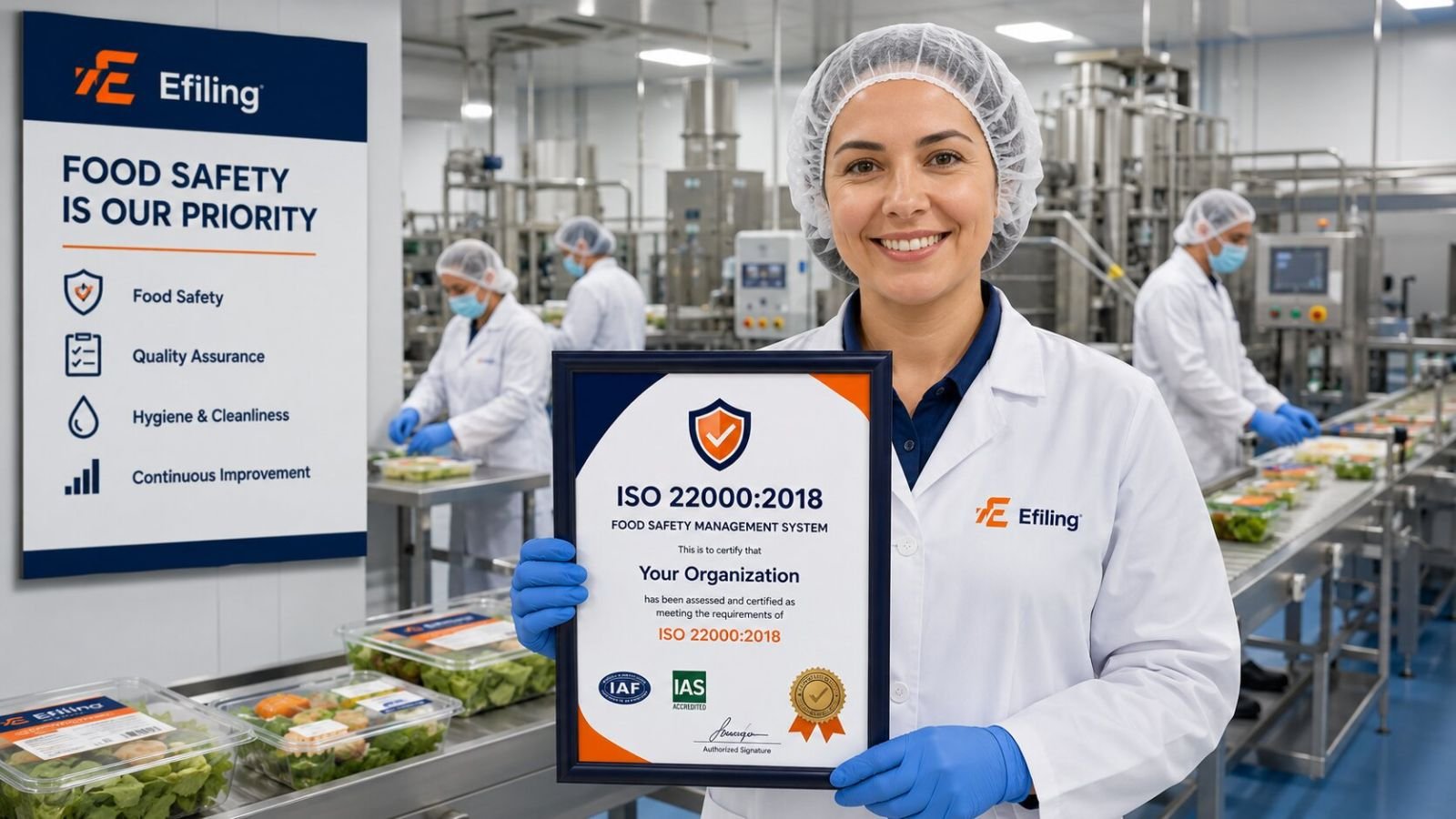

Expertise in ISO 22000 Certification

Enquiry Form
Among Asia Top
100
Consulting Firm

Get Consultation
Lowest Fees
100,000 + Clients.

Service Delivery
4.9 Customers Rating
50+ Offices
Contact us today to schedule your appointment.
You can call us on +919953004880 or write to us at info@efilingcompany.com
What is ISO 22000 Certification?
ISO 22000 is an internationally recognised Food Safety Management System (FSMS) standard. It gives food businesses a structured way to control food safety risks at every step of the supply chain. The standard applies to any organisation that produces, processes, packs, stores, transports, or sells food.
ISO 22000 is an internationally recognised Food Safety Management System (FSMS) standard. It sets out the requirements for controlling food safety hazards across the entire food supply chain — from farm to fork.
It combines the principles of HACCP (Hazard Analysis and Critical Control Points) with the management system approach of ISO 9001. This makes it more comprehensive than HACCP alone — it covers not just food safety risks, but also how you manage, monitor, and improve your system over time.
ISO 22000 is recognised in more than 100 countries. For Indian food exporters, it is often a mandatory requirement to enter international markets in the EU, USA, and the Gulf.
ISO 22000 Full Form
ISO 22000 full form is "International Organization for Standardization 22000" — the global standard for Food Safety Management Systems.
The Four Core Elements of ISO 22000
ISO 22000 is built on four key elements that work together to keep food safe:
🔄 Interactive Communication
Clear communication between everyone in the food chain — suppliers, staff, customers, and regulators — to identify and manage food safety risks.
⚠️ HACCP Principles
Systematic hazard analysis and critical control points to prevent, eliminate, or reduce food safety risks to acceptable levels.
📋 System Management
A structured management system to plan, implement, monitor, and improve food safety processes on an ongoing basis.
✅ Prerequisite Programs (PRPs)
Basic hygiene and sanitation practices — cleaning, pest control, personal hygiene, water quality — that form the foundation of food safety.
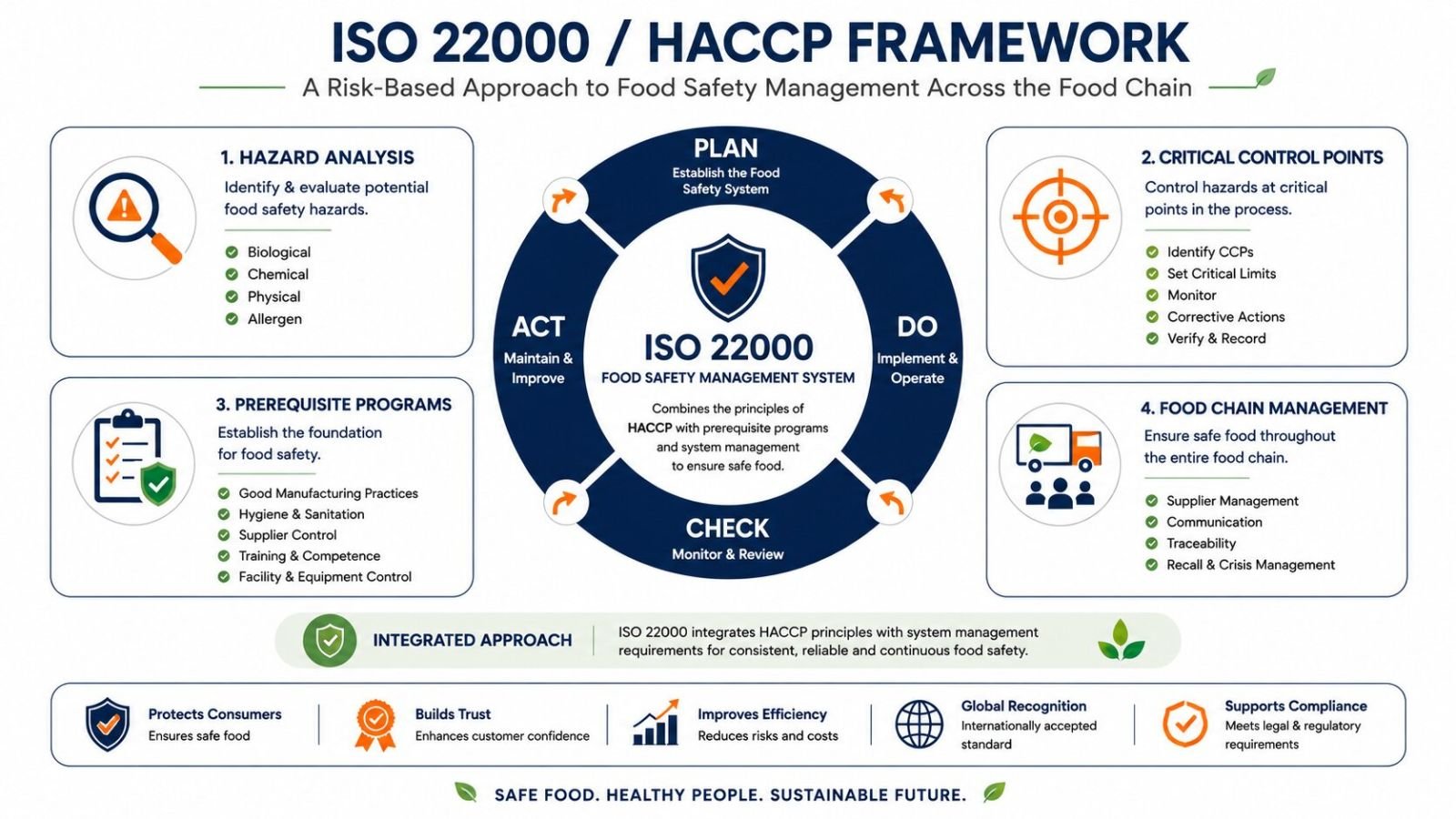
ISO 22000 & HACCP Framework
ISO 22000 integrates HACCP principles into a complete management system. Here is how the framework fits together:
Who Needs ISO 22000 Certification?
ISO 22000 applies to any organisation in the food supply chain. If your business falls into any of these categories, certification will directly help you win more contracts and enter new markets.
- Food and Beverage Manufacturers — processing, packing, and canning units
- Food Processing and FMCG Companies — snack foods, ready-to-eat meals, spices, and packaged goods
- FSSAI-Licensed Food Business Operators — restaurants, cloud kitchens, catering services, and food trucks
- Export-Oriented Units — seafood, meat, dairy, and processed food exporters to EU, USA, and Gulf markets
- Hotels, Hospitals, and Institutional Caterers — where food safety is critical to operations
- Packaging and Logistics Suppliers — food-grade packaging material makers and cold-chain transporters
If your business serves the food industry — directly or indirectly — you can explore our specialised ISO certification for the food industry to see which standards fit your operations best.
Key Benefits of ISO 22000 Certification
🌍 Access to Export Markets
EU, USA, and Gulf buyers often require ISO 22000 before signing contracts. It is your entry ticket to international markets.
🛡️ Reduce Food Safety Risks
Systematic hazard analysis helps you catch problems before they reach the customer — protecting your brand and reducing recalls.
📜 Meet Legal Requirements
ISO 22000 aligns with FSSAI regulations and global food safety laws — making compliance simpler and audit-ready.
🏆 Build Customer Trust
A recognised certificate on your packaging tells buyers you take food safety seriously. It is audited proof, not just a claim.
🔗 Integrates with Other ISO Standards
Uses the same Annex SL structure as ISO 9001 and ISO 14001 — making combined certification easier and cheaper.
⚙️ Improve Operations
Better process control, less waste, fewer rejections, and more efficient use of resources — all of which reduce cost.
ISO 22000:2018 vs ISO 22000:2005 — What Changed?
The current and only certifiable version is ISO 22000:2018. It replaced the older 2005 version and introduced major updates to bring food safety in line with other modern ISO standards.
| Feature | ISO 22000:2005 | ISO 22000:2018 |
|---|---|---|
| Status | ❌ Withdrawn | ✓ Current Standard |
| Structure | Older structure | ✓ Annex SL (HLS) |
| Risk Approach | Basic | ✓ Risk-based thinking (two levels) |
| Leadership | Limited | ✓ Stronger Clause 5 requirement |
| Context of Organisation | ❌ Not required | ✓ Mandatory (Clause 4) |
| PDCA Cycle | Single cycle | ✓ Two cycles (system + operations) |
| Integration with ISO 9001 | Difficult | ✓ Easy via Annex SL |
Important: If your business still holds an ISO 22000:2005 certificate, it is no longer valid. You need to transition to ISO 22000:2018. Contact us for a fast transition audit →
ISO 22000 vs HACCP vs FSSC 22000 — Which Should You Choose?
These three are related but not the same. Here is a simple comparison to help you decide:
| Factor | ISO 22000 | HACCP | FSSC 22000 |
|---|---|---|---|
| Scope | Full Food Safety Management System | Hazard analysis and control points only | ISO 22000 + additional sector-specific requirements |
| Basis | ISO standard | Codex Alimentarius guidelines | ISO 22000 + GFSI benchmarking |
| Certifiable? | ✓ Yes | Not a standalone certification | ✓ Yes |
| Recognition | Global (100+ countries) | Global framework | GFSI-recognised (preferred by global retailers) |
| Best For | Most food businesses and exporters | As a foundation step before ISO/FSSC | Exporters to global retail chains (Tesco, Walmart, etc.) |
| Cost in India | ₹40,000 – ₹1,50,000 | ₹15,000 – ₹50,000 | ₹1,00,000 – ₹3,00,000+ |
ISO 22000 Certification Requirements (10 Clauses)
ISO 22000:2018 follows the same 10-clause structure (Annex SL) used by other modern ISO standards. Here is what each clause requires:
| Clause | Title | What It Requires |
|---|---|---|
| 1 | Scope | Defines what the standard covers and who it applies to |
| 2 | Normative References | Lists reference documents needed to apply the standard |
| 3 | Terms & Definitions | Explains key terms used throughout the standard |
| 4 | Context of the Organisation | Understand internal and external issues affecting food safety |
| 5 | Leadership | Top management must commit to food safety and set policy |
| 6 | Planning | Set food safety objectives, assess risks, plan actions |
| 7 | Support | Provide resources, train staff, maintain documented information |
| 8 | Operation | Implement PRPs, HACCP plan, and operational controls |
| 9 | Performance Evaluation | Monitor, measure, verify, and conduct internal audits |
| 10 | Improvement | Fix non-conformities, take corrective action, and continually improve |
Clause 4–10 build on the same management system backbone as ISO 9001 (Quality Management System). If your business already has a quality management system in place, integration will be much simpler.
Documents Required for ISO 22000 Certification in India
eFilingCompany prepares all technical documents on your behalf. You only need to provide basic business information. Here is a quick checklist of what is typically required:
How to Get ISO 22000 Certified — Step by Step
Our process is simple, transparent, and designed for Indian food businesses:
Gap Analysis
We visit your facility, review current food safety practices, and identify the gaps between your operations and ISO 22000:2018 requirements.
FSMS Documentation
Our consultants prepare all required documents — Food Safety Manual, HACCP plan, PRP documentation, and SOPs — customised to your operations.
Implementation & Training
We train your staff on new processes, hygiene practices, and their roles in food safety. Your team learns how to maintain the system day to day.
Internal Audit
We stress-test your system with a full internal audit, identify non-conformities, and fix them before the official certification audit.
Certification Audit
The certification audit is conducted by an IAF/NACB-accredited certification body in two stages — Stage 1 (documentation review) and Stage 2 (on-site audit). We stand by you through both stages until your certificate is issued.
Validity & Renewal of ISO 22000 Certification
An ISO 22000 certificate is valid for 3 years. During this period, your organisation must undergo annual surveillance audits in Year 1 and Year 2 to confirm ongoing compliance. Before the certificate expires, a recertification audit is required to renew it for another full term. We manage this entire lifecycle for our clients — tracking dates, preparing your team, and handling recertification so your certificate never lapses.
ISO 22000 Certification Cost in India
The cost of ISO 22000 certification in India depends on several factors. Instead of quoting a fixed price, here is what actually drives your investment:
- Business size and headcount — number of employees directly affects audit man-days
- Number of sites — multi-location businesses require separate audits per site
- Process complexity — the more food safety hazards you handle, the more audit time is needed
- Scope of certification — single product line vs full operations
- Chosen certification body — IAF-accredited bodies carry slightly higher fees but global acceptance
For most small food businesses in India, the total investment (consultancy + certification audit) typically starts from ₹40,000 and scales with business size. Annual surveillance audits and the 3-year recertification are additional costs to plan for.
Want an exact cost for your business? Share a few details about your operations and we will give you an all-inclusive quote with no hidden charges.
Get a Free ISO 22000 Quote →ISO 22000 and FSSAI — Understanding the Relationship
FSSAI and ISO 22000 serve different but complementary purposes. Here is how they work together:
| Factor | FSSAI License | ISO 22000 Certification |
|---|---|---|
| Nature | Legal requirement (mandatory) | Voluntary standard |
| Issued By | Food Safety and Standards Authority of India | IAF/NACB-accredited certification bodies |
| Scope | Compliance with Indian food safety laws | International FSMS best practices |
| Purpose | Legal permission to operate | Competitive advantage in tenders and exports |
Bottom line: FSSAI is what you must have to operate legally in India. ISO 22000 is what you should have to grow — it helps you win contracts, export internationally, and prove to customers that your food safety practices are world-class. Most successful food businesses in India hold both.
Ready to Get ISO 22000 Certified?
Get a free consultation with our ISO 22000 experts. We will review your business and give you a clear timeline and cost estimate.
📞 Call: +91 9953004880 | ✉️ Email: info@efilingcompany.com
Get a Free ISO 22000 Quote →