ISO 26262 Certification
ISO 26262 is the international standard for functional safety of electrical and electronic systems in road vehicles. It provides a structured framework for identifying and managing hazards across the complete automotive development lifecycle — from concept to decommissioning.


2000
Happy Clients

1500
Expert Advisors

2+
Branch Offices
Free Consultation by Expert
.png)


.png)
.png)
ISO 26262 Certification — Automotive Functional Safety Standard for Road Vehicles
ISO 26262, titled Road Vehicles – Functional Safety, is the international standard for functional safety of electrical and electronic (E/E) systems in production automobiles. It is an adaptation of the general functional safety standard IEC 61508, specifically tailored to address potential hazards caused by malfunctions of E/E systems in passenger vehicles.
The standard provides a structured framework for managing functional safety in the automotive sector — addressing potential hazards caused by malfunctions in electrical and electronic systems across the complete vehicle safety lifecycle: from management and development through to production, operation, service, and decommissioning.
Components of automotive electrical and electronic systems play a critical role in achieving compliance with the ISO 26262 standard.
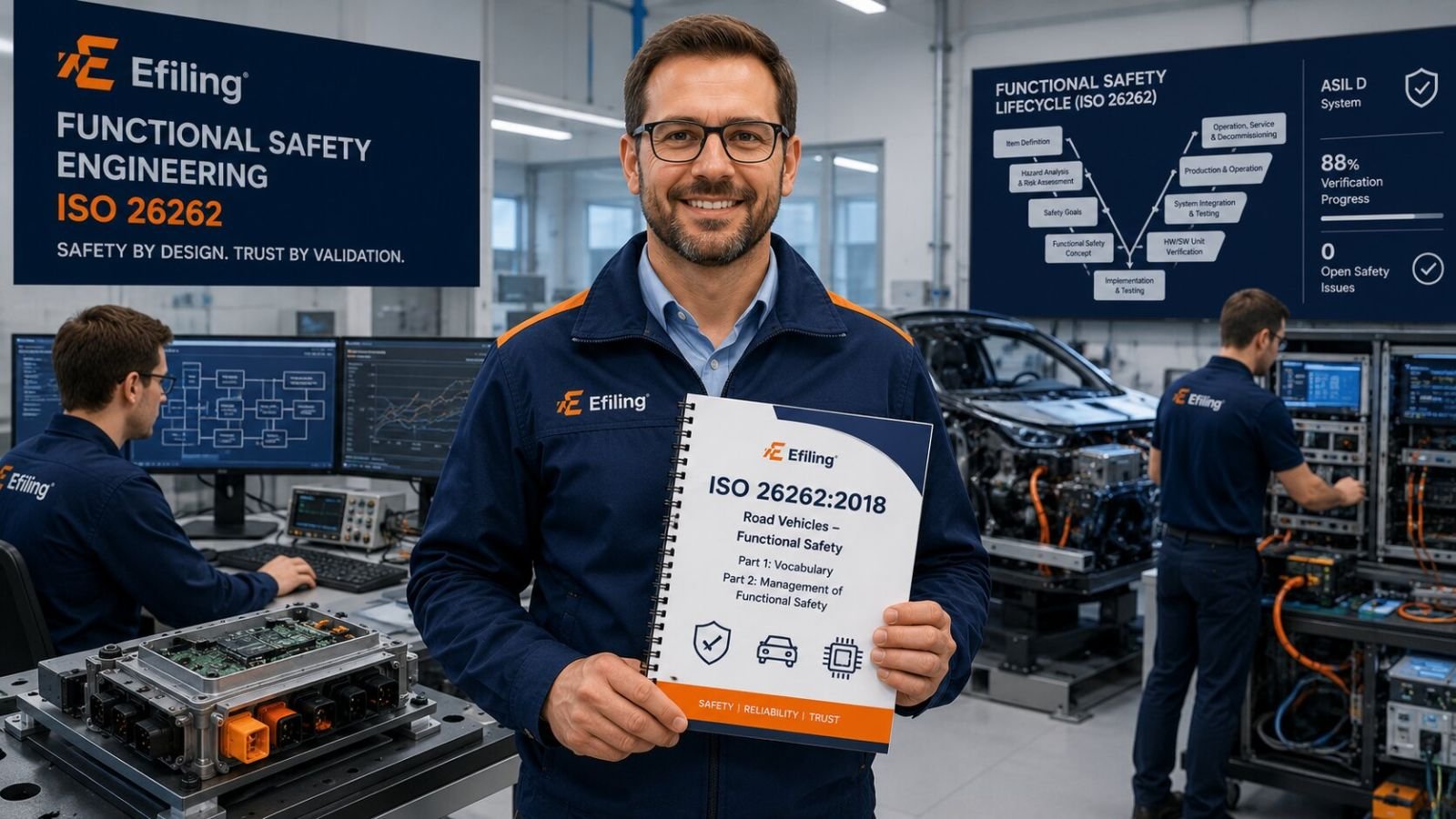

Expertise in ISO 26262 Certification

Enquiry Form
Among Asia Top
100
Consulting Firm

Get Consultation
Lowest Fees
100,000 + Clients.

Service Delivery
4.9 Customers Rating
50+ Offices
Contact us today to schedule your appointment.
You can call us on +919953004880 or write to us at info@efilingcompany.com
Scope and Structure of ISO 26262 |
ISO 26262 covers the entire safety lifecycle of a vehicle, encompassing management, development, production, operation, service, and decommissioning phases. The standard is structured into ten parts:
| Part | Description |
| Vocabulary | Defines terms and abbreviations used throughout the standard |
| Management of Functional Safety | Outlines organizational and project-specific requirements |
| Concept Phase | Describes initiation of safety lifecycle including hazard analysis and risk assessment |
| Product Development at System Level | Provides guidelines for system-level design and validation |
| Product Development at Hardware Level | Focuses on hardware-specific requirements and verification |
| Product Development at Software Level | Details software development requirements and verification |
| Production, Operation, Service, and Decommissioning | Addresses safety measures during these lifecycle phases |
| Supporting Processes | Covers configuration management, change management, and verification |
| ASIL-Oriented and Safety-Oriented Analyses | Explains how to perform safety analyses according to ASIL requirements |
| Guideline on ISO 26262 | Provides additional guidance on implementing the standard |
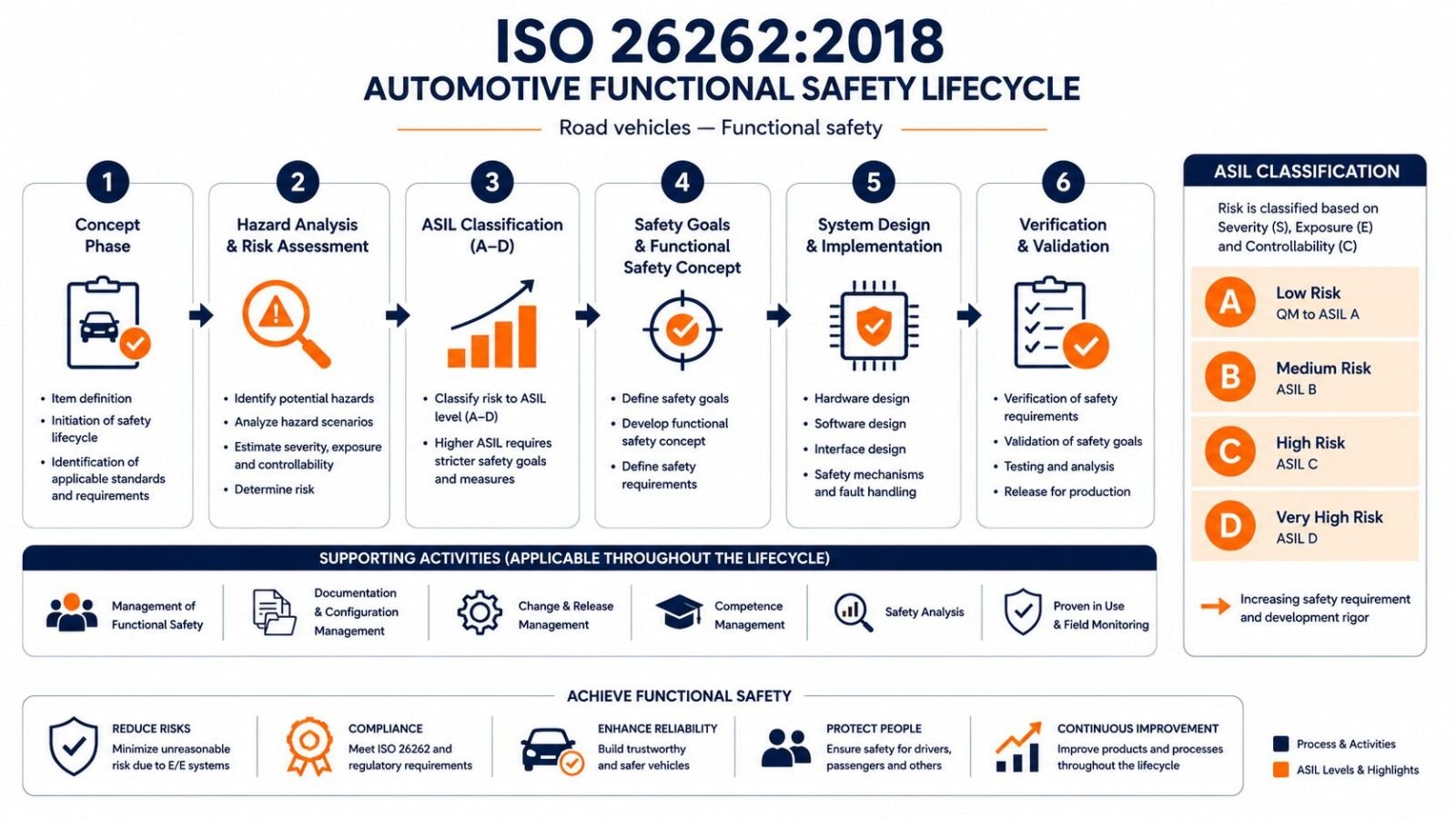
Automotive Safety Integrity Levels (ASIL) |
A key aspect of ISO 26262 is the concept of Automotive Safety Integrity Level (ASIL). ASIL is a risk classification scheme defined by the standard, which ranges from ASIL A (lowest risk) to ASIL D (highest risk). The ASIL is established by performing a risk analysis of a potential hazard based on three factors:
|
Severity
Potential impact of a failure on vehicle occupants or others
|
Exposure
Probability of the operational situation occurring
|
Controllability
Ability of the driver or system to avoid a potential hazardous event
|
There are four ASILs identified by the standard: ASIL A, ASIL B, ASIL C, ASIL D. ASIL D dictates the highest integrity requirements on the product and ASIL A the lowest. Hazards that are identified as QM (Quality Management) do not dictate any specific safety requirements under ISO 26262.
The ISO 26262 Certification Process |
Achieving ISO 26262 certification involves a rigorous process that includes:
| 1 | Gap Analysis — Assessing the current processes and identifying areas that do not comply with ISO 26262 requirements |
| 2 | Planning — Developing a detailed plan to address the identified gaps and ensure compliance throughout the development lifecycle |
| 3 | Implementation — Applying the required processes and safety measures throughout the development lifecycle |
| 4 | Documentation — Creating comprehensive documentation to demonstrate compliance with each part of the standard |
| 5 | Verification and Validation — Conducting thorough testing and reviews to ensure all safety requirements are met |
| 6 | Certification Audit — An independent certification body reviews the processes, documentation, and results to determine compliance with ISO 26262 |
`;