ISO 21001 Certification
ISO 21001 is the internationally recognised Educational Organisations Management System (EOMS) standard. Designed specifically for the education sector, it provides a framework to help schools, colleges, universities, and training centres improve teaching quality, boost learner satisfaction, and deliver equitable, personalised education. eFilingCompany helps educational institutions across India achieve ISO 21001 certification efficiently.


2000
Happy Clients

1500
Expert Advisors

2+
Branch Offices
Free Consultation by Expert
.png)


.png)
.png)
ISO 21001 Certification — Educational Organisations Management System for Schools, Colleges, Universities and Training Institutes in India
ISO 21001 Certification
ISO 21001 is the international standard for an Educational Organizations Management System (EOMS). It gives schools, colleges, universities, coaching centres, training providers and e-learning platforms a structured framework to plan, deliver, evaluate and continually improve their educational services — with the learner placed at the centre of every process.
The standard is built on the same High Level Structure as ISO 9001, so it integrates smoothly with quality management. But unlike ISO 9001, ISO 21001 is purpose-built for education: it focuses on learner satisfaction, curriculum design, teaching effectiveness, assessment, accessibility and the unique relationship between an institution and its learners. It replaced the earlier training-sector standard ISO 29990:2010.
Expertise in ISO 21001 Certification

Enquiry Form
Among Asia Top
100
Consulting Firm

Get Consultation
Lowest Fees
100,000 + Clients.

Service Delivery
4.9 Customers Rating
50+ Offices
Contact us today to schedule your appointment.
You can call us on +919953004880 or write to us at info@efilingcompany.com
ISO 21001 at a Glance
| ISO 21001 Quick Facts | |
| Current edition | ISO 21001:2025 (replaces ISO 21001:2018) |
| Full name | Educational Organizations Management Systems — Requirements with guidance for use |
| Who it is for | Schools, colleges, universities, training & coaching institutes, ed-tech / e-learning, corporate L&D departments |
| Certificate validity | 3 years, with annual surveillance audits |
| Typical cost (India) | ₹90,000 – ₹3,00,000 (consultancy + audit, by size) |
| Typical timeline | 6–9 months (smaller institutes); up to 12+ months (large universities) |
ISO 21001:2025 Is Now the Current Standard
On 7 July 2025, ISO published ISO 21001:2025 as the second edition, cancelling and replacing ISO 21001:2018. The principal technical change is that the assessment-related requirements have been revised to reflect current best practices in educational assessment. The standard remains aligned with ISO 9001 and retains the same overall management-system structure.
If your institution is already certified to the 2018 version, you will need to transition to the 2025 edition within the timeline set by the official transition policy to keep your certificate valid. New applicants should certify directly against ISO 21001:2025. Be cautious of any provider still issuing fresh certificates against the withdrawn 2018 version.
ISO 21001 Certification Cost in India & the Gulf
There is no single fixed price. The cost depends on the number of learners, number of campuses or locations, the maturity of your existing systems, and the audit scope. The figures below reflect typical market ranges for accredited certification including consultancy support.
| Institution Type | Indicative Cost (India) | Gulf / UAE |
| Small coaching / training centre | ₹90,000 – ₹1,40,000 | USD 850 – 1,100 |
| School / mid-size institute | ₹1,40,000 – ₹2,20,000 | USD 1,100 – 1,400 |
| College / university / multi-campus | ₹2,20,000 – ₹3,00,000+ | USD 1,400 – 1,600+ |
Beware of Unrealistically Cheap Certificates
If you see offers of an "ISO 21001 certificate for ₹4,000–₹5,000," understand what you are actually buying. A genuine, accredited certificate requires a real Stage 1 and Stage 2 audit by an accredited certification body. Ultra-cheap "certificates" are usually issued by non-accredited private bodies and carry no recognition with regulators, NAAC/NBA assessors, or international partners.
The IAF Accreditation Warning Every Institution Should Read
This is the most important — and most overlooked — point in the entire certification decision. Not all ISO 21001 certificates are equal.
A certificate only carries international recognition if it is issued by a certification body accredited under an IAF (International Accreditation Forum) MLA signatory accreditation board. Accredited certificates are verifiable on the public IAF CertSearch database. ISO has also published ISO/TS 21030:2023, which sets the specific requirements for bodies that audit and certify educational organizations.
Before you pay anyone, ask one question: "Which IAF-recognised accreditation body are you accredited under, and can I verify the certificate on IAF CertSearch?" If the answer is unclear, walk away. A non-IAF certificate may look identical on the wall but will not satisfy serious stakeholders.
The 7-Step ISO 21001 Certification Process
- Gap analysis — review your current systems against ISO 21001:2025 requirements.
- Documentation — develop your educational policy, objectives, procedures and records.
- Implementation — roll out the EOMS across teaching, admin and learner-support functions.
- Training & awareness — staff understand their roles within the system.
- Internal audit & management review — verify readiness and close gaps.
- Stage 1 + Stage 2 certification audit — conducted by the accredited certification body.
- Certification & surveillance — certificate issued (valid 3 years) with annual surveillance audits.
Key Benefits of ISO 21001 Certification
- Learner-centred quality: consistent education delivery regardless of instructor or mode.
- Credibility & trust: a recognised mark for students, parents, recruiters and accreditation bodies.
- Structured governance: clear roles, measurable objectives and evidence-based decisions.
- Inclusivity: better support for special-needs, distance and lifelong learners.
- Continual improvement: internal audits and feedback loops that raise outcomes over time.
- Integration: aligns easily with ISO 9001 and other management systems.
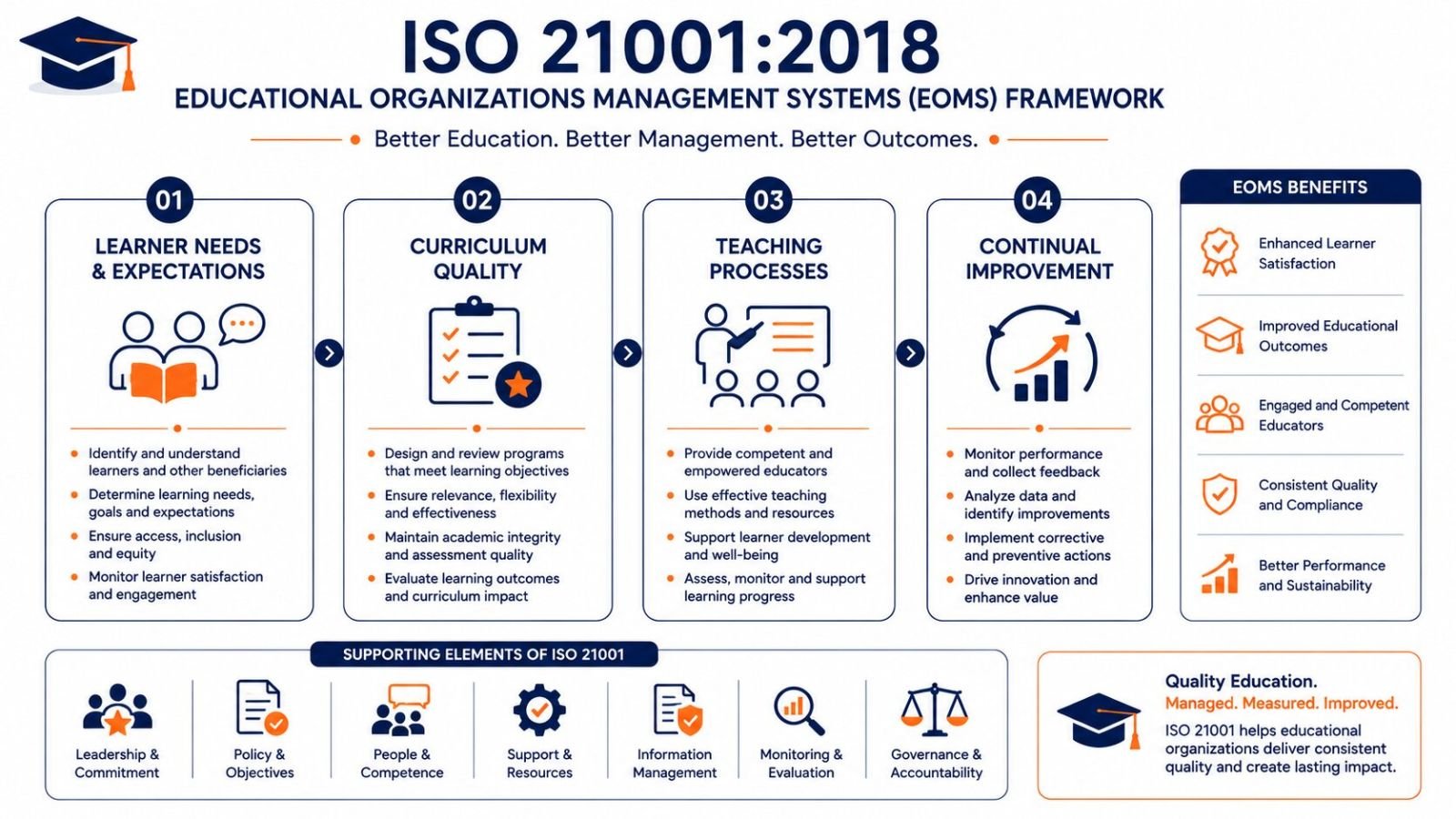
The 11 Management Principles of ISO 21001
ISO 21001 is built on eleven management principles that guide how an educational organization should operate:
- Focus on learners and other beneficiaries
- Visionary leadership
- Engagement of people
- Process approach
- Improvement
- Evidence-based decisions
- Relationship management
- Social responsibility
- Accessibility and equity
- Ethical conduct in education
- Data security and protection
Mandatory Documents Required for ISO 21001
To achieve certification, your institution must maintain documented information including:
- Scope of the EOMS
- Educational policy and educational objectives
- Documented procedures and work instructions
- Records of staff competence, training and qualifications
- Internal audit programme and results
- Management review minutes
- Records of corrective actions and continual improvement
ISO 21001 vs ISO 9001 vs ISO 29993
| Standard | Focus |
| ISO 21001 | Management system for educational organizations (whole institution) |
| ISO 9001 | General quality management for any industry |
| ISO 29993 | Learning services outside formal education (e.g. standalone in-company training) |
Get ISO 21001 Certified With Expert Guidance
We help educational institutions across India and the Gulf implement ISO 21001:2025 end to end — from gap analysis and documentation to a successful accredited audit. Explore related standards: ISO 9001, ISO 27001, or see our full ISO certification services. For institutions in educational hubs, see our ISO certification for educational institutions page.