SOC 2 Report Type 1 and Type 2
What SOC 2 Type 1 and Type 2 reports cover, the five Trust Services Criteria, and how SOC 2 differs from SOC 1 - in plain language for SaaS and IT companies.


2000
Happy Clients

1500
Expert Advisors

2+
Branch Offices
Free Consultation by Expert
.png)


.png)
.png)
SOC 2 Report Type 1 and Type 2
A SOC 2 report is an independent audit report that shows how well a company protects the data it holds for its customers. If you run a SaaS, cloud, IT, or data-handling business, your customers want proof that their information is safe with you, and a SOC 2 report is the document most of them ask for. It comes in two forms, Type 1 and Type 2, and it is built around a set of five areas called the Trust Services Criteria. This page explains what a SOC 2 report is, the difference between SOC 2 Type 1 and Type 2, what the five criteria mean, and how SOC 2 differs from SOC 1.
Quick note before we start: SOC 2 is an attestation report issued by a licensed CPA firm under a standard called SSAE 18. There is no "SOC 2 certificate," no official seal, and no logo that a government body hands out. If someone says they are "SOC 2 certified," that is the wrong word. The correct term is a SOC 2 report, or being "SOC 2 compliant."
What is a SOC 2 report?
SOC stands for System and Organization Controls. So the SOC 2 full form is System and Organization Controls 2. It is a reporting framework created by the American Institute of Certified Public Accountants (AICPA) in the United States.
A SOC 2 report is the result of an audit of how a service organization keeps customer data secure. Unlike SOC 1, which is about financial reporting, SOC 2 is about data protection, things like security, uptime, and privacy. A CPA firm examines your controls against the AICPA's Trust Services Criteria and issues a report describing whether those controls are designed properly and, in a Type 2, whether they actually worked over a period of time. SOC 2 reports fall under the SSAE 18 standard, specifically AT-C sections 105 and 205. (This is different from SOC 1, which sits under AT-C 320.)
What SOC 2 compliance actually means
People often search for "SOC 2 compliance meaning," so here it is in plain terms. Being SOC 2 compliant means an independent CPA firm has examined your data-protection controls and issued a report saying they meet the AICPA's criteria. It is not a pass or fail badge. It is a detailed report that your customers and their security teams can read to judge how you handle their data.
Who needs a SOC 2 report
SOC 2 is meant for service organizations that store, process, or transmit customer data. Common examples include:
- SaaS and software companies
- Cloud hosting and infrastructure providers
- Data centres and managed IT service providers
- Fintech and payment technology companies
- Analytics, marketing, and customer-data platforms
- Any B2B vendor whose customers ask "how do you protect our data?"
If your customers or their vendor risk teams are asking for security assurance before they sign, a SOC 2 report is usually what they mean.
SOC 2 Type 1 and Type 2 - the core difference
Every SOC 2 report is either a Type 1 or a Type 2. This is the question most people are really asking when they search for "SOC type 1 and type 2" or "SOC 2 type 1 vs type 2." Here is the difference at a glance.
| Aspect | SOC 2 Type 1 | SOC 2 Type 2 |
| What it assesses | The suitability of the design of controls | The design and the operating effectiveness of controls |
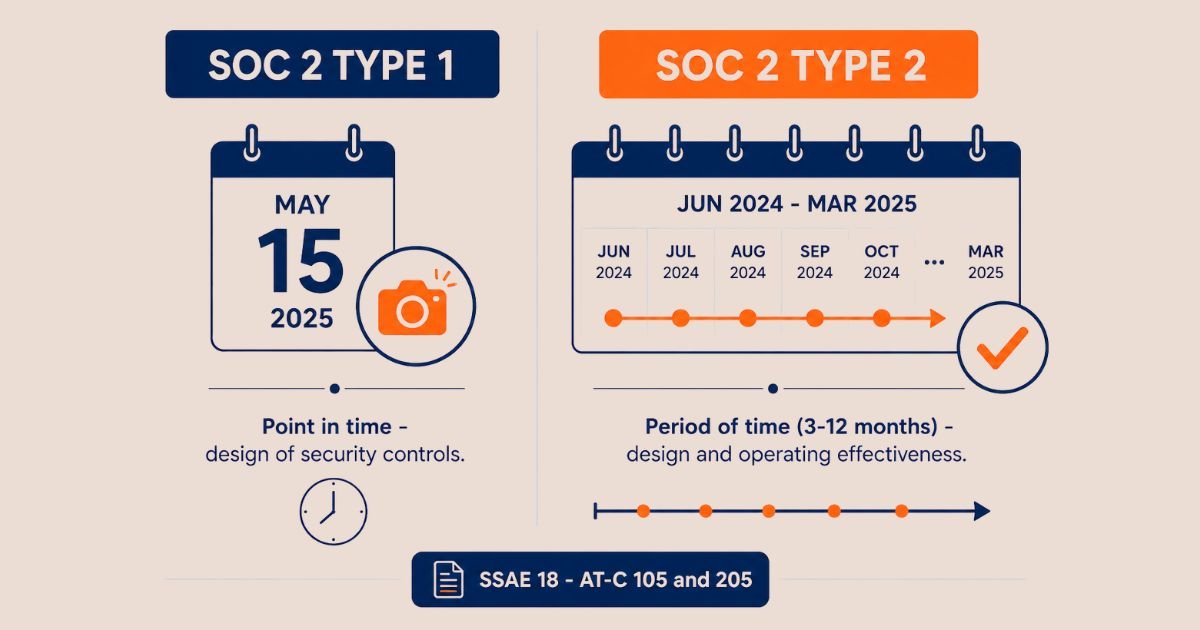
| Time frame | A single point in time (one specific date) | A period of time (usually three to twelve months) |
| Testing of controls | Controls are described and their design is checked, but not tested over time | Controls are tested to see how well they actually worked across the whole period |
| Time to complete | Often a matter of weeks | Longer, because it needs an observation period |
| Typical use | A fast first step to show customers you are on the way | The report most customers ultimately require |
| Level of assurance | Lower, because it is only a snapshot | Higher, because it shows controls worked over time |
SOC 2 Type 1 report - a point in time
A SOC 2 Type 1 report looks at your controls on one specific date. The auditor checks whether your security controls are designed properly and are in place as of that date. It does not test whether those controls actually operated over a period.
Because it is a snapshot, a Type 1 gives a lower level of assurance, but it is fast, often completed in weeks. Many companies get a Type 1 when a customer needs proof quickly, or when they are new to SOC 2 and want to show progress while they work towards a Type 2.
SOC 2 Type 2 report - a period of time
A SOC 2 Type 2 report goes further. It covers a period of time, usually three to twelve months, and the auditor tests whether your controls actually operated effectively across that whole period, not just whether they were designed well.
This is why "SOC 2 Type 2" is by far the most searched term in this area. A Type 2 answers the stronger question customers care about: "Over the last several months, did these security controls really work the way they are supposed to?" Because it involves real testing over time, a SOC 2 Type 2 report carries far more weight with customers, and it is the report most enterprise buyers insist on. A SOC 2 Type 2 report is sometimes written as SOC 2 Type II.
Which one do you need first?
If a customer needs assurance fast, a Type 1 can act as a short-term solution while you build towards a Type 2. But be aware that many enterprise customers reject a Type 1 on its own and ask for a Type 2. If you already have your controls running well, it can make sense to go straight to a Type 2 with a shorter observation window rather than pay for two separate audits.
The five Trust Services Criteria
What makes SOC 2 different from every other SOC report is that it is built on five areas called the Trust Services Criteria (TSC), defined by the AICPA. Your auditor tests your controls against the criteria you choose. You do not have to include all five.
| Criterion | What it covers | Required? |
| Security | Protecting systems and data against unauthorised access, disclosure, and damage. Also called the Common Criteria. | Yes, always |
| Availability | Whether your systems are up and available as promised in your service level agreements. | Optional |
| Processing Integrity | Whether your system processes data completely, accurately, and on time. | Optional |
| Confidentiality | Protecting information that is meant to stay confidential, such as business data and IP. | Optional |
| Privacy | How you collect, use, keep, and dispose of personal information (PII). | Optional |
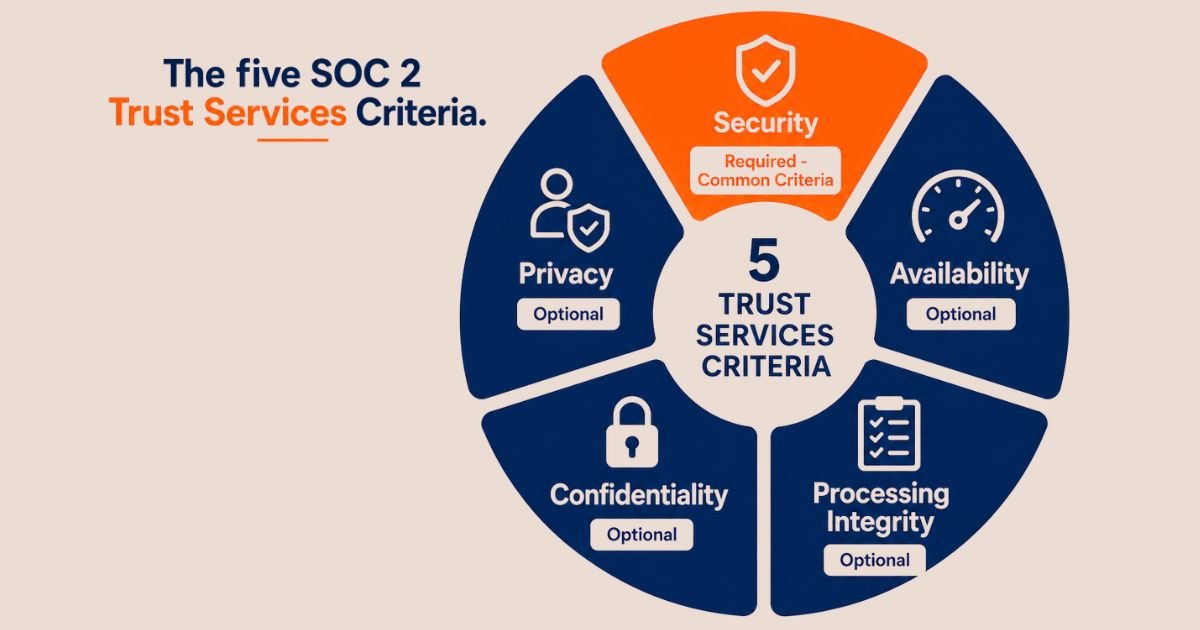
Security is the only criterion required in every SOC 2 report. It is known as the Common Criteria and is made up of nine sections (CC1 to CC9) that align with the COSO internal control framework. You add the other four only if they match what you promise customers and the kind of data you handle. A company that sells an uptime guarantee usually adds Availability. A company that handles a lot of personal data usually adds Privacy. Each extra criterion adds audit work, so most companies start with Security and expand over time.
SOC 1 vs SOC 2 (and SOC 3)
SOC 1 and SOC 2 use a similar audit approach, but they cover different things and are meant for different readers. The simple way to remember it: SOC 1 is about money, SOC 2 is about data.
| Report | Focus | Who it is for |
| SOC 1 | Controls that affect a client's financial reporting | Clients and their financial auditors |
| SOC 2 | Security, availability, processing integrity, confidentiality and privacy of data | Customers and their security and vendor-risk teams |
| SOC 3 | The same subject as SOC 2, but a short public summary | The general public (can be shared openly) |
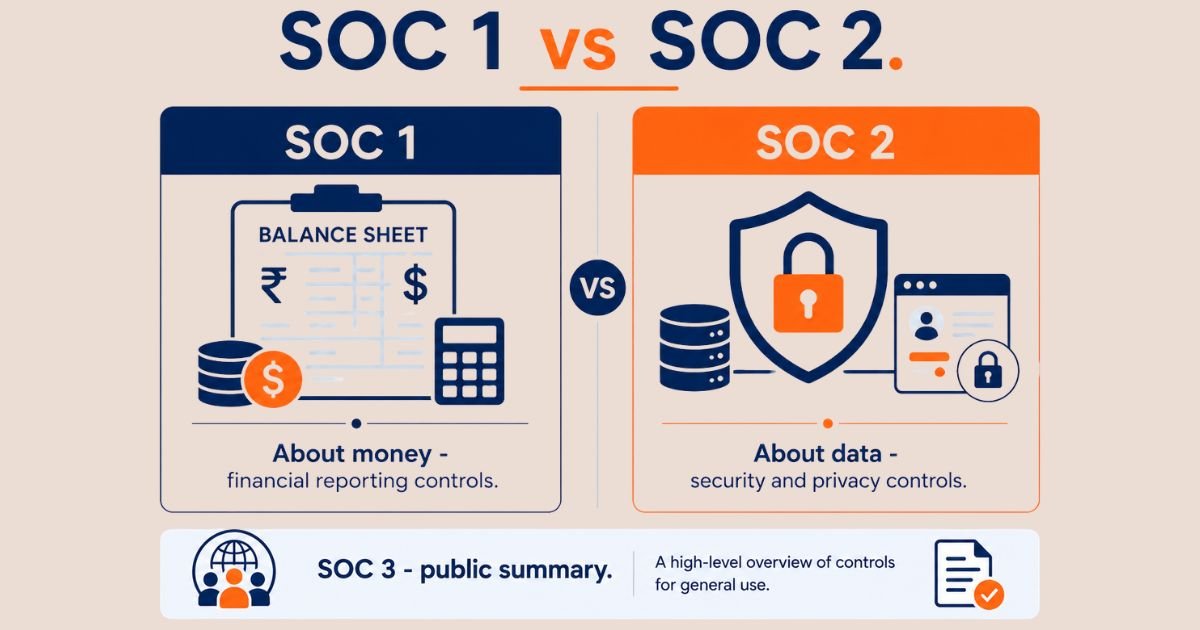
If your service affects your customers' financial numbers, you need SOC 1. If your customers care about how you protect their data, you need SOC 2. Some companies need both. We cover SOC 1 in detail on our SOC 1 report page.
The SOC 2 audit process
The path to a SOC 2 report usually follows these steps.
- Choose your criteria. Decide which Trust Services Criteria apply to your business. Security is always in; you add others based on customer needs.
- Readiness review. Check your current controls against the criteria and find any gaps.
- Fix the gaps. Put in place or improve any missing or weak controls.
- Type 1 report (optional first step). A CPA firm checks that controls are designed and in place as of a chosen date.
- Observation period. For a Type 2, controls run for a period of time, usually three to twelve months.
- Type 2 testing and report. The CPA firm tests how well the controls operated over that period and issues the SOC 2 Type 2 report.
What a SOC 2 report contains
A SOC 2 report is a formal document, not a certificate or a logo. A typical SOC 2 report contains these main sections:
- The auditor's opinion. The CPA firm's formal opinion on whether the controls are suitably designed (and, for Type 2, operating effectively).
- Management's assertion. A written statement from your company's management about the system and its controls.
- Description of the system. An explanation of the service you provide and the controls around it.
- Trust Services Criteria, controls, and tests. For a Type 2, this section also shows the tests the auditor performed and the results.
- Other information. Any additional details the service organization chooses to include.
SOC 2 for Indian companies and startups
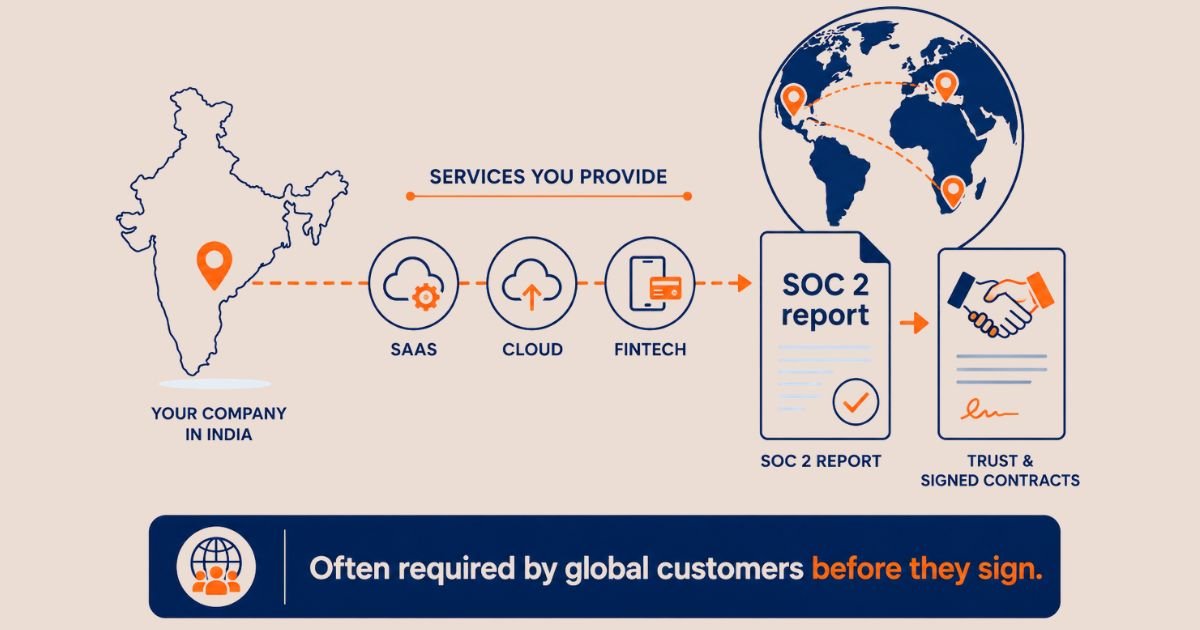
SOC 2 is a US standard, but it matters a great deal to Indian companies, especially SaaS startups. If you sell software or services to customers in the US, UK, or Europe, their security and procurement teams will very often ask for a SOC 2 report before signing, and again at renewal. For many Indian SaaS startups, a SOC 2 Type 2 report is effectively the price of doing business with larger overseas customers.
To be clear and honest: a SOC 2 report is issued by a licensed CPA firm under US attestation standards. It is not something an Indian government department issues, and there is no statutory fee for it. What an Indian company needs is the right choice of criteria, controls that are genuinely in place, and coordination with a suitable audit firm. That is where we can help.