ISO Certification for Hospitals and Healthcare
ISO certification for hospitals and healthcare providers validates adherence to global quality, safety, and operational standards. It helps healthcare organisations reduce medical errors, protect patient data, manage clinical risks, and demonstrate compliance with accreditation and insurance empanelment requirements. eFilingCompany helps hospitals, clinics, medical laboratories, and healthcare providers across India achieve ISO certification efficiently.


2000
Happy Clients

1500
Expert Advisors

2+
Branch Offices
Free Consultation by Expert
.png)


.png)
.png)
Which ISO Standards Apply to the Healthcare Industry and How to Get Certified in India
ISO certification for hospitals and healthcare providers validates adherence to global quality, safety, and operational standards. These internationally recognised frameworks help healthcare organisations reduce medical errors, protect patient data, manage clinical risks, and demonstrate compliance with accreditation and insurance empanelment requirements.
The International Organisation for Standardisation (ISO) publishes standards that are applicable to the healthcare sector. Certification is granted by accredited third-party certification bodies — not by ISO itself. ISO certification is not mandatory for all hospitals in India, but it is increasingly required by government tenders, insurance companies, and healthcare procurement agencies as a condition of empanelment.
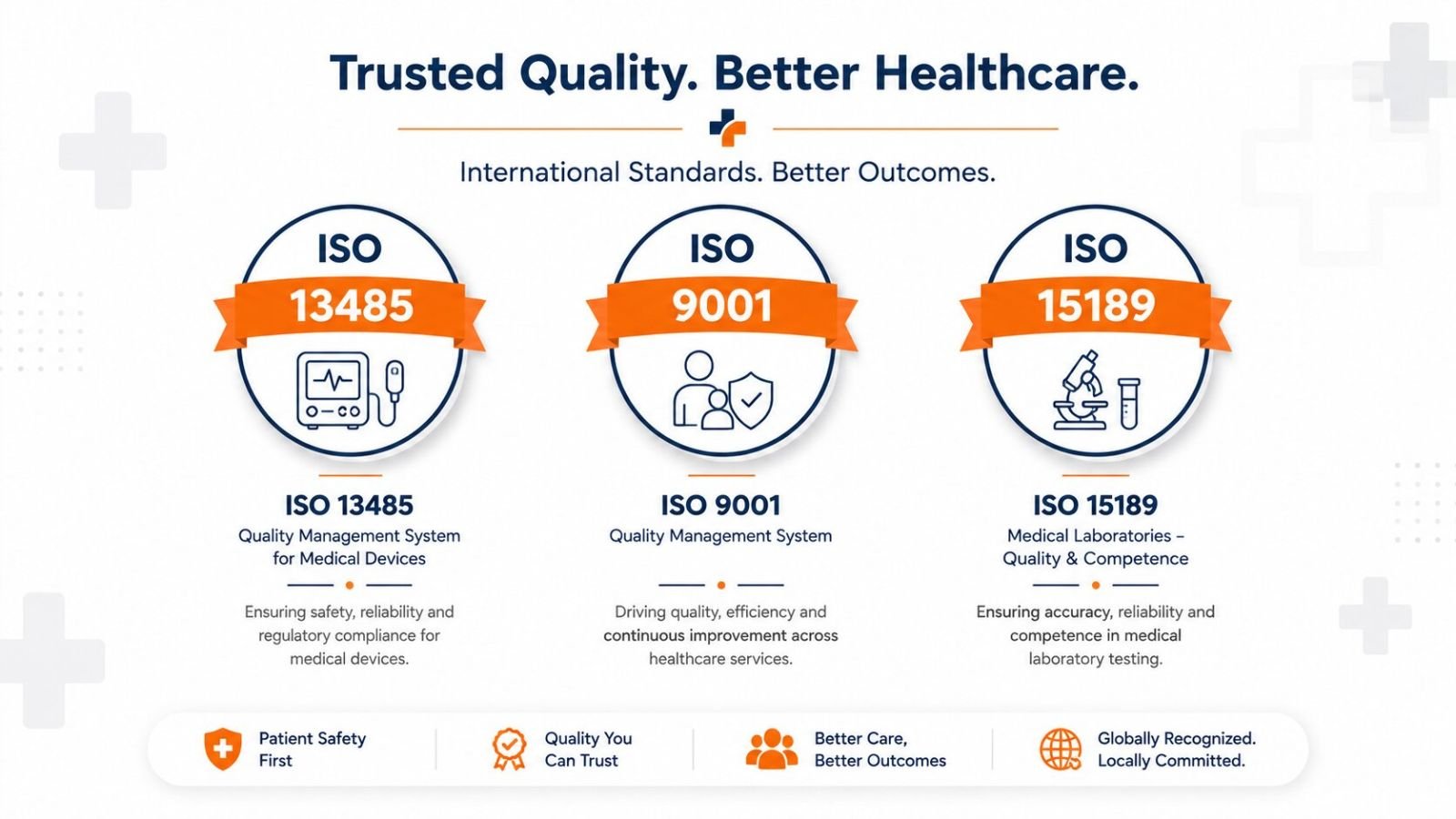
ISO 9001:2015 is the most commonly used and widely recognised ISO standard for hospitals. It provides a model for a quality management system that focuses on the effectiveness of clinical, business, and support processes — ensuring high quality care is provided to patients consistently.

| ISO Standards Applicable to Hospitals and Healthcare |
| ISO Standard | Full Name | Relevance to Healthcare |
| ISO 9001:2015 | Quality Management System | Baseline standard for clinical and administrative processes — most commonly used ISO standard for hospitals. Focuses on patient satisfaction, service consistency, and continuous improvement |
| ISO 13485:2016 | Medical Devices Quality Management System | For organisations that design, produce, distribute, or maintain medical devices and equipment. Required by regulatory authorities for medical device quality management compliance |
| ISO 15189:2012 | Medical Laboratories — Requirements for Quality and Competence | Tailored specifically to medical laboratories. Ensures laboratories provide accurate and reliable diagnostic results, contributing directly to patient care and diagnosis |
| ISO 45001:2018 | Occupational Health and Safety Management System | Protects healthcare workers from biological hazards, needle-stick injuries, chemical exposures, and physical risks in hospital and clinical environments |
| ISO/IEC 27001:2022 | Information Security Management System | Protects electronic health records, patient data, and clinical information systems. Addresses growing cybersecurity risks in healthcare organisations |
| ISO 14001:2015 | Environmental Management System | Helps healthcare facilities manage medical waste, chemical disposal, energy use, and compliance with biomedical waste management regulations |
| ISO 22301:2019 | Business Continuity Management System | Ensures healthcare services remain available during emergencies, power failures, and IT system disruptions — critical for hospitals providing continuous care |
| ISO 27701:2019 | Privacy Information Management System | For healthcare organisations handling patient personal data — demonstrates compliance with data protection regulations applicable to health information |
| ISO 7101:2023 | Healthcare Organisation Management | Provides requirements and guidance for quality management systems specific to healthcare organisations, focusing on patient-centred care and clinical governance |
| Key Benefits of ISO Certification for Hospitals |
| Enhances Patient Safety and Quality of Care ISO certification develops standardised processes for patient care that minimise medical errors and improve patient outcomes. Policies and procedures are continuously measured and improved for the best possible care. |
Enhances Efficiency It streamlines the efficiency of the systems within a hospital, including doctors, nurses, employees, and the community. Standardised processes reduce duplication and improve operational performance across all departments. |
| Builds Trust and Credibility ISO certification creates confidence among patients and stakeholders that the hospital follows globally recognised standards. It is beneficial to all the stakeholders of the business — patients, doctors, and the community. |
Aids in Compliance and Performance ISO certification assists hospitals in meeting international and national legal requirements, accreditation standards, and regulatory requirements. It helps prevent incidents and identify areas for improvement in clinical processes. |
| Supports Insurance and Government Empanelment ISO certification is a condition required by many insurance companies and government healthcare procurement agencies for hospital empanelment. It strengthens the credibility of the healthcare provider. |
Enhances Reputation and Performance ISO certification assists hospitals in finding the best way to optimise their overall performance. It signals compliance with global benchmarks and instils confidence in patients, insurers, and institutional buyers. |

Expertise in ISO Certification for Hospitals and Healthcare

Enquiry Form
Among Asia Top
100
Consulting Firm

Get Consultation
Lowest Fees
100,000 + Clients.

Service Delivery
4.9 Customers Rating
50+ Offices
Contact us today to schedule your appointment.
You can call us on +919953004880 or write to us at info@efilingcompany.com
| Key Challenges ISO Certification Addresses in Healthcare |
| Ensuring Consistent Patient Safety and Clinical Quality Machinery, tool, and instrument standards of use across clinical departments, labs, and wards, as well as care protocols, need consistent monitoring. An ISO quality management system helps hospitals maintain safety, efficiency, and continuous patient care standards. |
Protecting Patient Data and Health Information Electronic health records and digital clinical systems require constant protection. Patient data breaches in healthcare organisations require circuit information security management capabilities, addressed by ISO/IEC 27001:2022. |
| Managing Infection Control and Biological Hazards Healthcare environments create significant infection and biological hazard risks, particularly in ICUs, labs, and operation theatres. ISO 45001 helps healthcare organisations establish safety management systems that maintain strict infection prevention standards. |
Managing Medical Waste and Environmental Compliance Biomedical waste requires careful handling, segregation, and disposal. Healthcare facilities that fail to manage environmental risks create compliance and public health problems. ISO 14001 provides a framework for responsible environmental management in healthcare. |
| Retaining Skilled Healthcare Workers in Safe Environments Retaining staff in a safe work environment is a significant concern. Structured occupational health systems, as required under ISO 45001, help healthcare organisations demonstrate care for employee wellbeing. |
Meeting Accreditation and Insurance Empanelment Requirements Insurance companies and accreditation bodies increasingly require ISO certification as evidence of quality and compliance. ISO certification helps hospitals and healthcare providers win insurance empanelments and meet the conditions of accreditation bodies. |
| ISO Certification Process for Hospitals in India |
| 1 | Identify the Applicable ISO Standard — Choose the most relevant ISO standard based on your healthcare organisation's nature of operations. For example, ISO 15189 for medical laboratories; ISO 13485 for medical device facilities; ISO 9001 for hospitals and clinics broadly |
| 2 | Gap Analysis — Assess your current practices and processes against the requirements of the selected ISO standard. Identify areas where improvements are required to meet the standard's criteria |
| 3 | Implementation — Make modifications to your organisation's processes, policies, and procedures to align with the ISO standard's requirements. This involves implementing new quality management systems, documentation, and training programmes |
| 4 | Documentation — Develop and maintain the required documentation including quality manuals, procedures, work instructions, and records. These documents prove your organisation's compliance with the ISO standard |
| 5 | Training and Awareness — Train all staff on the ISO standard's requirements and implement changes. Ensure all employees understand their roles in maintaining compliance |
| 6 | Internal Audit — Conduct internal audits to assess your organisation's compliance with the ISO standard. Identify areas where improvements can be made and corrective actions can be taken |
| 7 | Stage 1 Audit (External) — An accredited certification body conducts a Stage 1 audit reviewing your documentation and management system to identify any outstanding non-conformances |
| 8 | Stage 2 Audit (External) — The certification body verifies that all processes are fully implemented and effective. If satisfied, it prepares the final ISO audit report and forwards it to the registrar |
| 9 | Certificate Issuance — The ISO certificate is issued upon satisfactory completion of the Stage 2 audit. The certificate is valid for 3 years |
| 10 | Surveillance Audits and Ongoing Compliance — Periodic surveillance audits are conducted by the certification body to ensure your organisation continues to meet ISO data management standards throughout the 3-year validity period |
| Documents Required for ISO Certification in Healthcare |
| Quality Policy | Legal and statutory compliance certificate |
| ISO Manual | Procedure Documents |
| ISO Manuals and Records | Defines documentation of the management system |
| Corrective and Preventive Action (CAPA) Documents | Guidelines for addressing identified non-conformances and improvements |
| Timeline and Validity for ISO Certification in Healthcare |
| Factor | Details |
| Certification Timeline | Generally 3 to 6 months depending on the size and complexity of the healthcare organisation |
| Certificate Validity | ISO certification is generally valid for 3 years, subject to annual surveillance audits |
| Surveillance Frequency | Periodic surveillance audits conducted throughout the 3-year validity period |
| Re-certification | Re-certification audit required at the end of the 3-year validity period to renew the certificate |
| Related ISO Certifications |
| ISO 13485 Certification | ISO 9001 Certification |
| ISO 27001 Certification | ISO 45001 Certification |
| ISO 14001 Certification | ISO Certifications |