ISO Certification in Qatar
A complete, up-to-date guide to getting ISO certified in Qatar — covering the standards that matter most, the step-by-step audit process, typical costs, and the tender and accreditation requirements every business should understand. Whether you're preparing for a QatarEnergy or Ashghal prequalification, entering a regulated sector, or building credibility with international clients, this guide shows you exactly how ISO certification works in Qatar in 2026.


2000
Happy Clients

1500
Expert Advisors

2+
Branch Offices
Free Consultation by Expert
.png)


.png)
.png)
Why Does ISO Certification Matter in Qatar?
Qatar's market is becoming more competitive, more regulated and more closely tied to international supply chains. From construction and energy to healthcare, logistics, IT and education, organisations are increasingly expected to prove they can manage quality, safety, compliance and operational consistency in a structured way.
That is why ISO certification in Qatar is now more than a business-improvement exercise. It is often part of how companies build trust, qualify for projects, and stay competitive — and it aligns directly with Qatar National Vision 2030, which prioritises economic diversification, sustainability and stronger institutional performance. Today, businesses in Qatar pursue ISO certification to:


Expertise in ISO Certification in Qatar

Enquiry Form
Among Asia Top
100
Consulting Firm

Get Consultation
Lowest Fees
100,000 + Clients.

Service Delivery
4.9 Customers Rating
50+ Offices
Contact us today to schedule your appointment.
You can call us on +919953004880 or write to us at info@efilingcompany.com
Who Oversees Standards and Accreditation in Qatar?
Qatar's national standards body is the Qatar General Organization for Standardization (QS), re-established under Emiri Decision No. 44/2014. QS develops and publishes Qatari and Gulf standards, operates conformity assessment, and accredits laboratories and non-governmental bodies. It also represents Qatar at international bodies including ISO, IEC and the GCC Standardization Organization (GSO).
For management-system certificates such as ISO 9001, the practical mark of credibility is accreditation. A certificate issued by a body accredited through a recognised route — such as the GCC Accreditation Center (GAC), UKAS, or another IAF member — is the kind accepted by Qatari clients, government entities and international partners. This matters most when your certificate will be reviewed during tenders, supplier approvals or client audits.
Which ISO Standards Are Most Common in Qatar?
The right standard depends on your industry, client expectations and tender requirements. These are the standards most frequently requested across Qatar:
| Standard | Management System | Best For |
|---|---|---|
| ISO 9001 | Quality Management (QMS) | Construction, manufacturing, logistics, healthcare |
| ISO 14001 | Environmental Management (EMS) | Construction, industrial operations, energy |
| ISO 45001 | Occupational Health & Safety | Construction, engineering, oil & gas |
| ISO 27001 | Information Security (ISMS) | IT, finance, telecom, healthcare |
| ISO 22000 | Food Safety (FSMS) | Catering, hospitality, food import & processing |
| ISO 37001 | Anti-Bribery Management | Corporate, contracting, government-linked work |
ISO 9001 Certification in Qatar
ISO 9001 certification in Qatar is the most widely adopted standard. It certifies a Quality Management System and is the certification most often requested during supplier registration and tender prequalification. For most businesses in Qatar, ISO 9001 is the natural starting point before adding sector-specific standards.
ISO 45001 Certification in Qatar
ISO 45001 certifies an Occupational Health & Safety Management System. In Qatar's construction, engineering and oil & gas sectors — where site safety is heavily scrutinised by contractors like Ashghal and QatarEnergy — it is frequently essential for project work and prequalification.
ISO 27001 Certification in Qatar
ISO 27001 certifies an Information Security Management System and is the fastest-growing certification demand in Qatar. Qatar's Personal Data Privacy Protection Law, QFC compliance expectations and international client pressure make it a practical necessity for technology, finance and professional-services firms in Doha.
ISO 14001 & ISO 22000 Certification in Qatar
ISO 14001 certifies an Environmental Management System, important for industrial, energy and construction firms aligning with Vision 2030 sustainability goals. ISO 22000 (and HACCP) certifies food safety across the supply chain for Qatar's catering, hospitality and food-import businesses.
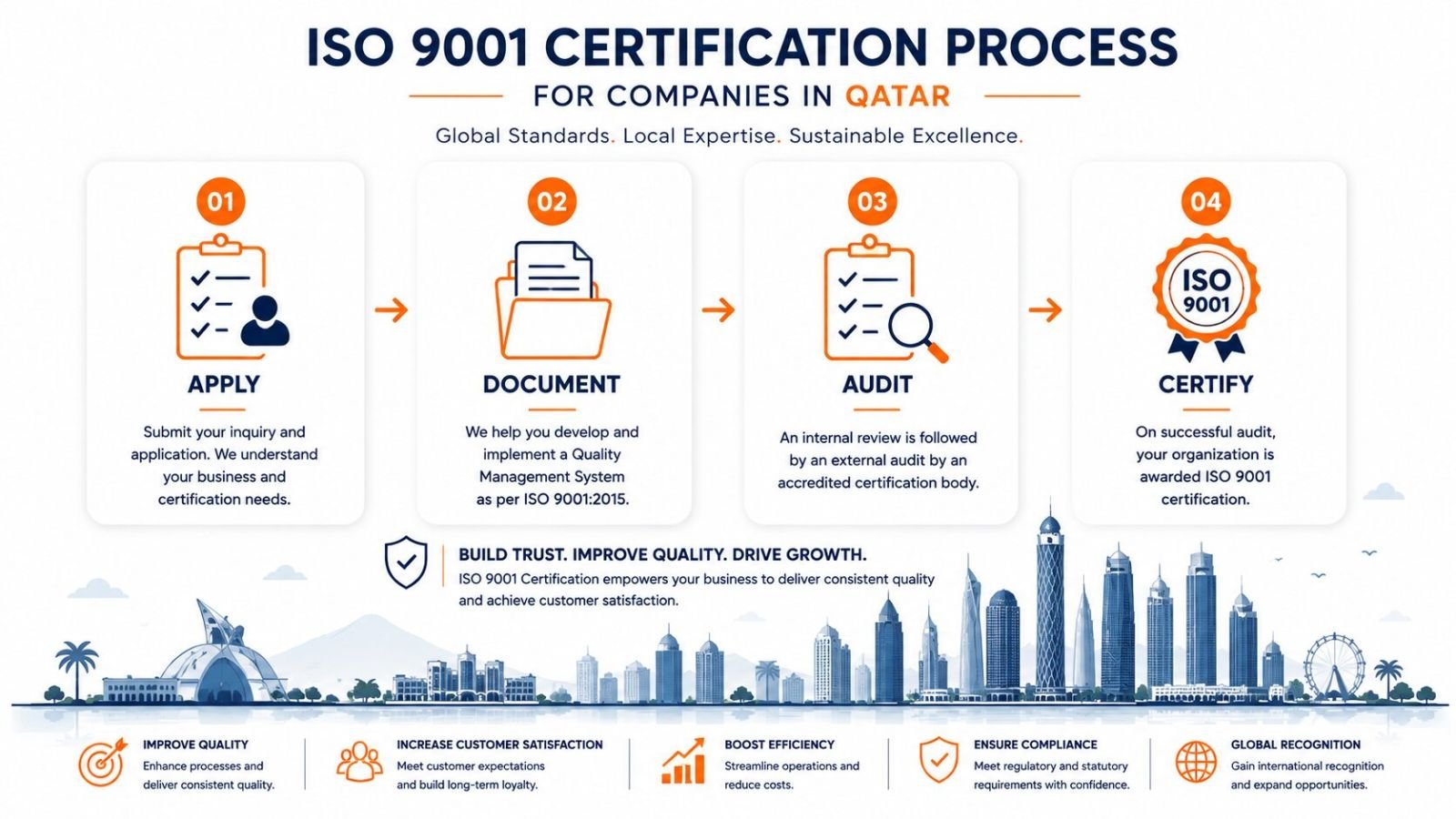
How Does the ISO Certification Process Work in Qatar?
The process follows a structured, internationally consistent path. Understanding each step helps you plan timelines and avoid surprises during the audit.
Choose the Right Standard
Identify which ISO standard matches your business activities, industry risks and client or tender requirements.
Gap Analysis & Documentation
Compare current practices against the standard, then develop the policies, procedures and records the system requires — based on how your business actually works.
Implementation & Staff Awareness
Roll out the system and train employees on their roles, so the management system is genuinely embedded rather than existing only on paper.
Internal Audit & Management Review
Run an internal audit and management review to find nonconformities and confirm readiness for the external certification audit.
Certification Audit (Stage 1 & Stage 2)
An accredited certification body conducts a two-stage audit: Stage 1 reviews documentation and readiness; Stage 2 evaluates how effectively the system works in practice. On success, your certificate is issued.
Surveillance & Ongoing Compliance
Certification is valid for three years, subject to annual surveillance audits. A recertification audit renews it at the end of the cycle.
How Much Does ISO Certification Cost in Qatar?
There is no single fixed price for ISO certification in Qatar. The cost depends on the factors below, which is why reputable providers give a quote only after a short assessment of your organisation:
Organisation Size & Sites
More employees and multiple locations increase audit days and therefore cost.
Choice of Standard
ISO 9001 is generally the most economical; complex standards like ISO 27001 cost more.
Current Readiness
If good processes already exist, fewer gaps need closing, which lowers the cost.
Accreditation Level
Accredited certificates cost slightly more but are accepted for tenders; non-accredited ones are cheaper but often rejected.
The total typically covers consultancy support, the certification body's audit fee, and ongoing surveillance audits over the three-year cycle. Avoid choosing on price alone — the credibility of the certification body strongly affects how clients and tender authorities view your certificate.
ISO Certification for Tenders in Qatar
Many tenders and supplier-registration processes in Qatar require or strongly prefer ISO-certified companies — particularly in construction, infrastructure, oil & gas, engineering and facility management. Organisations seeking vendor approval with bodies such as QatarEnergy, Ashghal (Public Works Authority) and the Ministry of Public Health (MOPH) are often asked to submit ISO certificates, audit reports, HSE documentation and quality procedures.
For most Qatar tenders, the core combination is ISO 9001 (quality), ISO 45001 (safety) and often ISO 14001 (environment). Without recognised, accredited certification, businesses may be unable to qualify for larger projects or approved-supplier lists.
How to Choose the Right ISO Certification Body in Qatar
The certification body you choose determines whether your certificate is genuinely recognised. Before applying, check the following:
Recognised Accreditation
Confirm the body is accredited via a recognised route (GAC, UKAS or another IAF member) and that the scope covers your industry.
Local Support in Qatar
A provider with a presence in Doha offers faster coordination, local audit support and a better understanding of Qatari sector expectations.
Relevant Audit Experience
Look for experience in your sector — construction, oil & gas, IT, healthcare — so the audit reflects real operational requirements.
Transparency & Support
Clear timelines, no hidden charges, and post-certification support for surveillance and recertification.
Common Mistakes to Avoid When Getting ISO Certified in Qatar
Choosing the wrong standard. Match the standard to your industry, risks and tender requirements rather than picking the most familiar one.
Focusing only on paperwork. A system that looks good on paper but isn't used in practice will fail audits and deliver no real value.
Using a non-accredited certificate. Cheaper certificates from weakly accredited bodies often cause problems during tenders and client audits in Qatar.
Treating certification as one-time. ISO is an ongoing system maintained through surveillance audits and continual improvement, not a single event.
Planning to Get ISO Certified in Qatar?
We help businesses across Qatar choose the right standard and achieve certification through accredited bodies — whether you're preparing for a QatarEnergy or Ashghal prequalification or building trust with international clients. Get a free consultation to understand the process, timeline and cost for your business.
Get a Free Consultation