ISO 17025 Certification
ISO/IEC 17025 is the global benchmark standard for the competence, impartiality, and consistent operation of testing and calibration laboratories. eFilingCompany helps testing and calibration laboratories across India understand and navigate the ISO/IEC 17025 accreditation process.


2000
Happy Clients

1500
Expert Advisors

2+
Branch Offices
Free Consultation by Expert
.png)


.png)
.png)
ISO 17025 Certification — ISO/IEC 17025:2017 Accreditation for Testing and Calibration Laboratories in India
ISO/IEC 17025 is the global benchmark standard for the competence, impartiality, and consistent operation of testing and calibration laboratories. The current version is ISO/IEC 17025:2017 (third edition), published jointly by the International Organisation for Standardisation (ISO) and the International Electrotechnical Commission (IEC).
ISO/IEC 17025:2017 enables laboratories to demonstrate that they operate competently and generate valid results — thereby promoting confidence in their work, facilitating global trade, and enabling mutual acceptance of test data across international markets.
It is applicable to all organisations performing laboratory activities regardless of the number of personnel — including research laboratories, manufacturing quality control labs, regulatory testing labs, and service laboratories across sectors including chemical, construction, automotive, aerospace, electrical, food, and pharmaceutical testing.

Expertise in ISO 17025 Certification

Enquiry Form
Among Asia Top
100
Consulting Firm

Get Consultation
Lowest Fees
100,000 + Clients.

Service Delivery
4.9 Customers Rating
50+ Offices
Contact us today to schedule your appointment.
You can call us on +919953004880 or write to us at info@efilingcompany.com
| Important: Accreditation vs Certification — Know the Difference |
The correct term for ISO/IEC 17025 is accreditation — not certification. While people commonly search for "ISO 17025 certification," the formal process is accreditation.
| Aspect | Accreditation (ISO 17025) | Certification (ISO 9001 etc.) |
| What it confirms | Competence of the laboratory to perform specific testing or calibration activities | That a management system is appropriately functioning |
| Granted by | Authoritative accreditation body (NABL in India; A2LA, UKAS, DAkkS globally) | Third-party certification body |
| Scope | Specific laboratory activities — testing and calibration | Organisation-wide management system |
| International recognition | Via ILAC MRA (International Laboratory Accreditation Cooperation Mutual Recognition Arrangement) | Via IAF MLA (International Accreditation Forum) |
In India, NABL (National Accreditation Board for Testing and Calibration Laboratories) is the accreditation body for ISO/IEC 17025. NABL is a signatory to the ILAC MRA, meaning NABL-accredited laboratory results are recognised internationally.
| Structure of ISO/IEC 17025:2017 — 8 Components |
| Section | Component | What it Covers |
| 1 | Scope | Defines the applicability of the standard to all organisations performing laboratory activities |
| 2 | Normative References | References to other documents indispensable for the application of this standard |
| 3 | Terms and Definitions | Defines terms and abbreviations used throughout the standard |
| 4 | General Requirements | Impartiality and confidentiality obligations of the laboratory |
| 5 | Structural Requirements | Defines the laboratory's legal status, scope, and activities |
| 6 | Resource Requirements | Competent personnel, suitable facilities, and appropriate measuring equipment |
| 7 | Process Requirements | Procedures for testing and calibration activities, handling of test items, and reporting of results |
| 8 | Management System Requirements | Documentation, records, corrective actions, internal audits (section 8.8), and management reviews (section 8.9) |
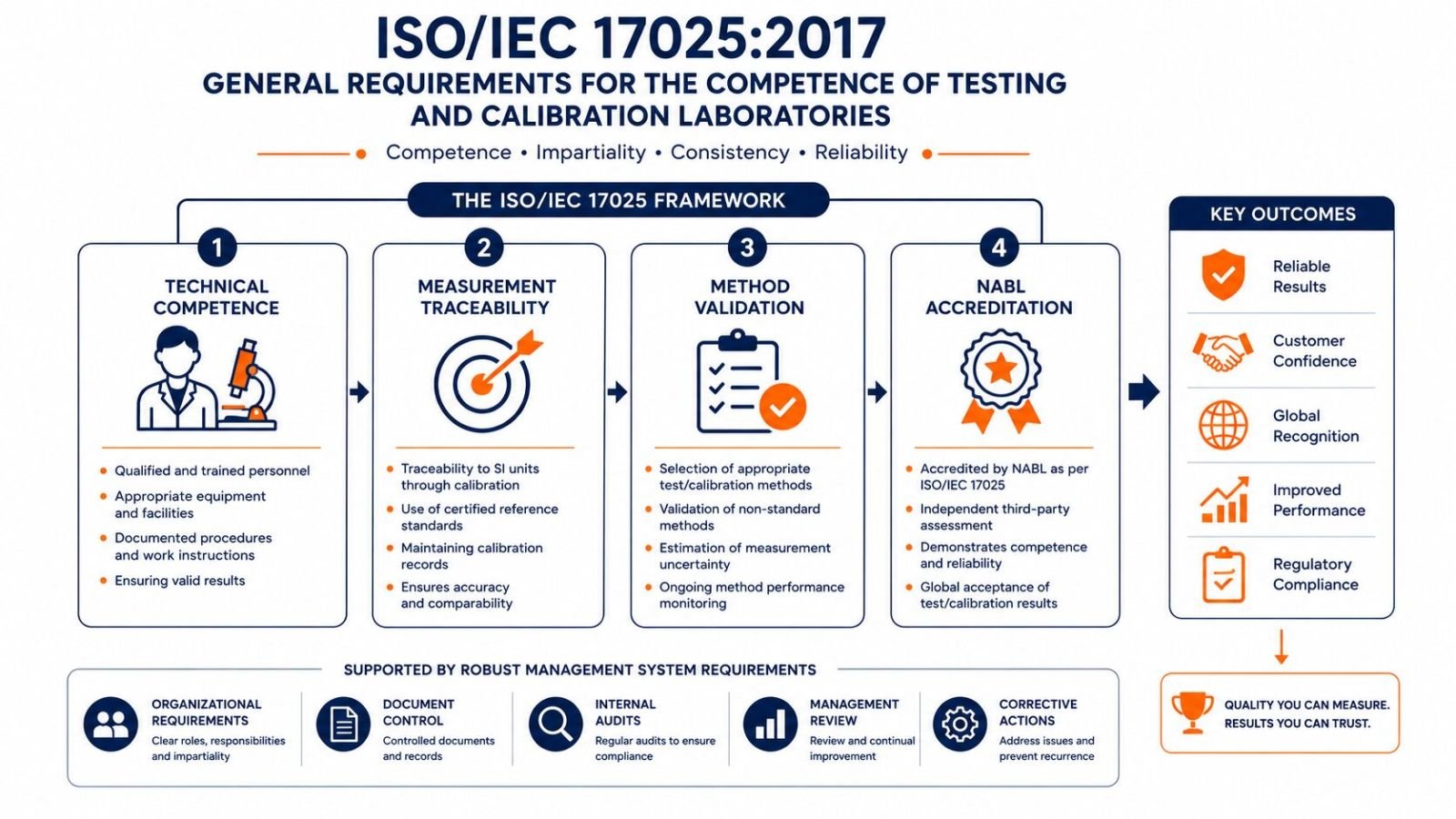
| Benefits of ISO/IEC 17025 Accreditation for Laboratories |
| Global Recognition of Test Results ISO/IEC 17025 accreditation ensures test and calibration results are internationally recognised and accepted across multiple industries and markets, facilitating global trade and enabling mutual acceptance of test data. |
Demonstrates Laboratory Competence Accreditation allows laboratories to ensure and demonstrate the reliability of their results as well as the security, compliance, and verification of their laboratory practices — providing clients and regulators with objective confidence in test results. |
| Increases Market Access ISO/IEC 17025 accreditation increases the number of clients the laboratory can work with across different industries. Many regulatory and commercial clients require accreditation as a condition of accepting test results or awarding contracts. |
Supports Regulatory Compliance It can be essential for professions involving regulatory testing, where accredited laboratory results serve as the sole reliable indicator of laboratory capability. Regulatory authorities in many sectors require ISO/IEC 17025 accredited test results. |
| Improves Internal Processes Becoming ISO/IEC 17025 accredited showcases your organisation's commitment to quality and the integrity of its work, driving better personnel standards, consistent operations, and a competitive advantage by providing assurance in the quality of testing with the objective of promoting confidence in test results. |
Enables Constructive Industry Partnerships Being an accredited laboratory means having a better group of personnel and a global plan to be consistent — enabling constructive partnerships with other companies and organisations managing measurement results across sectors. |
| ISO/IEC 17025 vs ISO 15189 — Key Differences |
| Aspect | ISO/IEC 17025:2017 | ISO 15189 |
| Designed For | All testing and calibration laboratories across all sectors | Medical and clinical laboratories specifically |
| Sectors Covered | Chemical, construction, automotive, aerospace, electrical, food, pharmaceutical, environmental testing | Medical diagnostic testing, clinical pathology, haematology, microbiology |
| Focus | Competence, impartiality, and consistent operation of testing and calibration activities | Competence and quality of medical testing — contributing to patient care and diagnosis |
| India Accreditation Body | NABL (National Accreditation Board for Testing and Calibration Laboratories) | NABL (National Accreditation Board for Testing and Calibration Laboratories) |
| Who Should Apply for ISO/IEC 17025 Accreditation? |
| Testing laboratories in chemical, food, pharmaceutical, and environmental sectors | Calibration laboratories providing measurement and instrument calibration services |
| Research and development laboratories requiring internationally recognised test data | Manufacturing quality control laboratories supplying test results to regulated industries |
| Government and regulatory testing laboratories | Laboratories supplying test results for export certification and international trade |
| Aerospace and automotive testing and inspection laboratories | Forensic, construction material, and electrical testing laboratories |
| ISO/IEC 17025 Accreditation Process — 10 Steps |
| 1 | Understand Accreditation — Understand the difference between accreditation and management system certification. ISO/IEC 17025 requires accreditation, not certification. In India, NABL is the relevant accreditation body |
| 2 | Obtain a Copy of the Standard — Obtain a copy of ISO/IEC 17025:2017 and familiarise yourself with its requirements. The most essential components are the Resource, Process, and Management System Requirements |
| 3 | Determine Training Needs — Provide general ISO/IEC 17025 training to all laboratory personnel. Training can be done in-house or through a public venue, and a variety of training options can be found through a simple internet search |
| 4 | Begin Documentation — Document all policies, procedures, programs, and instructions to ensure consistent application and quality results. Documentation should provide objective evidence of detail found in your laboratory's procedures |
| 5 | Implement Updated Policies, Processes, and Procedures — Once documented, implement your policies through thorough record keeping and showing that the processes and procedures have indeed been followed |
| 6 | Conduct an Internal Audit — Per section 8.8 of ISO/IEC 17025, an internal audit must be conducted prior to the accreditation body assessment by a qualified internal auditor. The purpose is to determine if the laboratory is in compliance with both the requirements of ISO/IEC 17025 and the management system documentation requirements |
| 7 | Perform Management Review — Per section 8.9 of ISO/IEC 17025, the laboratory must complete a management review at planned intervals. This is typically conducted by the laboratory's top management, which has the authority and responsibility to make changes based on corrective actions, complaints, feedback, and other inputs |
| 8 | Evaluate Accreditation Bodies — Select an accreditation body that is a signatory of the ILAC MRA (International Laboratory Accreditation Cooperation Mutual Recognition Arrangement). In India, NABL is the relevant accreditation body and is a signatory to the ILAC MRA — meaning NABL-accredited results are recognised internationally |
| 9 | Apply for Accreditation — Apply to the selected accreditation body. The accreditation body will identify any significant issues, carry out assessments, and determine the scope and conditions of your accreditation |
| 10 | Maintain and Market Your Accreditation — Accreditation is subject to surveillance assessments — typically 1, 2, or 3 times per year depending on the outcome of the previous assessment. Promote your accreditation to clients through all available channels |
| ISO/IEC 17025 Certified Lead Auditor — Individual Professional Certification |
In addition to laboratory accreditation, individual professionals working in or with testing and calibration laboratories can pursue the ISO/IEC 17025 Certified Lead Auditor certification. This professional certification is offered by accredited bodies such as GAQM (Global Association for Quality Management).
| Aspect | Details |
| Target Audience | Professionals working in or with a laboratory, ISO Managers, Internal/3rd Party Auditors, Process Owners, Improvement Specialists, Procurement Professionals, Training Professionals |
| Course Coverage | ISO/IEC 17025 requirements, quality management system audit against ISO/IEC 17025:2017, technical systems and issues of accredited laboratories, principles and concepts of ISO 19011 |
| Exam Validity | Exam voucher validity: 240 days; 2 attempts permitted |