Home ISO Certifications ISO 45001 Certification

ISO 45001 Certification

Expert ISO 45001 Occupational Health & Safety Management System (OHSMS) certification consulting across India. Get certified in 60โ€“90 days with full documentation, training, and audit support.

Call Now googlereview    trustpilot

2000 + Happy Customer

2000

Happy Clients

1500 + Expert Advisors

1500

Expert Advisors

2 + Branch Offices

2+

Branch Offices

Free Consultation by Expert

What is ISO 45001 Certification?

ISO 45001 is the internationally recognised standard for Occupational Health and Safety Management Systems (OHSMS). It was published by the International Organization for Standardization (ISO) in March 2018 and is the world's first international standard of its kind.

The standard gives organisations a proven framework to proactively prevent work-related injuries, illnesses, and fatalities — rather than reacting after accidents happen. It replaced the older OHSAS 18001, which was officially withdrawn in March 2021 and is no longer valid.

According to the International Labour Organization (ILO), India records approximately 48,000 fatal workplace accidents every year. ISO 45001 provides a structured, audited system that significantly reduces workplace incidents — typically by 20–40% within the first year of implementation.

Full Form: ISO 45001 stands for “International Organization for Standardization — Standard 45001.” OHSMS stands for “Occupational Health and Safety Management System.”

๐Ÿ“…
Published
March 2018 — replaces OHSAS 18001
๐ŸŒŽ
Applicable To
Any org, any size, any industry
๐Ÿ”„
Methodology
Plan-Do-Check-Act (PDCA)
๐Ÿ”—
Integrates With
ISO 9001 & ISO 14001 (Annex SL)
โœ“
Certificate Valid
3 years with annual surveillances
๐Ÿ›
Issued By
IAF-accredited certification bodies
โœ… What ISO 45001 IS
โœ“An international standard for workplace occupational health & safety management
โœ“Applicable to any organisation — any size, any sector, anywhere in the world
โœ“A proactive framework to identify and remove risks before accidents happen
โœ“The direct replacement for OHSAS 18001 (withdrawn March 2021)
โœ“Aligned with ISO 9001 & ISO 14001 via the same Annex SL structure for easy integration
โœ“Required for government tenders (CPWD, NHAI, PWD contracts) across India
โœ“Internationally recognised in 100+ countries via the IAF Multilateral Recognition Arrangement
โœ“Valid for 3 years with mandatory annual surveillance audits in Year 1 and Year 2
โŒ What ISO 45001 IS NOT
โœ—Not a legal mandate — but commercially required in most Indian tenders and export contracts
โœ—Not the same as ISO 9001 (Quality) or ISO 14001 (Environment) — each covers a different discipline
โœ—Not a one-time certificate — requires ongoing annual surveillance audits to remain valid
โœ—Not an individual qualification — that is the Lead Auditor course (see Section 9 below)
โœ—Not only for large companies — SMEs and micro-enterprises benefit equally, often more
โœ—Not just paperwork — requires actual, implemented safety systems verified by an on-site audit
โœ—Not OHSAS 18001 — that standard was withdrawn in March 2021 and is no longer accepted
โœ—Not valid if issued by a non-IAF accredited body — verify NABCB accreditation before engaging
Contact us to schedule your appointment — +919953004880 or write to us at info@efilingcompany.com
 
01
Tax Service Icon

Expertise in ISO 45001 Certification



02
Team icon

Enquiry Form

Among Asia Top
100 Consulting Firm

03
Secure Pay Icon

Get Consultation

Lowest Fees
100,000 + Clients.

04
Support Icon

Service Delivery

4.9 Customers Rating
50+ Offices

Contact us today to schedule your appointment.
You can call us on +919953004880 or write to us at info@efilingcompany.com

Transition Guide

ISO 45001 Full Form, Meaning & OHSAS 18001 Comparison

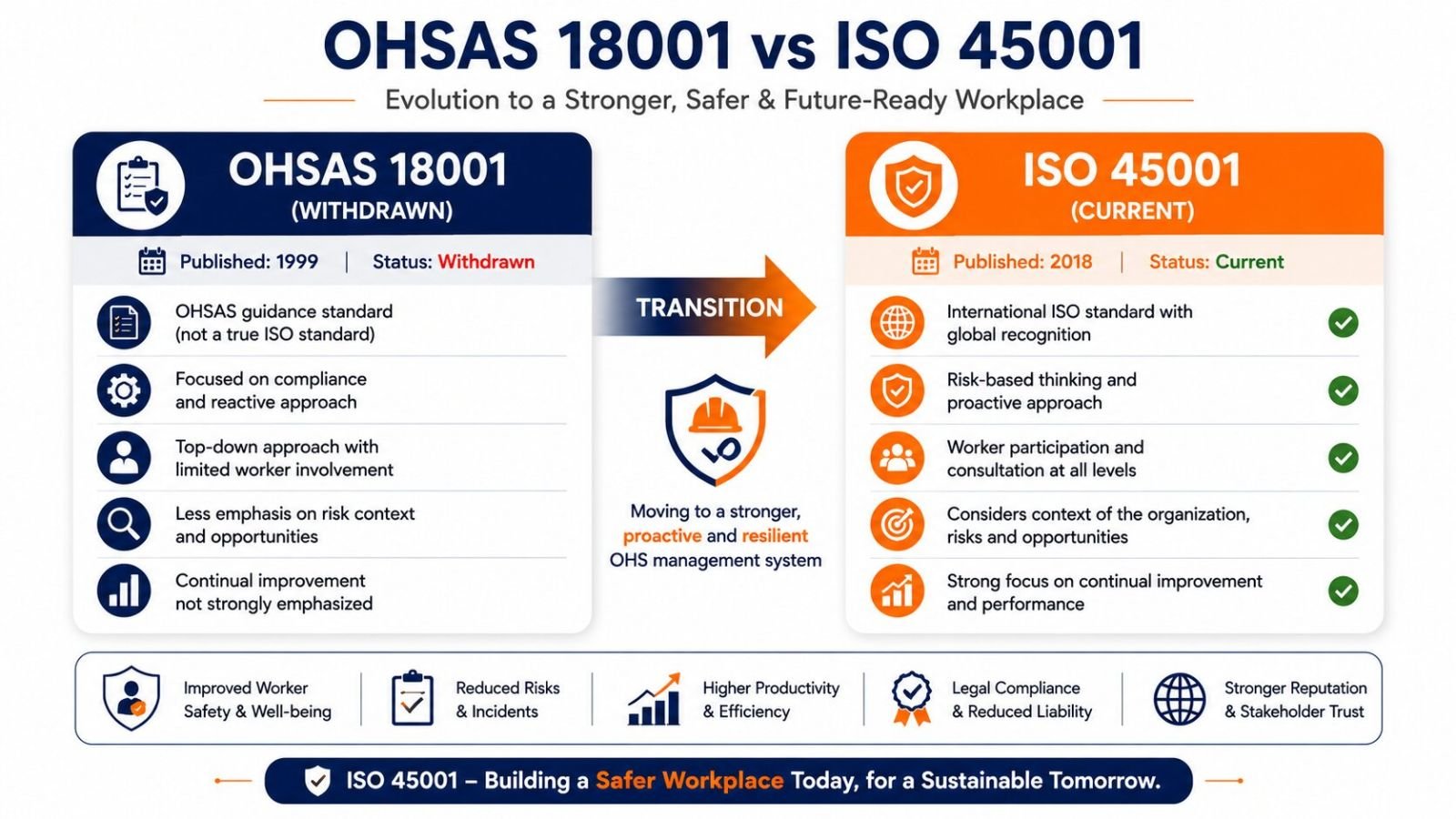
If your organisation still holds OHSAS 18001, your certificate is no longer valid. OHSAS 18001 was officially withdrawn in March 2021. ISO 45001:2018 is now the only internationally accepted standard. Here is exactly what changed and why it matters.

Key Changes: ISO 45001 vs OHSAS 18001
OHSAS 18001 addressed risks only. ISO 45001 requires organisations to identify both risks AND opportunities.
Leadership commitment is now an explicit, mandatory requirement under Clause 5 — not optional.
Worker participation must be formally demonstrated and documented — a major new requirement.
ISO 45001 uses Annex SL (High-Level Structure), making it easy to combine with ISO 9001 and ISO 14001.
Subcontractors, contractors, and agency workers are now explicitly within the OHSMS scope.
Context of the Organisation (Clause 4) is a new mandatory requirement — not in OHSAS 18001.
ISO 45001 expands to cover psychosocial hazards — stress, burnout, and mental health risks.
Amendment 1 (2024) adds climate change considerations to OH&S hazard identification.
ISO 45001 vs OHSAS 18001 — Side by Side
Feature OHSAS 18001 ISO 45001:2018
Status โŒ Withdrawn 2021 โœ“ Current Standard
Risk & Opportunity Risk only Both risk & opportunity
Leadership Focus Moderate Mandatory (Clause 5)
Worker Participation Limited Explicit requirement
Annex SL Structure โŒ No โœ“ Yes
Contractors Included Limited Explicitly included
Context of Org (Cl.4) โŒ Not required โœ“ Mandatory
Psychosocial Hazards Not addressed โœ“ Addressed
Climate Change (Amd 1) โŒ No โœ“ Yes (2024)
Use for Certification โŒ No longer valid โœ“ Only valid standard
โš  Still have OHSAS 18001? Your certificate is not accepted for government tenders or export contracts. Contact us for an urgent transition assessment →

Why Get Certified

Key Benefits of ISO 45001 Certification for Indian Businesses

ISO 45001 delivers measurable, real-world outcomes — not just a certificate on the wall. Here is what certified organisations in India actually gain.

โš–๏ธ
Legal Compliance Under Indian Law
Demonstrates compliance with the Factories Act, 1948 and the Employees' Compensation Act, 1923. Reduces your exposure to penalties, fines, regulatory inspections, and workplace litigation — all of which are increasing in frequency across Indian industries.
๐Ÿ“‰
20–40% Reduction in Accidents
Organisations typically see a 20–40% reduction in workplace incident rates within the first year. Fewer accidents mean lower medical costs, reduced absenteeism, and significantly less disruption to production schedules and operations.
๐Ÿ’ฐ
Lower Insurance Premiums
Indian insurers recognise the reduced occupational risk profile of ISO 45001 certified organisations. Many businesses report measurable reductions in employer liability insurance and group health insurance premiums after certification.
๐Ÿ›๏ธ
Win Government Tenders in India
ISO 45001 is a mandatory requirement for CPWD, NHAI, PWD, and state government infrastructure contracts. Without it, bids are disqualified before evaluation. Certification directly increases the volume of tenders you can participate in.
๐ŸŒŽ
Access International Export Markets
International buyers, freight forwarders, and global supply chains increasingly require ISO 45001 as a supplier pre-qualification. Especially critical for import and export companies and manufacturers supplying to the EU, US, and Middle East.
๐Ÿ‘ท
Higher Productivity & Staff Retention
Workers perform better and stay longer when management demonstrably takes safety seriously. ISO 45001 now formally requires addressing psychosocial hazards — stress and burnout — improving overall employee wellbeing and output.
๐ŸŒฟ
ISO 45001 Amendment 1: Climate Change (2024) — New Requirement
Amendment 1, published in 2024, adds a new requirement for organisations to consider climate change impacts on occupational health and safety. For Indian industries — particularly construction, mining, logistics, and agriculture — extreme heat events, monsoon flooding, and air quality hazards must now be part of your hazard identification and risk assessment. Organisations seeking new certification or recertification must address this amendment.

Step by Step

How to Get ISO 45001 Certified in India: Step-by-Step Process

Our consultants guide you through every stage from the initial gap analysis to receiving your ISO 45001:2018 certificate. Below is the complete certification journey with typical timelines for Indian organisations.

1
Scoping and Gap Analysis
Our ISO 45001 experts review your current safety practices against all 10 clauses of the standard. We identify gaps, document existing hazard controls, and prepare a detailed action plan with timelines and resource requirements. You receive a written gap analysis report.
Duration: 1 to 2 Weeks
2
Hazard Identification and Risk Assessment
We work with your team to conduct a systematic hazard identification exercise covering all operations, equipment, chemicals, contractors, and visitors. We build your Hazard Register and Risk Assessment Matrix which are the core documents required under Clause 6.
Duration: 1 to 2 Weeks
3
OHSMS Documentation Preparation
We prepare all mandatory OHSMS documents including OH&S Policy, Legal and Compliance Register, Safe Operating Procedures (SOPs), Emergency Response Plan, and your KPI dashboard. All documents are tailored to your specific industry and operations.
Duration: 2 to 4 Weeks
4
Employee Awareness Training
We conduct ISO 45001 awareness training for all employee levels from shop floor workers to senior management. We also train your Internal Auditor and Management Representative on their specific roles and responsibilities under the OHSMS.
Duration: 1 to 2 Weeks
5
System Implementation
The OHSMS is deployed across your organisation. Safety controls, permit-to-work systems, toolbox talks, and incident reporting channels go live. Employees begin following documented procedures and recording compliance evidence.
Duration: 3 to 6 Weeks
6
Internal Audit
A qualified internal auditor conducts a full OHSMS audit across all departments. Non-conformities are identified and corrective actions are raised, tracked, and closed before the external certification audit.
Duration: 1 Week
7
Management Review Meeting
Top management reviews internal audit results, safety KPIs, incident data, and corrective action status. Formal decisions are documented in Management Review Minutes which are a mandatory record under Clause 9.
Duration: 1 Week
8
Stage 1 Audit - Document Review
The IAF-accredited certification body reviews all your OHSMS documentation for completeness and compliance. Stage 1 is typically remote or a brief on-site visit. Any observations are addressed before Stage 2 begins.
Duration: 2 to 5 Days
9
Stage 2 Audit - On-Site Certification Audit
Certification body auditors visit your premises. They conduct employee interviews, observe live processes, and inspect safety records. They verify the OHSMS is genuinely implemented across all departments. Non-conformities must be closed within agreed timelines.
Duration: 2 to 5 Days
โœ“
ISO 45001:2018 Certificate Issued!
After resolution of any non-conformities, your accredited ISO 45001:2018 certificate is issued by the certification body. Valid for 3 years. Year 1 and Year 2 surveillance audits confirm ongoing compliance. Year 3 triggers a full recertification audit.
1 to 2 Weeks after Stage 2 Audit
Timeline Guide
60
to 120 Days
Typical total timeline
Gap Analysis 1-2 wks
Hazard Assessment 1-2 wks
Documentation 2-4 wks
Training 1-2 wks
Implementation 3-6 wks
Internal Audit 1 wk
Mgmt Review 1 wk
Stage 1 Audit 3-5 days
Stage 2 Audit 2-5 days
Certificate 1-2 wks
Apply Online

Standard Structure

ISO 45001 Certification Requirements and Controls

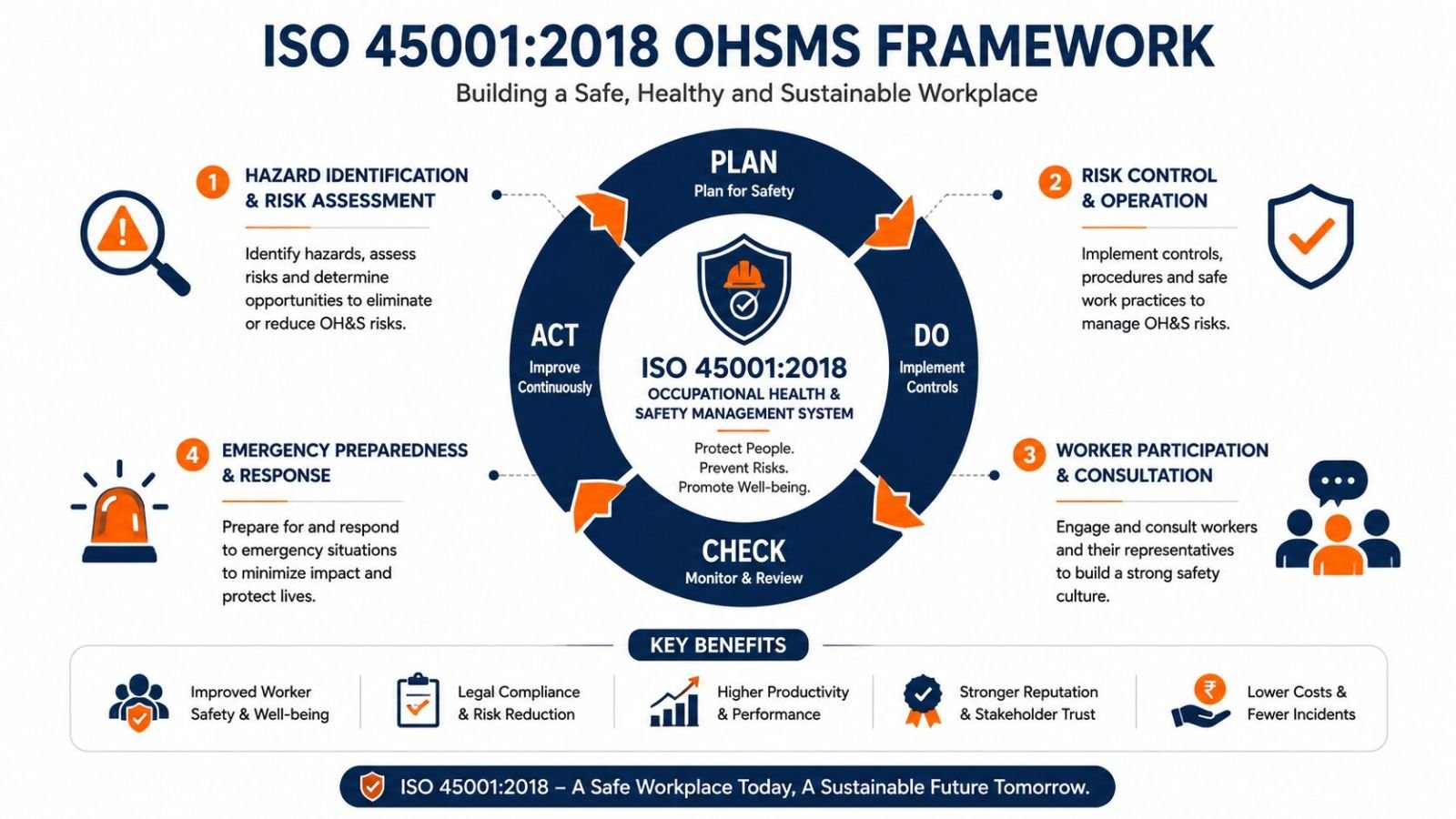
ISO 45001 is structured across 10 clauses using the High-Level Structure (Annex SL). Clauses 1–3 are introductory. The implementable requirements begin at Clause 4.

Mandatory clauses apply to ALL organisations — no clause can be excluded to avoid compliance obligations.
Clause 4
Context of the Organisation
Define internal and external issues, understand interested parties (workers, regulators, clients, contractors), and set the OHSMS scope. This is a new requirement not found in OHSAS 18001.
Clause 5
Leadership & Worker Participation
Top management must demonstrate active commitment through an OH&S policy, defined roles and responsibilities, and formal worker consultation mechanisms. Worker participation is now a core clause.
Clause 6
Planning
Conduct hazard identification, assess risks and opportunities, identify legal and compliance obligations, set measurable OH&S objectives, and plan for operational changes and their potential hazards.
Clause 7
Support
Provide adequate resources, ensure personnel competence, deliver awareness training, establish communication processes, and maintain all required documented information — records and procedures.
Clause 8
Operation
Implement operational controls for all hazards, manage contractors and outsourced activities, control change within the OHSMS, and establish and test emergency preparedness and response procedures.
Clause 9
Performance Evaluation
Monitor and measure OH&S performance against objectives, conduct a formal internal audit programme, and hold a documented management review meeting to assess system effectiveness.
Clause 10
Improvement
Investigate all incidents and near-misses, manage non-conformities with corrective actions, and drive continual improvement of the OHSMS. Corrective actions must address root causes, not just symptoms.
๐Ÿ“‹ Key Documents Required for ISO 45001 Certification
โœ“OH&S Policy (Clause 5.2)
โœ“Hazard Identification Register (Clause 6.1)
โœ“Risk Assessment Report (Clause 6.1)
โœ“Legal & Compliance Register (Clause 6.1.3)
โœ“Emergency Response Procedures (Clause 8.2)
โœ“Employee Training Records (Clause 7.2)
โœ“Internal Audit Programme & Reports (Clause 9.2)
โœ“Management Review Minutes (Clause 9.3)
โœ“Incident Investigation Records (Clause 10.2)
โœ“Corrective Action Log (Clause 10.2)
โœ“OH&S Objectives & KPI Tracker (Clause 6.2)
โœ“Competence Records for Key Roles (Clause 7.2)

Who Needs It

Who Needs ISO 45001 Certification in India?

ISO 45001 applies to any organisation regardless of size or sector. However, these industries face the greatest regulatory pressure, commercial requirement, or risk exposure — making certification either mandatory or critical for business continuity.

๐Ÿ—๏ธ
Construction & Real Estate
Mandatory for CPWD, NHAI, and state government tenders. Sub-contractors to large developers are increasingly required to hold ISO 45001 for empanelment. Fall protection and site safety are primary hazard areas.
๐Ÿญ
Manufacturing
OEM vendor qualification for automotive Tier 1 & Tier 2 suppliers. Machinery guarding, chemical exposure, ergonomic hazards, and noise are covered. Required for export to the EU and US.
โ›๏ธ
Mining & Metals
DGMS (Directorate General of Mines Safety) regulatory environment makes ISO 45001 essential. Coal, iron ore, and mineral exporters must demonstrate OHSMS compliance for international buyers.
๐Ÿงช
Chemicals & Pharma
Hazardous material handling, process safety, US FDA and EU GMP alignment. Pharmaceutical companies applying for export registration increasingly cite ISO 45001 as a prerequisite for facility audits.
๐Ÿฅ
Healthcare
Protects clinical and non-clinical staff from biological hazards, sharps injuries, and latex allergies. Required by NABH accreditation processes for many hospital and diagnostic centre categories.
๐Ÿšข
Import & Export
International buyers and freight forwarders require ISO 45001 for warehouse safety, port handling, and logistics vendor qualification — see the special section directly below.
๐Ÿš›
Logistics & Transport
Road accident prevention, driver fatigue management, warehouse material handling hazards, and forklift safety all require systematic OHSMS documentation and evidence.
๐Ÿ’ป
IT & Services
Ergonomic risks, psychosocial hazards (ISO 45003 alignment), mental well-being, and growing enterprise client requirements. MNCs increasingly mandate ISO 45001 for their Indian IT vendor base.
โšก
Energy & Power
High-voltage environments, confined space entry, work-at-height, and arc flash hazards. Critical infrastructure projects require ISO 45001 as a condition of contract.
๐Ÿข
E-commerce & Retail
Warehouse picking and packing safety, customer delivery rider safety, and large marketplace platform vendor compliance requirements are driving rapid adoption across the sector.
โ›ด Special Focus: ISO 45001 for Import & Export Industry

International buyers from the EU, US, Middle East, and Southeast Asia increasingly require ISO 45001 as a supplier pre-qualification standard. It is especially critical for these businesses:

Warehouse & storage operators
Port handling & stevedoring companies
Freight forwarding & logistics providers
Customs clearing agents
Cold chain & temperature-controlled logistics
International packaging manufacturers
Get a Quote →
๐Ÿ“Œ ISO 45001 Certification for Individuals — Not the Same as Organisational Certification

If you are a safety officer, EHS consultant, or safety professional looking for personal accreditation, you need the ISO 45001 Lead Auditor or Lead Implementer course — not organisational certification. See Section 9 below for full details including course fees in India, Saudi Arabia, Pakistan, and online.

Individual Certification

ISO 45001 Lead Auditor and Lead Implementer Certification

Many people searching for “ISO 45001 Lead Auditor course fees” and “ISO 45001 course fee” need individual professional certification — not the organisational OHSMS certificate. Here is the clear distinction and current fee information for India, Saudi Arabia, Pakistan, and online formats.

ISO 45001
Lead Auditor
For Individuals — Safety Professionals & Consultants
Who It's For
For safety officers, EHS consultants, and professionals who want to conduct first, second, and third-party ISO 45001 audits on organisations. A globally recognised qualification issued by CQI/IRCA or equivalent accredited training providers.
How It Works
5-day classroom or online course. Written examination required (minimum 70% pass mark). CQI/IRCA approved certificate issued upon passing. Globally recognised.
Course Fees
India (Classroom)โ‚น30,000–โ‚น60,000
India (Online)โ‚น15,000–โ‚น35,000
Saudi ArabiaSAR 2,500–SAR 5,000
PakistanPKR 60,000–PKR 1,20,000
ISO 45001
Lead Implementer
For Individuals — EHS Managers & Project Leads
Who It's For
For professionals who want to implement, manage, and continuously improve an OHSMS within their organisation. Covers documentation, hazard management, internal audit methodology, and management review facilitation.
How It Works
5-day course covering all 10 ISO 45001 clauses in depth with practical exercises. Certificate issued upon successful completion. Recognised by global employers.
Course Fees
India (Classroom)โ‚น25,000–โ‚น50,000
India (Online)โ‚น12,000–โ‚น28,000
Saudi ArabiaSAR 2,000–SAR 4,000
PakistanPKR 50,000–PKR 1,00,000
ISO 45001
Company Certification
For Organisations — All Businesses
Who It's For
This is what efilingcompany.com provides. Your organisation receives an ISO 45001:2018 certificate from an IAF-accredited certification body. The certificate is issued to your company, not to an individual. Valid for 3 years.
How It Works
Gap Analysis → Documentation → Training → Internal Audit → Stage 1 & Stage 2 Audits by accredited body → Certificate issued to the company.
Organisation Cost
Small (≤50 emp)โ‚น25,000–โ‚น60,000
Medium (50–250)โ‚น60,000–โ‚น1,50,000
Large (250–1000)โ‚น1,30,000–โ‚น2,50,000
Enterprise (1000+)โ‚น2,50,000+
๐Ÿ’ก Pro Tip: If you are a business owner or manager looking to certify your organisation, you need Company Certification. If you are a safety professional wanting to add a personal qualification to your CV, you need the Lead Auditor course. Not sure which applies? Contact us and we will advise you →

Critical Difference

IAF vs Non-IAF ISO 45001 Certification: What's the Difference?

Not all ISO 45001 certificates carry the same value. Many organisations in India have unknowingly obtained worthless certificates from non-accredited bodies. Here is how to tell the difference and why it matters for your business.

โŒ Non-IAF Accredited Certificate
โœ—Not accepted for any government tender — CPWD, NHAI, PWD, or Defence procurement
โœ—Rejected by international buyers and export qualification processes
โœ—Cannot be verified on the IAF MLA public database at iaf.nu
โœ—Not recognised by insurance companies for premium discounts or liability cover
โœ—Often issued by unknown or self-declared certification bodies with no oversight
โœ—Provides zero real-world legal, commercial, or regulatory value
โœ—May have been issued without any actual on-site audit being conducted
โœ—Potentially fraudulent — several cases have been investigated by MCA and enforcement agencies
โœ“ IAF Accredited Certificate
โœ“Accepted globally in 100+ countries via the IAF Multilateral Recognition Arrangement (MLA)
โœ“Accepted for all government tenders and public procurement processes across India
โœ“Verifiable on the IAF MLA public database at iaf.nu and NABCB at nabcb.qci.org.in
โœ“Issued by bodies accredited by NABCB, UKAS, DAkkS, or equivalent national bodies
โœ“Recognised by Indian insurers for occupational risk assessment and premium discounts
โœ“Provides genuine legal defence evidence in case of workplace incident litigation
โœ“Requires actual on-site audits conducted by qualified and registered auditors
โœ“Issued by trusted bodies such as TÜV, Bureau Veritas, LRQA, BSI, and others
How to Verify an ISO 45001 Certificate is Genuine

Ask your certification body for their NABCB accreditation number (for India-based bodies) or their UKAS/DAkkS accreditation number (for international bodies). Verify it on the NABCB public directory at nabcb.qci.org.in or the IAF MLA database at iaf.nu. Any body that cannot provide a verifiable accreditation number should be avoided entirely.

Get IAF-Accredited Certificate

Key Definitions

ISO 45001 Terminology and Definitions Explained

Understanding the exact ISO 45001 terminology is essential for audit readiness and system implementation. Here are the key terms defined with India-specific workplace context.

Hazard Identification
The systematic process of recognising any source, situation, or act with potential to cause injury, illness, or death. In Indian workplaces, common hazards include falls from height (construction), chemical exposure (pharma and chemicals), machinery entanglement (manufacturing), electrical hazards (energy sector), and extreme heat stress (outdoor and agricultural workers). Hazard identification is a mandatory Clause 6.1 requirement and must be conducted before any risk assessment.
The Worker
Under ISO 45001, “worker” is broadly defined to include employees, contractors, agency workers, self-employed persons, apprentices, interns, and trainees — anyone working under the organisation's management and control. This is a significant expansion from OHSAS 18001, which focused mainly on direct employees. For Indian businesses using contract labour extensively, this means your OHSMS must formally cover all contract workers on your premises.
The Hazard
Any source, situation, or act with potential for harm in terms of human injury or ill health, or a combination of these. ISO 45001 now explicitly includes psychosocial hazards — excessive workload, workplace bullying, lack of job control, poor interpersonal relationships, and work-related stress. These must be included in your Hazard Register alongside physical, chemical, biological, and ergonomic hazards. This aligns with the ISO 45003 guidance standard on psychological safety.
Workplace
Under ISO 45001, “workplace” is defined as any place under the organisation's management and control where a person performs work. This includes factories and offices, client sites, delivery vehicles, remote locations, and work-from-home (WFH) environments. Since COVID-19 normalised WFH in India's IT and services sector, the definition of workplace now formally extends to employees' home offices — requiring organisations to address home ergonomics and mental health under their OHSMS.
Risk Assessment
The process of evaluating identified hazards using a Likelihood x Severity matrix. Risks are ranked (low, medium, high, critical) and controls are applied in priority order using the Hierarchy of Controls: Elimination → Substitution → Engineering Controls → Administrative Controls → Personal Protective Equipment (PPE). ISO 45001 requires residual risk to be evaluated after controls are applied. Risk assessments must be reviewed whenever operations change, incidents occur, or on a scheduled periodic basis.
OH&S Objectives
Measurable safety targets set by the organisation under Clause 6.2. Examples for Indian organisations: “Reduce Lost-Time Injury Frequency Rate (LTIFR) by 25% within 12 months”, “Achieve zero fatalities in financial year 2025–26”, “Complete 100% contractor safety induction within 30 days of engagement.” Objectives must be documented, communicated to workers, monitored regularly, and formally reviewed at management review meetings.
Continual Improvement
ISO 45001 requires continual improvement of the OHSMS — an ongoing process of enhancing OH&S performance over time. This is distinct from “continuous improvement” (which implies unbroken, constant improvement). Improvement is driven by incident investigations, audit findings, worker feedback, performance data, and management review decisions. Each year your OHSMS should demonstrably perform better than the year before in measurable terms.
Documented Information
The mandatory records and procedures your OHSMS must maintain under Clause 7.5. Includes both documents (living procedures and policies that are regularly updated) and records (completed forms, meeting minutes, and audit reports that provide evidence of compliance). During Stage 2 certification audit, auditors will request documented information as primary evidence. Missing records are the most common cause of non-conformities raised during ISO 45001 audits in India.
Management Representative
The senior person responsible for the overall OHSMS —

Contact us today to schedule your appointment.
You can call us on +919953004880 or write to us at info@efilingcompany.com

We offer our ISO 45001 Certification service in this areas