ISO Certifications
ISO certification is an independent, third-party verification that an organisation's management system, processes, or products meet internationally recognised standards published by the International Organization for Standardization (ISO) — founded in Geneva in 1947. Certification is not issued by ISO itself. It is awarded by accredited third-party bodies — such as TÜV, BSI, Bureau Veritas, DNV, or NABCB-accredited certification bodies — after auditing your organisation against the chosen standard's requirements.


2000
Happy Clients

1500
Expert Advisors

2+
Branch Offices
Free Consultation by Expert
.png)


.png)
.png)
What is ISO Certification?
ISO stands for International Organization for Standardization an independent, non-governmental international body that develops and publishes standards to ensure quality, safety, efficiency, and interoperability of products, services, and systems.
ISO certification (also called an ISO certificate or ISO compliance) is formal recognition — issued by an accredited certification body — that your organisation has implemented and maintained a management system meeting the requirements of a specific ISO standard.
International Organization for Standardization. The name 'ISO' comes from the Greek word isos, meaning "equal" — which is why the abbreviation is the same in all languages.
Key Facts About ISO
Year Founded
Headquarters
Member Countries
Standards Published
What ISO Certification is NOT
- Not issued by ISO itself— ISO writes the standards only. Certification is issued by accredited third-party bodies.
- Not a government approval— It is voluntary in most cases, though required for many tenders.
- Not a one-time event— Certificates are valid for 3 years with annual surveillance audits.
- Not one-size-fits-all— There are different standards for quality, security, environment, food safety, and more.
Not sure which ISO standard fits your business?
Types of ISO Certifications
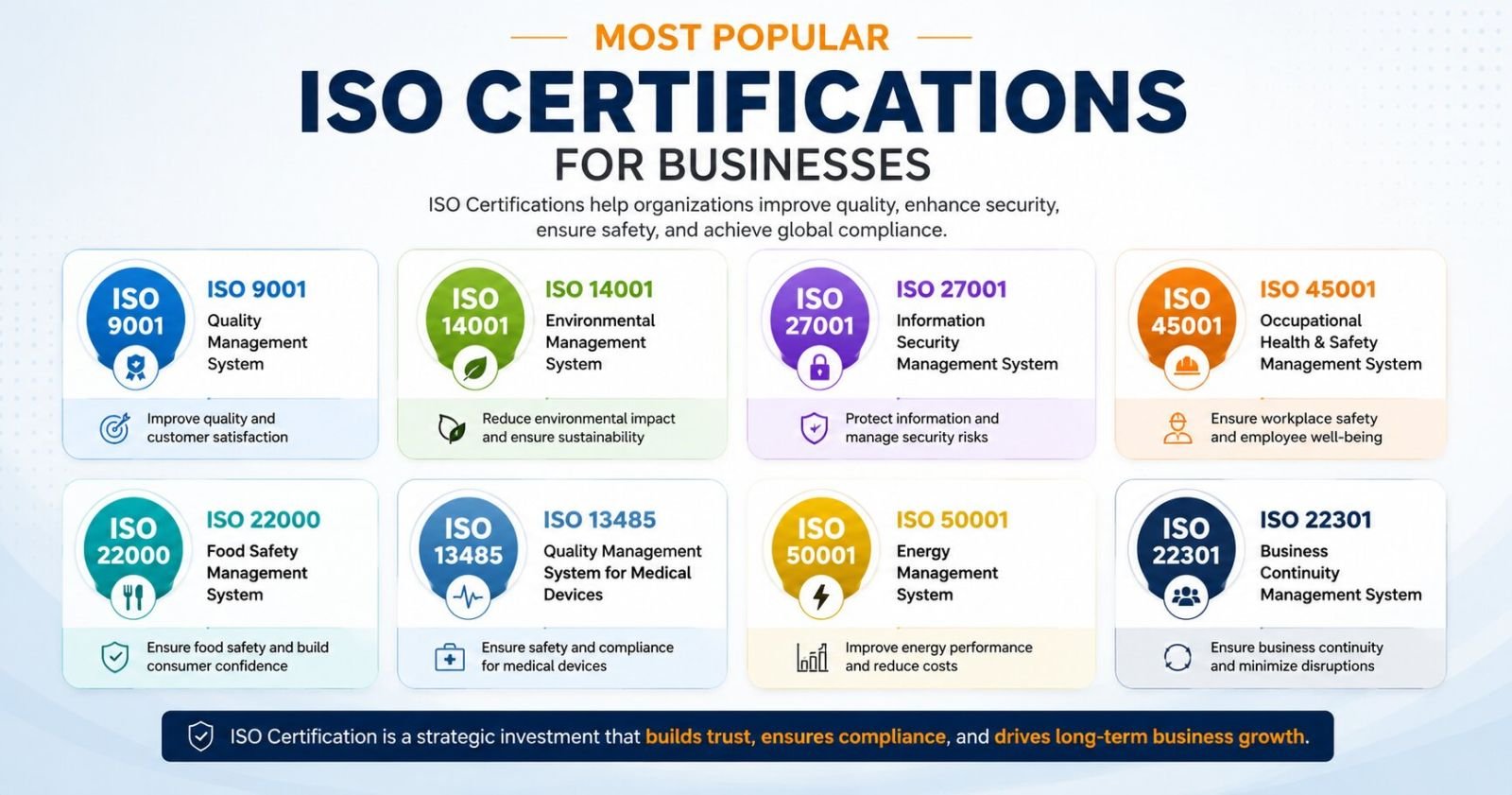
ISO has published over 24,000 standards, but for businesses in India, a core set of certifications covers most industries. Explore the most popular ISO standards, their purpose, and who they are best suited for.
| ISO Standard | What It Covers | Best For |
|---|---|---|
| ISO 9001 | Quality Management System (QMS) | All Industries |
| ISO 27001 | Information Security Management (ISMS) | IT / BPO / Fintech |
| ISO 14001 | Environmental Management System (EMS) | Manufacturing |
| ISO 45001 | Occupational Health & Safety (OHSMS) | Construction / Logistics |
| ISO 22000 | Food Safety Management (FSMS) | Food / Catering |
| ISO 13485 | Medical Devices Quality Management | Pharma / Medtech |
Tip: Choosing the right ISO certification depends on your industry, compliance needs, customer requirements, and business goals.
ISO Certification Standards
ISO 9001 Certification — Quality Management System
ISO 9001:2015 is the world's most widely adopted quality management standard, applicable to organisations of any size or sector. It requires businesses to document, implement, and continuously improve their quality management system (QMS), covering processes from customer communication to product delivery. This certification is a mandatory requirement for most government tenders in India, and a trusted signal of operational quality for international buyers.
ISO 27001 Certification — Information Security
ISO 27001:2022 specifies the requirements for establishing, implementing, and maintaining an Information Security Management System (ISMS). It is the primary certification for IT companies, BPOs, fintech firms, and any organisation handling sensitive client data. ISO 27001 is increasingly a mandatory vendor requirement from international BFSI and healthcare clients, and from the Indian government for IT project vendors.
ISO 14001 Certification — Environmental Management
ISO 14001:2015 helps organisations systematically manage their environmental responsibilities — reducing waste, minimising pollution, and demonstrating compliance with environmental regulations. For export-oriented manufacturers in India, ISO 14001 is increasingly required by EU and US buyers as part of ESG and supply chain due diligence requirements.
ISO 45001 Certification — Occupational Health & Safety
ISO 45001:2018 is the international standard for Occupational Health and Safety Management Systems (OHSMS), replacing the earlier OHSAS 18001 standard. It requires organisations to proactively manage workplace safety risks. In India, ISO 45001 is critical for construction, manufacturing, and logistics companies — both for regulatory compliance and qualifying for large corporate supply chains.
ISO 22000 Certification — Food Safety
ISO 22000:2018 is a food safety management standard covering the entire food supply chain — from producers to retailers. It integrates HACCP principles with ISO's management system approach. For India's food processing, catering, and export sector, ISO 22000 is increasingly required alongside FSSAI registration by modern retail chains and international food buyers.
Other ISO Standards
ISO Certification Cost in India
ISO certification cost in India typically ranges from Inr 25,000 to Inr 1,50,000, depending on the standard chosen, company size, number of employees, and the accreditation body selected. The total cost includes: (1) consultancy fees for gap analysis, documentation, and training, and (2) certification body fees paid directly to the auditing organisation.
| ISO Standard | Typical Cost | Timeline |
|---|---|---|
| ISO 9001 — Quality | Inr 25,000 | 30–45 days |
| ISO 27001 — Info Security | Inr 15,000 | 45–60 days |
| ISO 14001 — Environmental | Inr 45,000 | 30–50 days |
| ISO 45001 — Safety | Inr 65,000 | 30–45 days |
| ISO 22000 — Food Safety | Inr 8,000 | 35–50 days |
| ISO 13485 — Medical DevicesInr | Inr 45,000 | 45–60 days |
What Affects ISO Certification Cost?
Several factors determine your final ISO certification cost in India: the number of employees and sites (larger scope = longer audit = higher fee), existing documentation maturity, the accreditation body chosen (UKAS, DAkkS, JAS-ANZ each have different fee structures), the complexity of the chosen standard, and whether staff training is bundled into the engagement.
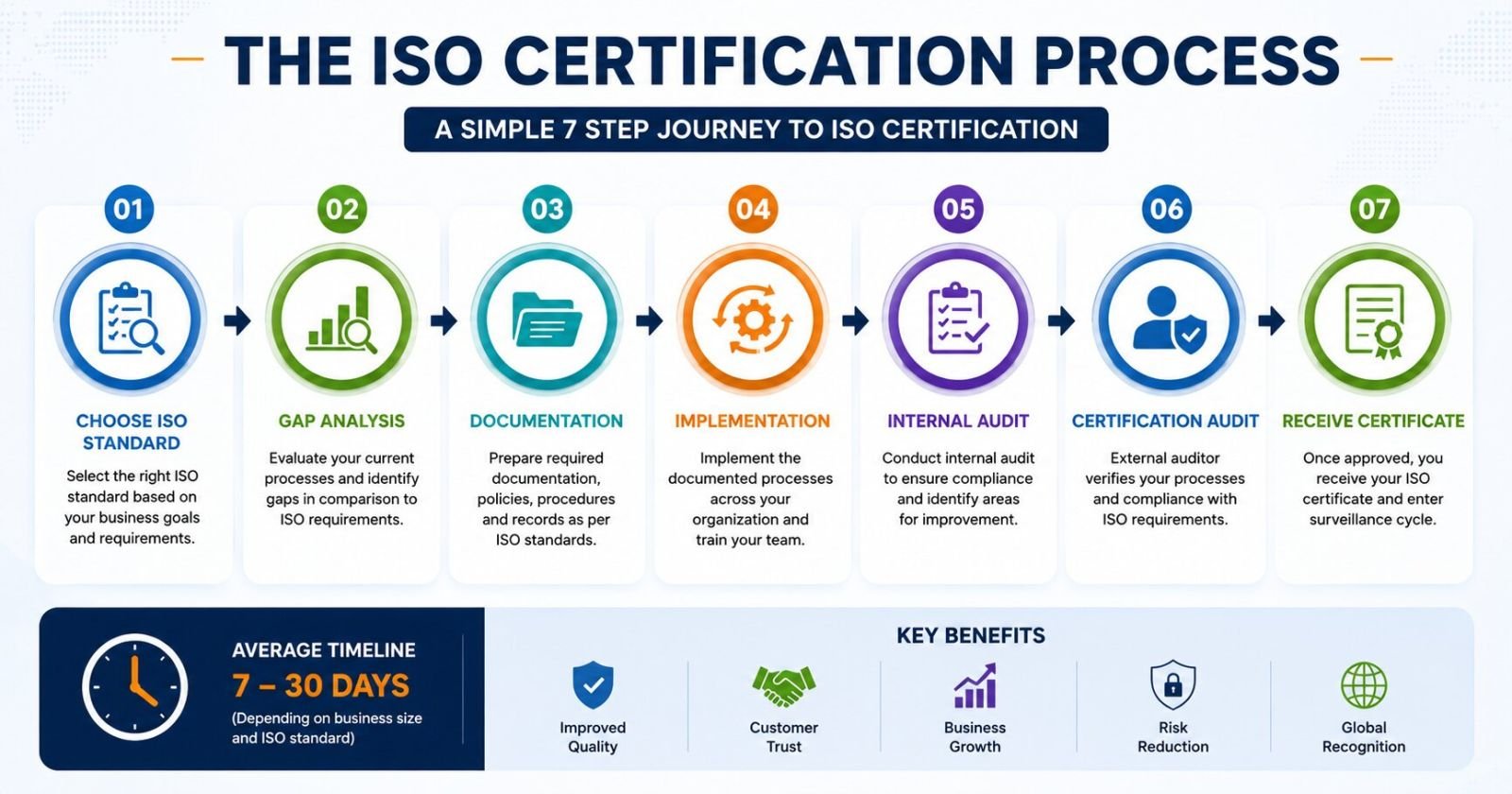
How to Get ISO Certification — 5 Steps
The ISO certification process in India follows a standard five-stage framework, whether you are applying online or through a local consultant. Most businesses complete the process in 30 to 60 days with proper guidance.
Choose the Right ISO Standard
Identify which standard applies to your business. ISO 9001 is the universal starting point for most organisations. IT companies typically need ISO 27001. Food processors need ISO 22000. Manufacturing plants benefit from combining ISO 9001, ISO 14001, and ISO 45001.Gap Analysis
A qualified consultant conducts a gap analysis — comparing your current processes against the ISO standard requirements and identifying exactly what needs to be created or improved. This step is free with eFilingCompany and typically takes 2–3 days.Documentation Preparation
Your consultant prepares the Quality Manual, Standard Operating Procedures (SOPs), risk register, and all required records. ISO 9001 typically covers 15–25 documents; ISO 27001 may involve 30+ controls documentation. Your team reviews and approves everything.Implementation & Training
Your team is trained on the new processes and the management system is operationally implemented. This phase typically takes 10–20 days. Staff training can be conducted on-site or online. Internal audits are completed before the external audit.Certification Audit
An accredited certification body conducts a two-stage audit: Stage 1 reviews documentation; Stage 2 verifies implementation on-site. Once your organisation passes, the ISO certificate is issued — valid for 3 years, with annual surveillance audits required.
Documents Required for ISO Certification
ISO certification does not require your organisation to have everything documented from day one — your consultant prepares all management system documentation. You only need to supply these core company documents to begin:
| Document | Notes |
|---|---|
| Company registration certificate | MCA/ROC certificate, partnership deed, or proprietorship proof |
| GST registration certificate | GSTIN certificate from the GST portal |
| PAN card | Company PAN + director/proprietor PAN |
| Udyam / MSME registration | If registered — strengthens tender applications |
| List of products and services | Defines the scope of certification |
| Organisational chart | Reporting structure and key roles |
| List of key personnel | Names, designations, and contact details |
| Existing quality / documents | Any SOPs or work instructions already in place |
| Office / site address proof | Utility bill, rent agreement, or property ownership documents |
eFilingCompany prepares all management system documentation — Quality Manual, SOPs, risk registers — as part of the certification package. You only need the core company registration documents to start.
Benefits of ISO Certification
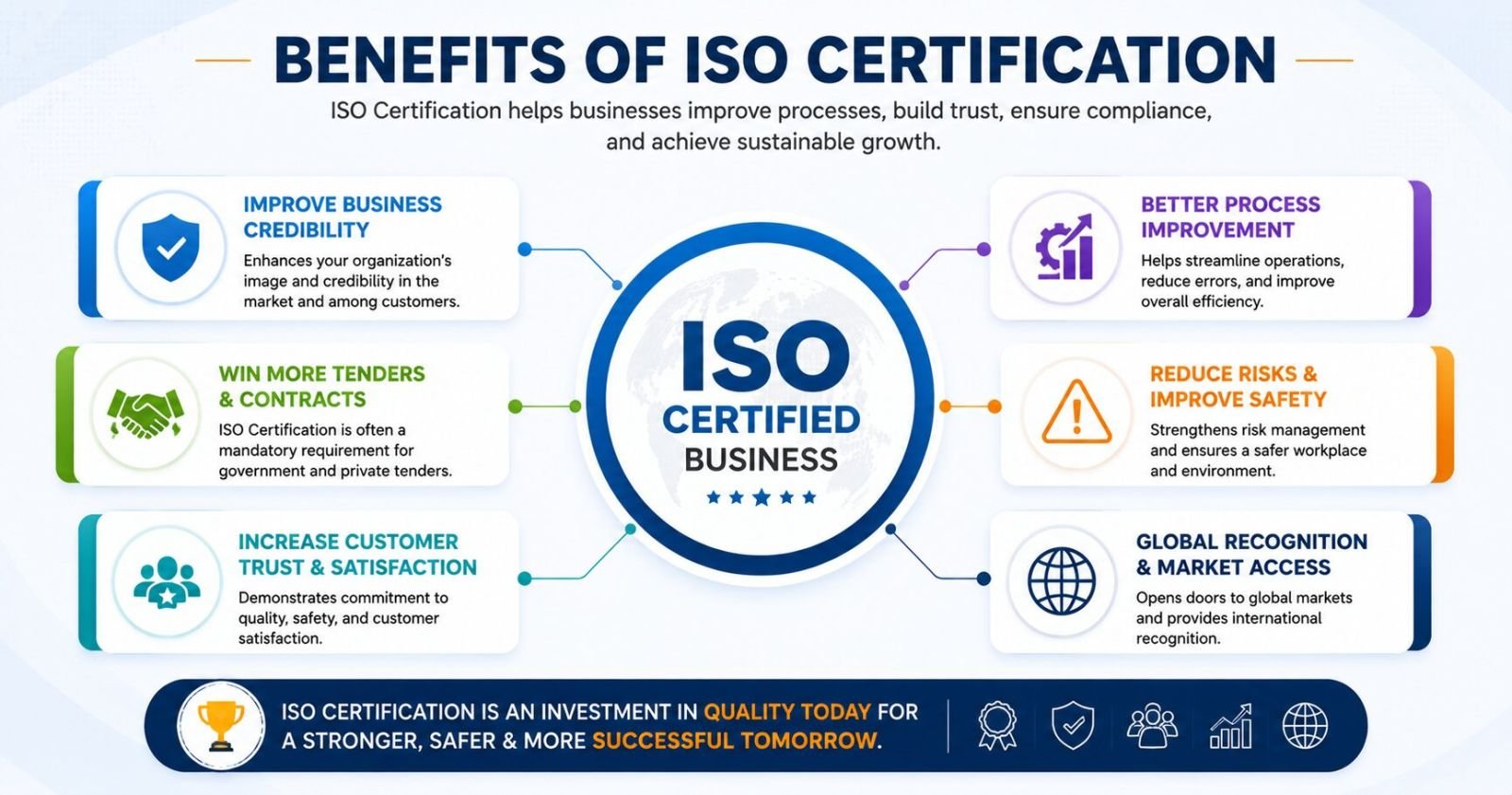
ISO certification delivers measurable, documented business outcomes — not just a certificate on the wall. Here is what Indian businesses actually gain:
Central and state government tenders (CPWD, DMRC, DDA, PSUs) routinely mandate ISO 9001 at the technical evaluation stage. Without it, bids are rejected before financials open.
Large Indian and MNC companies require ISO certification in their vendor qualification processes. It removes a key barrier to entry for high-value supply chains.
EU, UK, and US buyers require ISO certification before onboarding Indian suppliers. It is effectively mandatory for export-oriented businesses serving global clients.
ISO implementation forces process documentation. Most businesses discover 15–25% cost reduction from rework and inefficiency elimination in Year 1 alone.
ISO 45001-certified businesses consistently negotiate 10–20% lower workplace insurance premiums with Indian insurers through demonstrated safety management.
An ISO certificate on proposals and websites signals that your quality, security, or safety practices have been independently verified by an accredited third party.
Certified workplaces — particularly ISO 45001 — signal care for employee wellbeing, reducing attrition in competitive talent markets.
ISO creates documented, repeatable processes — the foundation of any business that can grow beyond its founders and operate without depending on key individuals.
Registered micro and small enterprises (MSEs) can avail the Government of India's incentive scheme for ISO certification, which reimburses 75% of certification expenses (up to INR 75,000) for ISO 9001, ISO 14001, and HACCP certifications. Apply through your local MSME Director's office with your Udyam registration.
ISO Certification in India — City & Region Guide
eFilingCompany provides ISO certification consultancy services across all major Indian cities. Click your city for a complete guide including local costs, top-industry context, and consultant contact details.
Major Indian Cities
ISO Certification by Industry
Different industries require different ISO standards. The table below gives a quick reference — click your sector for a detailed guide including the relevant standard, certification process, and estimated cost.
| Industry / Sector | Recommended Standard(s) | Guide |
|---|---|---|
| IT, Software & BPO | ISO 27001 (security) + ISO 9001 (quality). Required for BFSI, healthcare IT, and govt IT contracts. | IT Companies → |
| Manufacturing | ISO 9001 + ISO 14001 + ISO 45001. Required for OEM supplier qualification and export. | Manufacturing → |
| Hospitals & Clinics | ISO 9001 for quality + ISO 13485 for medical devices. Enhances patient trust and meets regulatory requirements. | Healthcare → |
| Food Processing | ISO 22000 (food safety management with HACCP). Required for modern retail supply chains and export. | Food Industry → |
| Schools & Colleges | ISO 21001 (educational management). Signals quality commitment to students and accreditation bodies. | Education → |
| MSME & Small Businesses | ISO 9001 is the most accessible starting point. Most MSMEs complete it in 30 days from ?30,000. | MSME → |
| ISO Auditors & Professionals | ISO lead auditor and internal auditor certification for individuals. ISO 27001, ISO 9001, ISO 22301 lead auditor courses. | Auditors → |
How to Verify an ISO Certificate Online
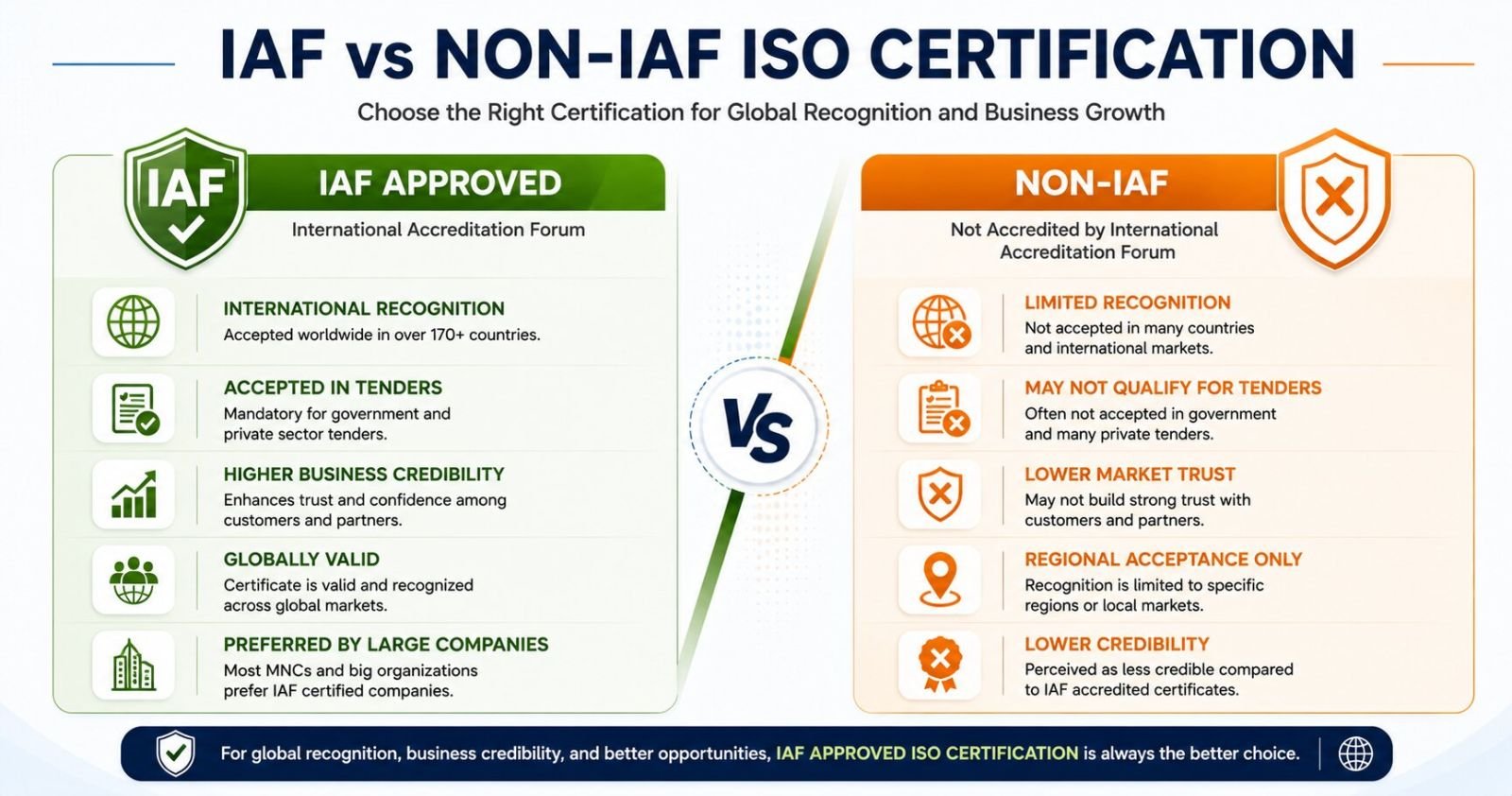
ISO certificates can be verified online through the certification body's official database. Every legitimate ISO certificate carries the name and accreditation mark of the certification body that issued it. Non-IAF certificates — issued by unaccredited bodies — are generally not accepted for government tenders, international trade, or corporate vendor qualification.
- Locate the certification body name on the certificate — e.g. TÜV, BSI, Bureau Veritas, DNV, or any NABCB/IAF-accredited body.
- Visit the certification body's website and use their online certificate verification tool. Most require the certificate number or company name.
- Check IAF accreditation — verify that the certifying body is accredited by a member of the International Accreditation Forum (IAF). In India, NABCB is the IAF-recognised accreditation body.
- For eFilingCompany-facilitated certificates — verify directly with the accredited certification body using the certificate number printed on your ISO certificate.
IAF vs Non-IAF ISO Certificate — What's the Difference?
IAF-Accredited Certificate
Issued by certification bodies accredited by national accreditation bodies that are IAF members (e.g. NABCB in India, UKAS in the UK, DAkkS in Germany). Internationally recognised and accepted for government tenders, corporate vendor qualification, and international trade. This is what eFilingCompany arranges for all clients.
Non-IAF / Unaccredited Certificate
Issued by bodies not accredited by any IAF-recognised national body. These certificates may appear genuine but are not accepted by government departments, major corporates, or international buyers. Always verify the accreditation status before engaging a certification body.