ISO Certification for Educational Institutions
ISO certification for educational institutions is an internationally recognised framework. While not legally mandatory, it demonstrates a commitment to excellence, student satisfaction, and continuous improvement. eFilingCompany helps schools, colleges, universities, coaching centres, and training institutes across India achieve ISO certification efficiently.


2000
Happy Clients

1500
Expert Advisors

2+
Branch Offices
Free Consultation by Expert
.png)


.png)
.png)
ISO Certification for Educational Institutions — ISO 21001, ISO 9001 and Other Standards for Schools, Colleges and Universities in India
ISO certification for educational institutions is an internationally recognised framework that standardises administrative processes, enhances teaching quality, and boosts institutional credibility. While not legally mandatory, it demonstrates a commitment to excellence, student satisfaction, and continuous improvement.
The ISO standard specifically designed for educational organisations is ISO 21001:2018 — Educational Organisations Management System (EOMS). Published in 2018 by the International Organisation for Standardisation (ISO), it specifies requirements for a management system that helps educational organisations improve educational processes, respond to learners' needs, and demonstrate commitment to excellence.
ISO 21001:2018 can be applied to educational organisations of all types and sizes — including schools, colleges, universities, coaching centres, vocational institutes, and training providers. It can also be applied to educational organisations within larger organisations whose core business is not education, such as corporate training divisions and professional training institutes.
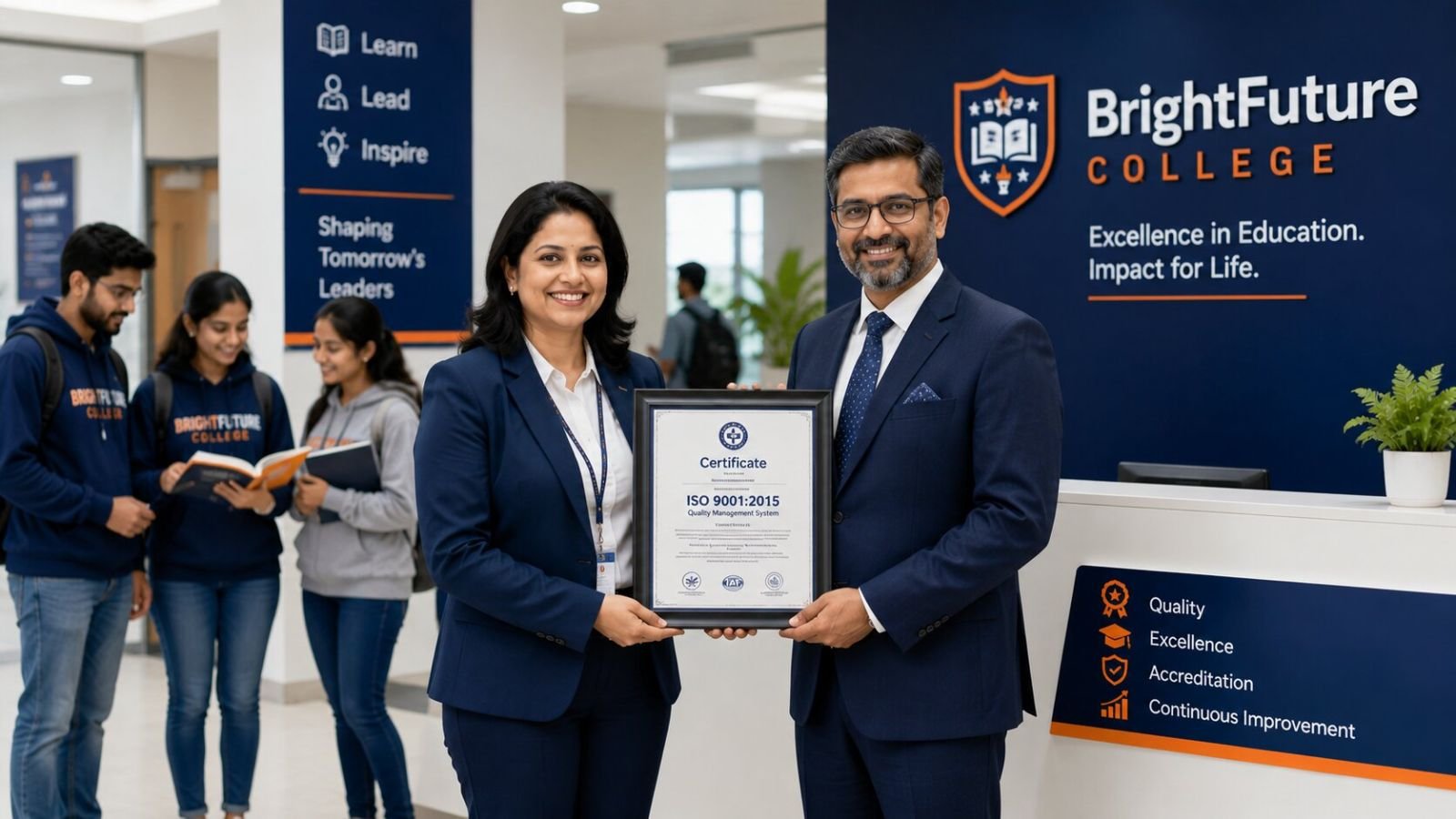
Expertise in ISO Certification for Educational Institutions

Enquiry Form
Among Asia Top
100
Consulting Firm

Get Consultation
Lowest Fees
100,000 + Clients.

Service Delivery
4.9 Customers Rating
50+ Offices
Contact us today to schedule your appointment.
You can call us on +919953004880 or write to us at info@efilingcompany.com
| ISO Standards Applicable to Educational Institutions |
| ISO Standard | Full Name | Relevance to Education |
| ISO 21001:2018 | Educational Organisations Management System (EOMS) | The primary ISO standard specifically designed for educational institutions — provides a management framework for curriculum delivery, student support, and continual improvement; supports accreditation applications |
| ISO 9001:2015 | Quality Management System | Widely adopted by universities and training organisations — provides a quality management framework supporting accreditation for government grants and international recognition; adopted by engineering colleges and management institutions |
| ISO 45001:2018 | Occupational Health and Safety Management System | Protects students, staff, and visitors across campus environments including laboratories, workshops, sports facilities, and construction zones; helps manage campus safety risks systematically |
| ISO/IEC 27001:2022 | Information Security Management System | Protects electronic student records, academic research data, and management information systems from cyber threats; helps institutions comply with data protection regulations |
| ISO 14001:2015 | Environmental Management System | Supports green campus initiatives and sustainable campus management — helps educational institutions reduce energy use, manage waste, and demonstrate environmental responsibility to students, staff, and the wider community |
| ISO 50001:2018 | Energy Management System | Helps educational institutions manage energy consumption across buildings, laboratories, and residential facilities; supports energy cost reduction and sustainability commitments increasingly expected by students, staff, and institutional funders |
| ISO 22301:2019 | Business Continuity Management System | Ensures educational institutions can maintain learning continuity during disruptions such as natural disasters, system failures, or public health events; protects student learning outcomes and institutional continuity |
| ISO 22000:2018 | Food Safety Management System | Relevant for educational institutions operating canteens, hostels, or food service facilities — ensures food safety management practices protect the health of students and staff |
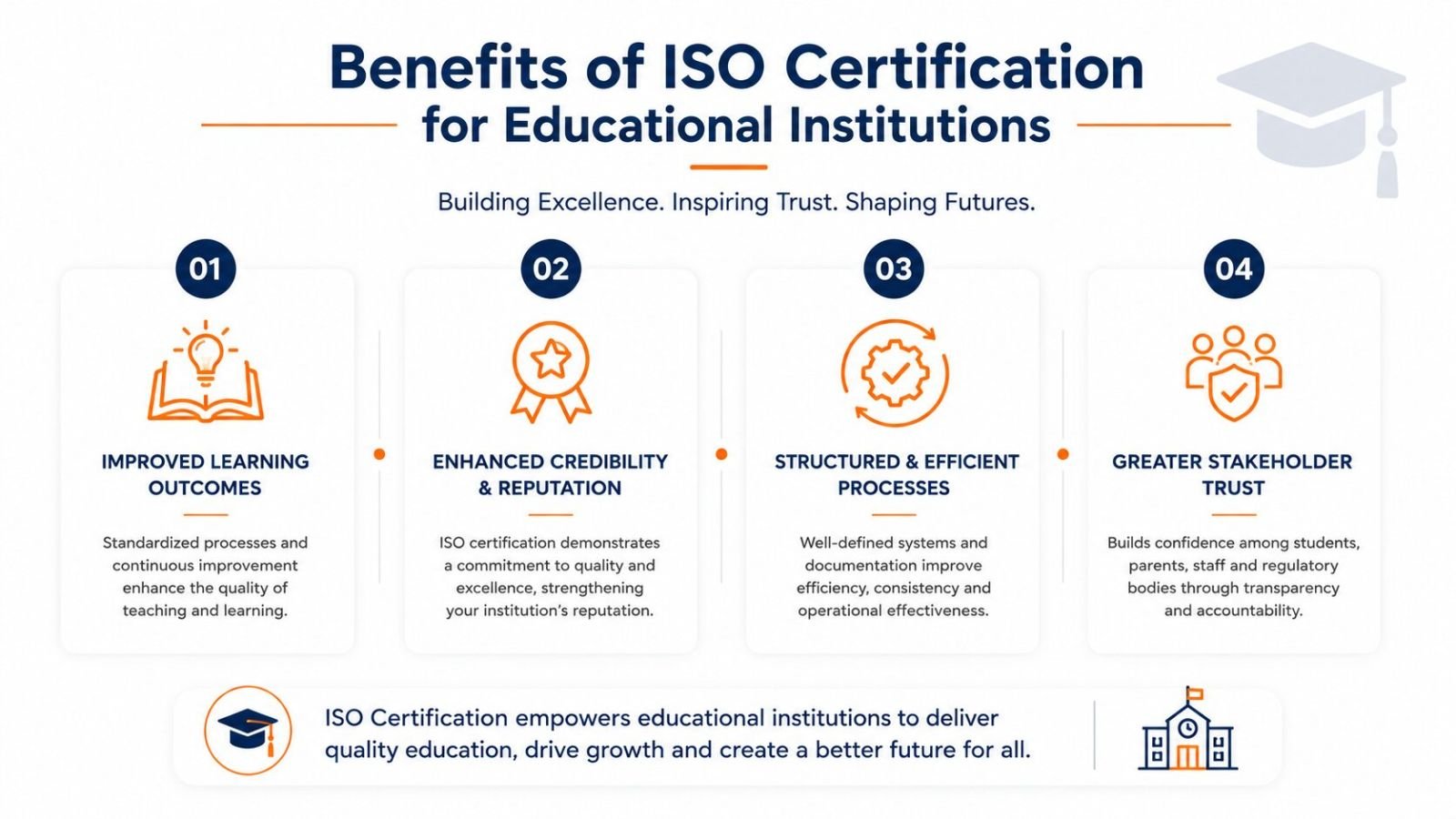
| Benefits of ISO Certification for Educational Institutions |
| Ensures High Quality Standards for Education ISO certification ensures that high-quality standards for education and academic processes are in place across all departments. It provides a framework for consistently delivering quality learning experiences across programmes, levels, and campuses. |
Builds Institutional Credibility and Trust ISO certification provides worldwide approval and recognition from other educational institutions. It builds trust among students, parents, and staff, and signals that the institution meets internationally recognised management and quality standards. |
| Supports Accreditation Applications Implementing ISO — particularly ISO 9001 or ISO 21001 — helps institutions build the documentation, process discipline, and quality management culture that supports NAAC, NBA, and international accreditation applications. Many institutions pursue ISO certification first as a structured step before applying for formal accreditation. |
Enhances Student Satisfaction ISO certification helps institutions improve satisfaction through feedback-based improvement processes, well-defined processes for student support, and clear service standards. ISO 21001 specifically requires institutions to understand and respond to learners' needs and expectations. |
| Attracts International Students and Partners ISO certification can help educational institutions attract international students and establish educational partnerships by demonstrating adherence to globally recognised quality standards. International students, scholarship bodies, and foreign educational partners use ISO certification as an indicator of institutional quality. |
Streamlines Overall Management Effectiveness ISO certification provides institution-wide defined processes, improves quality of education and efficiency in management, and supplies long-term growth and development. It eliminates duplication and creates consistent, well-documented administrative and academic workflows. |
| ISO 21001:2018 vs ISO 9001:2015 — Key Differences for Education |
| Aspect | ISO 21001:2018 | ISO 9001:2015 |
| Designed For | Specifically for educational organisations of all types and sizes | General quality management — applicable to all industries including education |
| Focus | Educational effectiveness, curriculum delivery, learner support, and student satisfaction | Customer satisfaction, process quality, and continuous improvement broadly |
| Accreditation Support | Specifically supports education-sector accreditation requirements | Supports general quality management accreditation and government grant eligibility |
| Best For | Schools, colleges, universities, coaching centres, vocational institutes | Universities, training organisations, professional institutes seeking broad QMS recognition |
| Key Challenges ISO Certification Addresses in Education |
| Delivering Consistent Educational Quality Across Programmes Ensuring consistent quality across diverse academic programmes, campuses, and delivery modes is challenging. ISO certification provides structured quality management frameworks that help institutions standardise educational delivery and student support consistently. |
Meeting Accreditation and Regulatory Requirements Education institutions face multiple accreditation requirements from bodies including NAAC, NBA, and international equivalents. ISO certification helps institutions build and document the quality management processes these accreditation bodies look for. |
| Managing Student Data and Digital Learning Security The digitisation of education has created new data security responsibilities. Student records, examination data, and research information must be protected. ISO 27001 provides an information security management framework that helps educational institutions meet these responsibilities and comply with applicable data protection regulations. |
Ensuring Campus Safety Across Diverse Environments Campus environments include laboratories, workshops, sports facilities, hostels, and construction zones — all carrying occupational health and safety risks. ISO 45001 helps educational institutions systematically manage safety risks and comply with applicable health and safety regulations. |
| Improving Student Satisfaction and Learning Outcomes Student satisfaction and learning outcomes are key institutional performance indicators. ISO 21001 specifically requires institutions to understand and respond to learners' needs, and structured quality management systems help institutions systematically measure, manage, and improve learning quality and student satisfaction. |
Managing Sustainability and Environmental Responsibilities Students, staff, and communities increasingly expect educational institutions to demonstrate environmental responsibility. ISO 14001 and ISO 50001 provide frameworks for managing campus energy use, waste, and environmental impact, supporting green campus initiatives and sustainability commitments. |
| ISO Certification Process for Educational Institutions |
| 1 | Select the Relevant ISO Standard — Identify the most appropriate ISO standard based on your institution's activities and objectives. For schools and colleges: ISO 21001; for universities seeking broader QMS: ISO 9001; for campus safety: ISO 45001; for data security: ISO 27001 |
| 2 | Gap Analysis — Conduct a gap analysis to compare your current processes with ISO standard requirements and identify areas for improvement |
| 3 | Documentation and Implementation — Develop and implement the required documentation including quality manuals, procedures, and records; modify existing processes to meet ISO standard requirements and follow standardised processes |
| 4 | Employee Training and Awareness — Train all staff on ISO standard requirements and implement changes. Ensure all employees understand their roles in maintaining compliance across the institution |
| 5 | Internal Audit — Conduct an internal audit to evaluate compliance and identify non-conformances before the external audit. Address any findings before proceeding to the certification audit |
| 6 | Management Review — Top management reviews audit findings, system performance, and improvement actions to ensure the management system is functioning effectively |
| 7 | Certification Audit (Stage 1 and Stage 2) — An accredited certification body conducts a Stage 1 documentary review followed by a Stage 2 on-site verification that all processes are fully implemented and effective. Upon satisfactory completion, the certification body issues the ISO certificate |
| 8 | Surveillance Audits — Periodic surveillance audits ensure continued compliance and system effectiveness throughout the certificate's 3-year validity period |
| Documents Required for ISO Certification in Education |
| Company/Institution Registration Certificate | Legal proof of business existence |
| Quality Policy and Objectives | Shows commitment to quality and improvement |
| ISO Manuals and Records | Defines documentation of the management system |
| Internal Audit Report | Confirms compliance before certification audit |
| Corrective and Preventive Action (CAPA) Records | Notes non-conformances and improvements |
| Timeline and Validity for ISO Certification in Education |
| Factor | Details |
| Certification Timeline | Generally 1 to 6 months depending on the size and complexity of the educational institution |
| Certificate Validity | ISO certification is generally valid for 3 years, subject to periodic surveillance audits |
| Surveillance Audits | Conducted periodically throughout the 3-year validity period to ensure continued compliance |
| Re-certification | Re-certification audit required at the end of the 3-year validity period to renew the certificate |
| Related ISO Certifications |
| ISO 21001 Certification | ISO 9001 Certification |
| ISO 27001 Certification | ISO 45001 Certification |
| ISO 14001 Certification | ISO Certifications |