IATF 16949 Certification in India
What IATF 16949 certification is, what it really costs, how the two-stage audit works, and what the Rules 6th Edition changed. Built for automotive suppliers in India.


2000
Happy Clients

1500
Expert Advisors

2+
Branch Offices
Free Consultation by Expert
.png)


.png)
.png)
IATF 16949 Certification in India
If your company makes parts, components, or assemblies for the automotive industry, sooner or later a customer will ask for one thing: your IATF 16949 certificate. Without it, supplying a Tier 1 supplier or an OEM is very difficult, and in many cases simply not possible. This page explains what IATF 16949 certification actually is, what it costs, how the process works step by step, and what changed with the new Rules 6th Edition that took effect on January 1, 2025. We answer your questions first and talk about how we help second.
One honest point up front, because it matters. The IATF 16949 certificate can only be issued by an IATF-recognized certification body, such as TUV, DNV, BSI, or Bureau Veritas. No consultant and no government office can issue it. What a good advisor does is get your quality system ready, help you pass the audit the first time, and help you pick the right certification body. That is where we come in.
What Is IATF 16949?
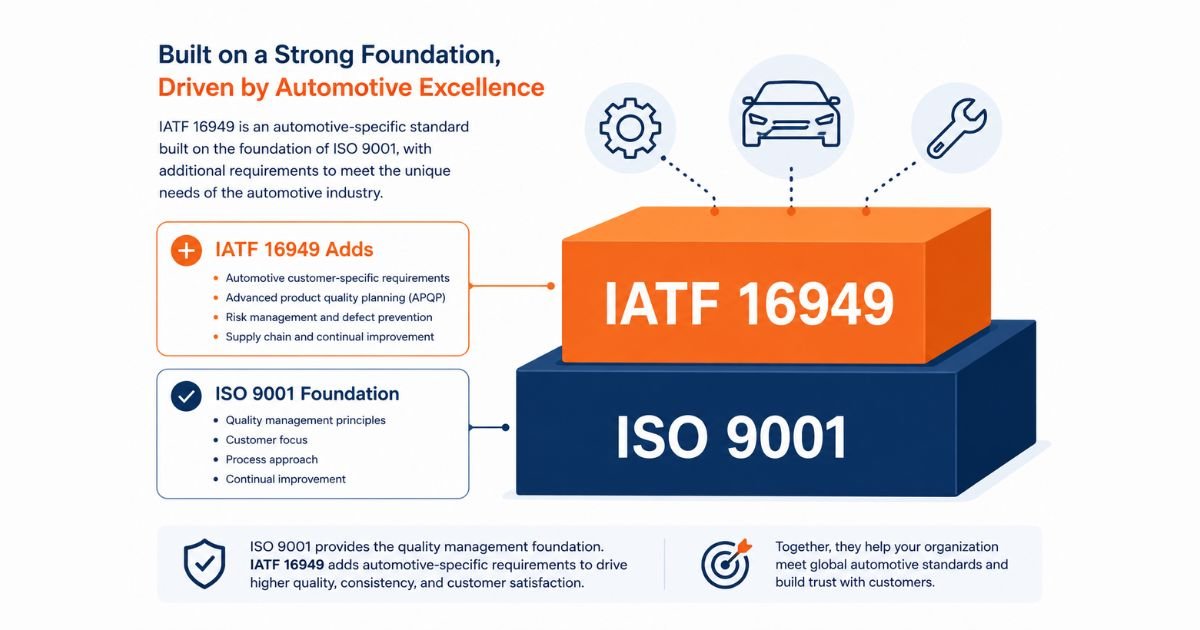
IATF 16949:2016 is the international quality management standard for the automotive industry. It was developed by the International Automotive Task Force (IATF), a group of major vehicle manufacturers and their trade associations, together with ISO. In plain terms, it is the single global rulebook for how an automotive supplier should run its quality system so that it consistently makes good parts and prevents defects.
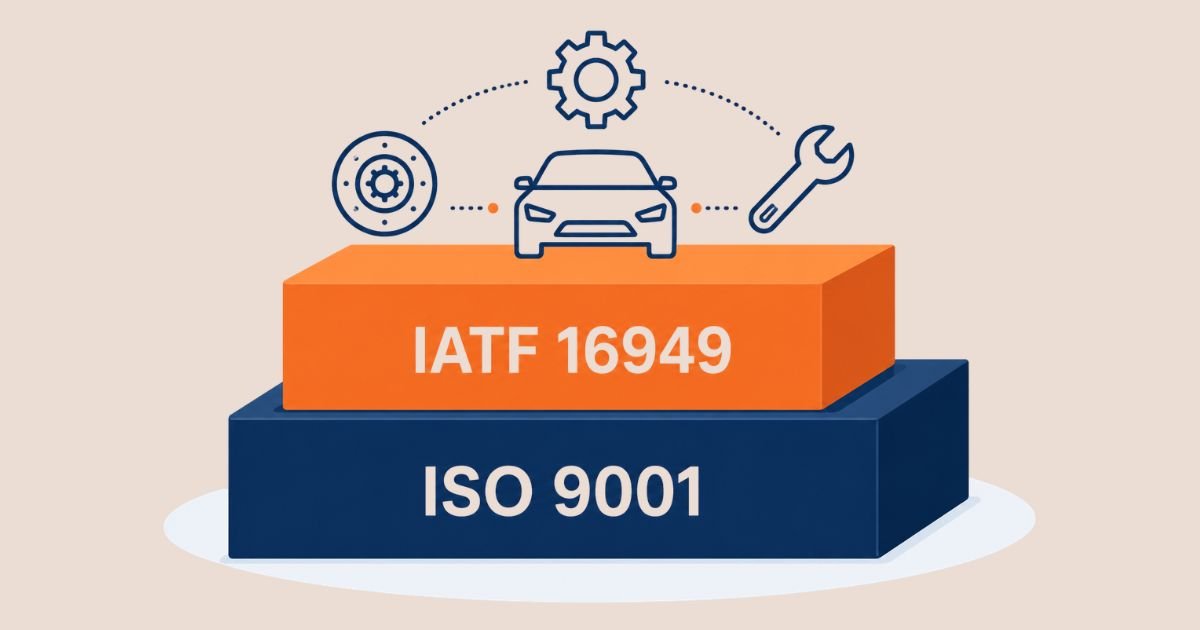
The standard is built on top of ISO 9001. It is not a standalone document; it takes the general quality management requirements of ISO 9001 and adds strict, automotive-specific requirements on top. So an IATF 16949 quality system includes everything ISO 9001 asks for, plus the extra discipline the car industry demands, such as defect prevention, risk management, and the core automotive tools (APQP, PPAP, FMEA, MSA, and SPC). The whole focus is on preventing errors rather than catching them after they happen.
IATF 16949 replaced the older ISO/TS 16949 standard in October 2016. If you still hear people say "TS 16949," they are talking about the previous version, which is no longer valid. The current and valid standard is IATF 16949:2016.
| Quick facts | Detail |
| Full form of IATF | International Automotive Task Force |
| Current standard | IATF 16949:2016 (replaced ISO/TS 16949 in October 2016) |
| Based on | ISO 9001 (automotive-specific supplement, not standalone) |
| Current rules for auditors | Rules 6th Edition, effective 1 January 2025 |
| Certificate validity | 3 years, with annual surveillance audits |
| Who can issue it | Only an IATF-recognized certification body |
Who Needs IATF 16949 Certification?
The standard applies to any organization that manufactures parts, components, or assemblies for supply to the automotive industry. If a car company or its suppliers use what you make, IATF 16949 is likely relevant to you.
In practice, this covers a wide range of Indian businesses: manufacturers of engine and transmission parts, sheet metal and forgings, plastic and rubber components, electricals and wiring harnesses, castings, fasteners, and accessory parts. India has a large and growing automotive component sector, and for many of these companies certification is not a nice-to-have; it is the entry ticket to the supply chain. A supplier without a valid certificate has little chance of supplying a Tier 1 supplier, and no realistic chance of supplying an OEM that participates in the IATF.
One important detail that surprises many first-time applicants: IATF 16949 is site-specific. Certification is granted only to locations where actual manufacturing happens, such as assembly, welding, heat treatment, or painting. A head office, a design center, or a warehouse on its own cannot be certified; support functions are audited as part of a manufacturing site, not separately. So you certify the plant where value is added, not the company in the abstract.
Benefits of IATF 16949 Certification
Certification is demanding, so it is fair to ask what you actually get for the effort. The benefits are real and mostly commercial.
| Benefit | What it means for you |
| Access to the supply chain | Most OEMs and Tier 1 suppliers require it before they will place an order. It opens doors that stay closed otherwise. |
| Fewer defects and less waste | The core tools force you to prevent problems early, which lowers scrap, rework, and warranty costs. |
| Stronger customer confidence | A globally recognized certificate tells customers your quality system has been independently checked. |
| One system for many customers | Instead of a different quality scheme per customer, you run one harmonized system across the automotive industry. |
| Better internal discipline | Preparing for audit forces you to fix real gaps in your processes, not just paperwork. |
How Much Does IATF 16949 Certification Cost?
This is the question everyone asks and almost no certification website answers honestly, because the true cost depends on your specific situation. We will not quote a single fake number. Instead, here is how the cost is actually made up, so you can build a realistic estimate for your plant.
The total cost of IATF 16949 certification has several parts, and the audit fee is only one of them.
| Cost component | What drives it |
| Certification body audit fee | Priced in audit days. The number of audit days is set by IATF rules based on your headcount, number of shifts, and processes. More people and more sites mean more days. |
| Number of sites | Each manufacturing site adds cost. Remote support locations are handled differently under the rules. |
| Consulting or readiness support | Optional but common. Getting the system right before the audit is usually cheaper than failing and re-auditing. |
| Internal cost of implementation | Staff time, training, documentation, and any process changes needed to meet the standard. |
| Ongoing surveillance audits | Annual audits over the three-year cycle, plus recertification at the end. This is a recurring cost, not one-time. |
Three honest points on cost. First, be wary of any provider promising a fixed low price without knowing your headcount and number of sites, because audit days are set by IATF rules, not by the seller. Second, a proper readiness process usually saves money overall, because the biggest hidden cost is failing the audit and paying for a repeat. Third, remember it is an ongoing cost: you pay for surveillance audits every year, not just once. For a realistic estimate based on your actual plant size and processes, our team can walk you through it; details are at the end of this page.
The IATF 16949 Certification Process, Step by Step
Certification is not a one-time event; it is a three-year cycle that starts with a two-stage audit and continues with annual checks. Here is the full journey.
Step 1: Implement your quality system
Before any external auditor gets involved, you build and run a quality system that meets IATF 16949 and any customer-specific requirements. Crucially, you need to have the system actually running and producing real performance data. Most bodies expect at least twelve months of records before they will certify you, because they need evidence the system works in practice, not just on paper.
Step 2: Gap assessment and readiness
You (often with an advisor) check your current processes against the standard, find the gaps, and fix them. This is where good preparation pays off. Under the new Rules 6th Edition, formal pre-assessment or gap-analysis audits by the certification body are no longer allowed, so this readiness work has to be done by you or your advisor, not by the auditor who will certify you.
Step 3: Stage 1 audit (readiness review)
An IATF-recognized certification body sends an auditor to check whether you are ready. This stage reviews your documentation and confirms the system is in place and mature enough to move forward. If there are gaps, you get a report and a chance to correct them before Stage 2.
Step 4: Stage 2 audit (the main audit)
This is the full, in-depth audit of how your quality system works in practice, on the shop floor. The auditor checks effectiveness against every relevant requirement and your customer-specific requirements. Any non-conformities found must be addressed within set timelines: typically 20 calendar days to respond to a major non-conformity and 60 calendar days for a minor one. Major issues usually require the auditor to verify the fix before the certificate can be granted.
Step 5: Certification decision and certificate
Once non-conformities are closed, the certification body makes the decision and, if positive, issues your IATF 16949 certificate. Your details are entered into the official IATF database, where customers can verify your certificate at any time. The certificate is valid for three years.
Step 6: Annual surveillance and recertification
Certification is maintained through surveillance audits at 12-month intervals during the three-year cycle. These are partial audits that confirm you are still compliant and improving. At the end of three years, a full recertification audit renews the certificate. Miss a surveillance audit window and you can lose your certification, so the cycle has to be managed carefully.
What Changed: IATF 16949 Rules 6th Edition (2025)
This is where many suppliers are confused right now, so here is the clear version. There are two separate things: the standard and the rules.
The standard is IATF 16949:2016, and it has not changed. The requirements your quality system must meet are still the 2016 requirements. What changed is the Rules for Achieving and Maintaining IATF Recognition, which moved to the 6th Edition, effective 1 January 2025. The rules govern how certification bodies plan and run audits, not what your quality system must contain. So the 6th Edition changes the audit process, not the standard itself.
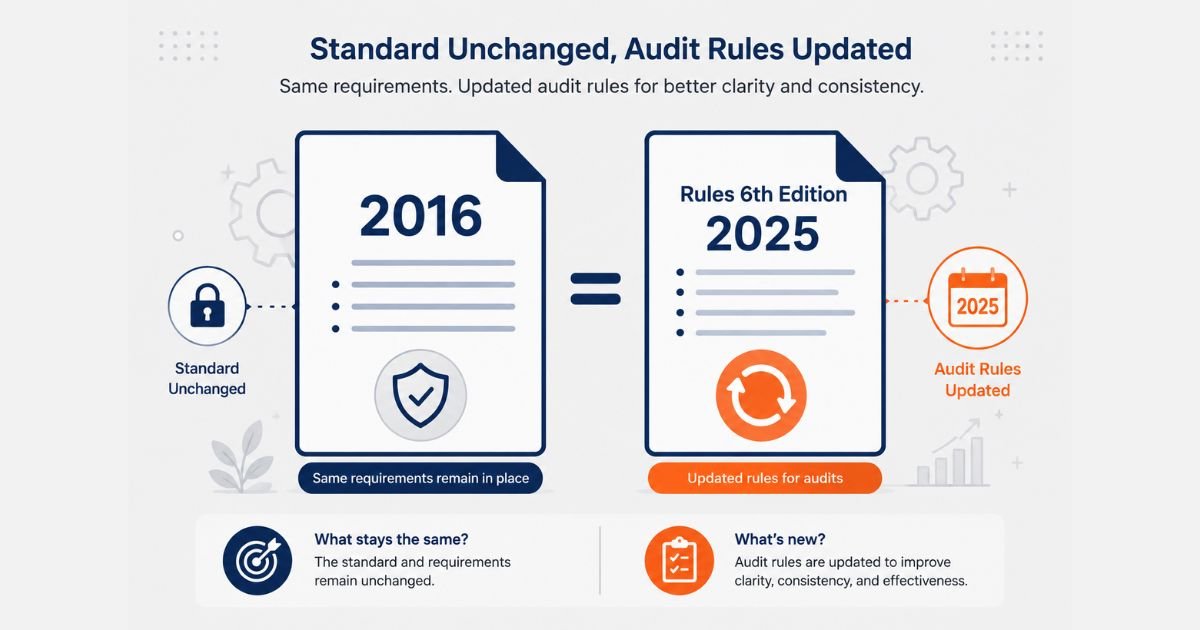
The most important practical changes in the Rules 6th Edition include the following.
| Change under Rules 6th Edition | Why it matters to you |
| No more pre-assessment or gap-analysis audits by the CB | You must get ready on your own or with an advisor; the certifying body can no longer do a practice run for you. |
| Stricter audit scheduling and time caps | Audit days and planning are more tightly controlled, which affects timelines and how audits are booked. |
| Extended Manufacturing Site (EMS) redefined | A nearby site can be included in your main certificate only if it is within about 16 km (10 miles) or 60 minutes of the main site; otherwise it is a separate certification. |
| Two surveillance audits in the three-year cycle | Clearer, standardized surveillance rhythm across the cycle. |
| More evidence required for major non-conformities | You must submit correction, root-cause analysis, containment, and a systemic corrective action plan. |
Looking ahead, a fuller revision of the IATF 16949 standard itself (a 2nd edition) is expected around 2027, after the planned ISO 9001:2026 update, since IATF 16949 is built on ISO 9001 and follows its revision. Nothing is final yet, so for now IATF 16949:2016 remains the valid standard. We track these changes and will tell you what actually affects your certification when the time comes.
The Ten Clauses of IATF 16949
IATF 16949 follows the same ten-clause structure as ISO 9001, which makes the two easier to run together. Clauses 1 to 3 are introductory (scope, references, terms), and the real requirements sit in clauses 4 to 10.
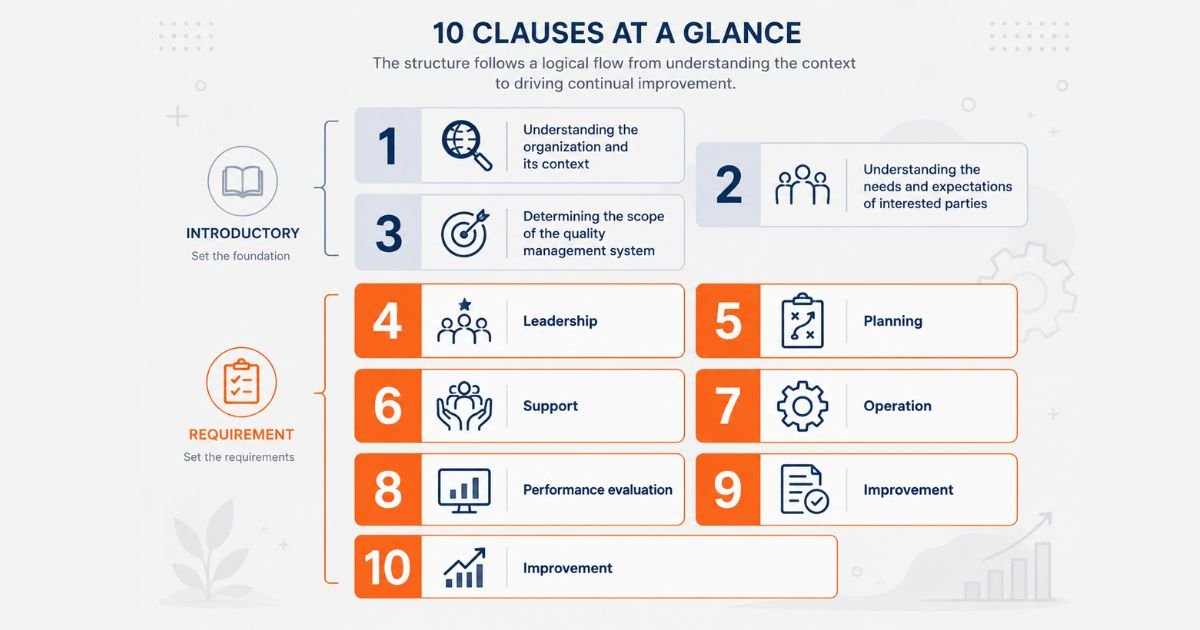
| Clause | What it covers |
| 1 to 3 | Scope, normative references, and terms and definitions |
| 4. Context of the organization | Understanding your business, interested parties, and the scope of your quality system |
| 5. Leadership | Top management commitment, quality policy, roles and responsibilities |
| 6. Planning | Addressing risks and opportunities, quality objectives, planning changes |
| 7. Support | Resources, people, competence, infrastructure, and documented information |
| 8. Operation | The core: product design, control of production, and the automotive tools (APQP, PPAP, FMEA, and more) |
| 9. Performance evaluation | Monitoring, measurement, internal audit, and management review |
| 10. Improvement | Nonconformity, corrective action, and continual improvement |
Clause 8 is usually the heaviest for automotive suppliers, because that is where the core tools live. If your team is new to APQP, PPAP, FMEA, MSA, and SPC, that is normally where the most preparation work is needed.
IATF 16949 vs ISO 9001: What Is the Difference?
People often ask whether they need both. The short answer: IATF 16949 already includes ISO 9001, but it is stricter and automotive-only.
| Point | ISO 9001 | IATF 16949 |
| Who it is for | Any industry | Automotive supply chain only |
| Automotive core tools | Not required | Required (APQP, PPAP, FMEA, MSA, SPC) |
| Where you can certify | Flexible | Manufacturing sites only, site-specific |
| Customer-specific requirements | General | Mandatory, set by each OEM |
| Relationship | The base standard | Includes ISO 9001 plus automotive rules |
So if you are an automotive supplier, IATF 16949 is what your customers want, and it already covers the ISO 9001 ground. If you also serve non-automotive customers who ask specifically for ISO 9001, that is a separate conversation, and we cover ISO 9001 certification separately.
IATF 16949 Certification for Indian Automotive Suppliers
India is one of the largest automotive component manufacturing hubs in the world, with major clusters around Chennai, Pune, the Delhi-NCR belt (Gurgaon and Manesar), and Ahmedabad. For suppliers in these regions, IATF 16949 is often the difference between winning an OEM contract and being left out.

The standard is global, so the requirements are the same in India as anywhere else, and the certificate is issued by the same internationally recognized certification bodies that operate here. What changes locally is the practical side: which certification bodies have a strong presence near you, how to schedule audits efficiently, and how to prepare your team on the core tools. As an Indian advisory firm, this is exactly the ground we help you cover, from readiness to choosing the right body to passing the audit the first time.
How to Verify an IATF 16949 Certificate
Because the certificate carries real commercial weight, it is worth knowing that every genuine IATF 16949 certificate is listed in the official IATF database of recognized organizations. If a supplier gives you a certificate, or if you want to confirm your own is active, you can check it there. Be cautious of any certificate that cannot be verified in the official database, because a certificate that is not in the system does not carry the recognition that customers rely on.