Private Limited Company Registration
Register your Private Limited Company online through the SPICe+ form on the MCA V3 portal in 7 to 10 working days. Expert-assisted, accurate, and fully compliant.


2000
Happy Clients

1500
Expert Advisors

2+
Branch Offices
Free Consultation by Expert
.png)


.png)
.png)

Start Your Private Limited Company Today
Private Limited Company registration is the most preferred way to start a business in India. Defined under Section 2(68) of the Companies Act, 2013, a Private Limited Company (Pvt Ltd) is a separate legal entity that gives its owners limited liability, perpetual succession, and the credibility that investors, banks, and clients trust. The entire company registration in India is now completed online through the SPICe+ form on the MCA V3 portal, and a standard pvt ltd company registration is usually finished in about 7 to 10 working days when documents are in order.
This guide explains everything a first-time founder needs: the meaning of a private company, the minimum requirements, the documents required, the step-by-step SPICe+ process, the real cost breakdown, the benefits, how it compares with an LLP and an OPC, taxation, and the post-incorporation compliance you must not miss. Every legal reference below is drawn from the Companies Act, 2013 and current MCA and Income Tax provisions.
What Is a Private Limited Company?
A Private Limited Company is a business entity registered under the Companies Act, 2013 and regulated by the Ministry of Corporate Affairs (MCA). As defined in Section 2(68), a private company is one that, by its Articles of Association, restricts the transfer of its shares, limits its members to a maximum of 200 (excluding present and past employees who hold shares), and prohibits any invitation to the public to subscribe for its securities.
Once registered, the company becomes a separate legal entity, distinct from the people who own and run it. This means the company can own property, open bank accounts, sign contracts, and sue or be sued in its own name. The liability of the shareholders is limited to the unpaid value of the shares they hold, so their personal assets stay protected if the business runs into debt. Every private company must carry the words "Private Limited" at the end of its name.
Key characteristics of a Private Limited Company include:
- Separate legal identity that exists independently of its shareholders and directors.
- Limited liability for shareholders, restricted to their shareholding.
- Perpetual succession, meaning the company continues even if owners change, retire, or pass away.
- Restricted share transfer, keeping ownership within a closely held group.
- Minimum 2 and maximum 200 members, with a minimum of 2 directors.
Minimum Requirements for Private Limited Company Registration
Before you begin the registration, make sure the following conditions under the Companies Act, 2013 are met. These are the basic eligibility rules for every private limited company registration in India.
| Requirement | Details | Legal Reference |
| Shareholders | Minimum 2 and maximum 200 shareholders. | Sec 3(1)(b) & Sec 2(68) |
| Directors | Minimum 2 and maximum 15 directors. More than 15 requires a special resolution. | Sec 149(1) |
| Resident Director | At least one director must have stayed in India for 182 days or more in the previous financial year. | Sec 149(3) |
| Unique Company Name | The name must not resemble any existing company name or registered trademark. | Rule 8, Companies (Incorporation) Rules, 2014 |
| Minimum Capital | No minimum paid-up capital is required after the Companies (Amendment) Act, 2015. You can start with any amount. | Sec 2(68) |
| Registered Office | Every company must have a registered office address in India capable of receiving official communication. | Sec 12(1) |
| DIN & DSC | Every director needs a Director Identification Number (DIN) and a Class 3 Digital Signature Certificate (DSC). | Sec 153 |
Documents Required for Private Limited Company Registration
Accurate documents are the key to a smooth registration and help you avoid rejections and delays. The documents required for private limited company registration fall into two groups: documents for the directors and shareholders, and documents for the registered office.
For Directors and Shareholders (Indian Nationals)
| Document | Requirement |
| PAN Card | Mandatory as the primary identity proof for all Indian directors and shareholders. Name and date of birth must match other documents. |
| Aadhaar Card | Used for identity verification and DSC OTP authentication. Should be linked to an active mobile number. |
| Address Proof | Bank statement, electricity bill, or mobile or telephone bill not older than 2 months, showing the current residential address. |
| Passport-size Photograph | A recent colour photograph with a plain white background. |
| Digital Signature Certificate | A Class 3 DSC issued by an authorised Certifying Authority, used to sign the incorporation forms. |
For Foreign Nationals and NRIs
Foreign nationals and NRIs can be directors or shareholders in an Indian Private Limited Company. Their passport is mandatory and must be notarised and apostilled (for Hague Convention countries) or consularised, depending on the country of issue. A recent photograph and an overseas address proof not older than 2 months are also required. If the passport is not in English, a certified English translation must be provided.
For the Registered Office
| Document | Requirement |
| Utility Bill | Electricity bill, water bill, or gas bill not older than 2 months, showing the complete address of the premises. |
| No Objection Certificate (NOC) | A signed NOC from the property owner allowing the premises to be used as the registered office. |
| Rent Agreement or Ownership Proof | A rent agreement if the office is rented, or ownership proof if the property is owned. |
Can you use your home address? Yes. A residential address is permitted as the registered office under Section 12. Many startups begin from home to save costs. If the property is rented, you simply need the owner’s NOC and a recent utility bill.
Private Limited Company Registration Process (Step by Step)
The entire process of company registration in India is 100% online through the SPICe+ form on the MCA V3 portal. SPICe+ (Simplified Proforma for Incorporating Company Electronically Plus) is a single integrated form that bundles multiple services, so you do not need to visit any government office. Here is how how to register a private limited company online works, step by step.
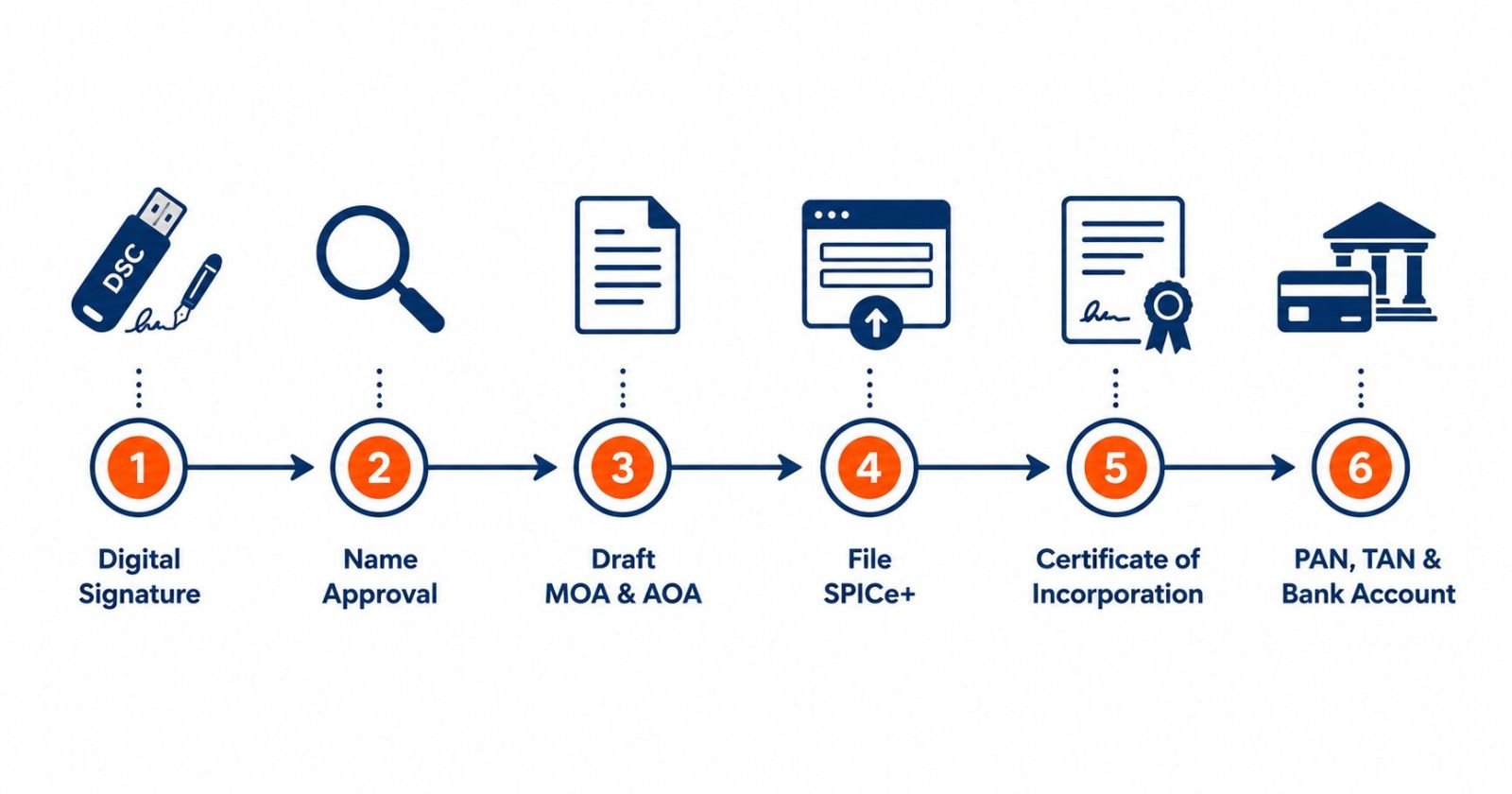
Step 1: Obtain Digital Signature Certificates (DSC). Every proposed director and subscriber needs a Class 3 DSC to sign the incorporation forms electronically. The DSC is issued by an authorised Certifying Authority after a short video e-KYC.
Step 2: Reserve the Company Name (SPICe+ Part A). Apply for name approval through SPICe+ Part A on the MCA V3 portal. It is wise to run a name and trademark search first to avoid rejection. Once approved by the Central Registration Centre, the name is reserved for 20 days.
Step 3: Draft the MOA and AOA. Prepare the Memorandum of Association (which defines the company objectives) and the Articles of Association (the internal rulebook). These are filed electronically as e-MOA (INC-33) and e-AOA (INC-34).
Step 4: File SPICe+ Part B with Linked Forms. Submit SPICe+ Part B (INC-32) with director, shareholder, capital, and registered office details, along with the INC-9 declaration and the AGILE-PRO-S (INC-35) form. This single filing also applies for DIN, PAN, TAN, GSTIN, EPFO, ESIC, and a bank account. A practising CA, CS, or CMA certifies the forms.
Step 5: Get the Certificate of Incorporation. The Registrar of Companies reviews the application. On approval, it issues the Certificate of Incorporation (COI) under Section 7(2), which carries your unique 21-digit Corporate Identification Number (CIN), along with the company PAN and TAN.
Step 6: Complete Post-Incorporation Steps. Open a company current account, deposit the subscribed share capital, and file Form INC-20A (declaration of commencement of business) within 180 days under Section 10A.
Key Forms Used in Company Registration
| Form | Purpose |
| SPICe+ Part A | Company name reservation. |
| SPICe+ Part B (INC-32) | Main incorporation application with company details. |
| e-MOA (INC-33) | Electronic Memorandum of Association. |
| e-AOA (INC-34) | Electronic Articles of Association. |
| INC-9 | Declaration by subscribers and first directors. |
| AGILE-PRO-S (INC-35) | Linked registrations: GSTIN, EPFO, ESIC, profession tax, and bank account. |
| INC-20A | Declaration of commencement of business, filed within 180 days. |
Timeline for Private Limited Company Registration
| Stage | Activity | Estimated Time |
| Day 1 to 2 | Collect KYC and issue Digital Signature Certificates. | 1 to 2 working days |
| Day 2 to 4 | Name reservation through SPICe+ Part A. | 1 to 2 working days |
| Day 4 to 7 | Draft MOA and AOA, file SPICe+ Part B and linked forms. | 2 to 3 working days |
| Day 7 to 10 | ROC review and issue of Certificate of Incorporation. | 1 to 2 working days |
| Total | From DSC to Certificate of Incorporation | 7 to 10 working days |
Timelines assume that documents are accurate and the MCA portal is functioning normally. Delays can occur if a name is rejected, documents are incomplete, or during peak filing periods.
Private Limited Company Registration Fees and Cost
The total cost of a private limited company registration is made up of a few separate components. It is important to understand each one, because the biggest variable, stamp duty, changes from state to state. The figures below are indicative ranges and the exact amount is calculated by the MCA V3 portal at the time of filing based on your authorised capital and the state of your registered office.
| Cost Component | Details |
| MCA Government Fee | The SPICe+ filing fee is nil for authorised capital up to ?15 lakh. Higher capital attracts fees as per the Companies (Registration Offices and Fees) Rules, 2014. |
| DIN | Included within the SPICe+ form. No separate fee when applied during incorporation. |
| PAN and TAN | Auto-allotted with incorporation. No separate cost. |
| Digital Signature Certificate | Approximately ?1,500 to ?2,500 per director (indicative). Charged by the Certifying Authority. |
| Stamp Duty | A state-level charge on the MOA and AOA, calculated on authorised capital. It varies significantly by state and is auto-computed on the MCA V3 portal. |
| Professional Fees | Charges for expert assistance with drafting, filing, and certification. Varies by service provider. |
A note on stamp duty: Because stamp duty is levied by each state government, the government portion of the cost differs depending on where your registered office is located. States such as Delhi, Karnataka, and Tamil Nadu are generally on the lower side, while some other states levy higher stamp duty. This is the single biggest reason the total registration cost varies across India. A tip to keep costs low is to start with a modest authorised capital (many startups begin in the ?1 lakh to ?10 lakh range) and increase it later when you raise funds.
Benefits of Registering a Private Limited Company
Choosing a pvt ltd company structure over a proprietorship or partnership offers several long-term advantages that make it the default choice for startups and growing businesses.
- Limited Liability Protection: Shareholders are liable only up to the unpaid value of their shares, so personal assets are protected from business debts.
- Separate Legal Entity: The company can own property, sign contracts, and take legal action in its own name, independent of its owners.
- Perpetual Succession: The company continues to exist even when directors or shareholders change, ensuring business continuity.
- Easy Access to Funding: Venture capitalists and angel investors strongly prefer investing in a Private Limited Company, which can issue equity shares and ESOPs.
- Enhanced Credibility: A registered company builds trust with customers, vendors, banks, and investors, and its details are publicly verifiable on the MCA portal.
- 100% FDI Allowed: Most sectors permit 100% Foreign Direct Investment through the automatic route, making it easy for foreign investors to participate.
- Tax and Startup Benefits: Eligible for Startup India recognition and can opt for a concessional corporate tax rate under Section 115BAA.
- Easy Transfer of Ownership: Ownership can be transferred by transferring shares, without disrupting the business.
Private Limited Company vs LLP vs OPC: Which Should You Choose?
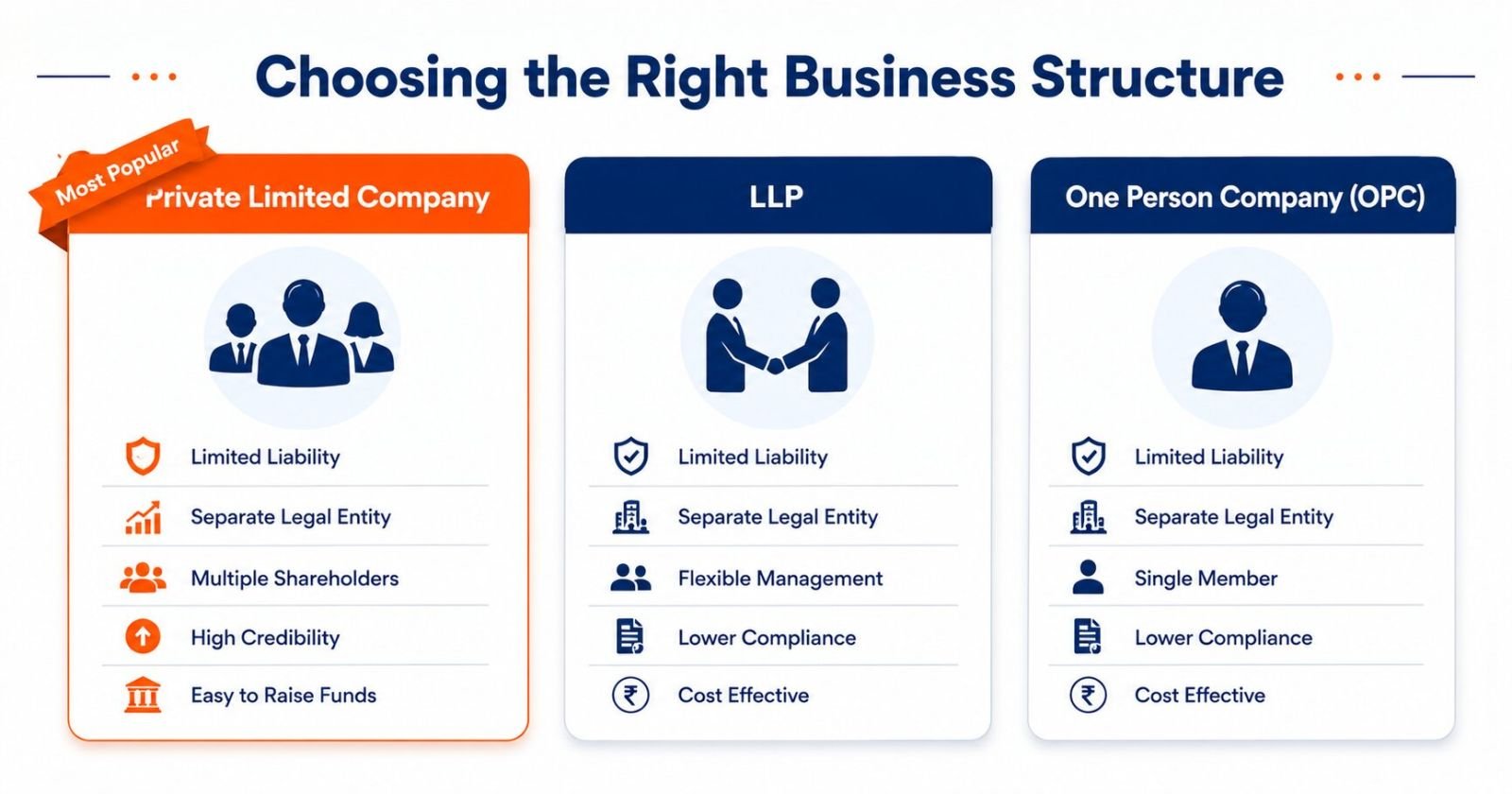
A Private Limited Company is not the only option. A Limited Liability Partnership (LLP) and a One Person Company (OPC) also offer limited liability but differ in ownership, funding, taxation, and compliance. The table below compares the three so you can pick the right structure for your goals.
| Feature | Private Limited Company | LLP | OPC |
| Governing Law | Companies Act, 2013 | LLP Act, 2008 | Companies Act, 2013 |
| Minimum Owners | 2 shareholders and 2 directors | 2 designated partners | 1 member and 1 nominee |
| Maximum Owners | 200 shareholders, 15 directors | No upper limit | 1 member only |
| Ideal For | Startups, VC-funded and scalable businesses | Professional firms and small businesses | Solo founders wanting corporate status |
| Funding | Best for equity and VC funding, ESOPs | Limited flexibility for equity | Cannot issue equity to multiple investors |
| Compliance | Higher: audit, board meetings, AOC-4, MGT-7 | Moderate: Form 8 and Form 11 | Similar to Pvt Ltd with some relaxations |
| FDI | Widely allowed under automatic route | Allowed in 100% FDI sectors | Not allowed |
How to decide: Choose a Private Limited Company if you plan to raise venture capital, issue ESOPs to employees, or scale into a large business. Choose an LLP if you run a professional practice, such as a firm of consultants, and want limited liability with lighter compliance. Choose an OPC if you are a solo founder who wants corporate status now, and are comfortable converting to a Private Limited Company later as the business grows.
Taxation of a Private Limited Company (AY 2026-27)
A domestic Private Limited Company can be taxed under the regular regime or opt for a concessional regime under the Income Tax Act, 1961. The rates below are for Assessment Year 2026-27.
| Tax Regime | Base Rate | Effective Rate | Key Points |
| Regular Regime | 25% or 30% | Varies with surcharge and cess | 25% if turnover in FY 2023-24 was up to ?400 crore, otherwise 30%. Deductions allowed. |
| Section 115BAA | 22% | About 25.17% | Concessional rate (22% base plus 10% surcharge plus 4% cess). MAT not applicable. Most deductions foregone. |
| Section 115BAB | 15% | About 17.16% | For new manufacturing companies meeting the prescribed conditions. MAT not applicable. |
Companies opting for Section 115BAA or 115BAB are exempt from Minimum Alternate Tax (MAT) under Section 115JB. The option under Section 115BAA is exercised by filing Form 10-IC and, once chosen, applies to all future years and cannot be withdrawn. Companies choosing these concessional regimes must forego most deductions, except a few such as those under Sections 80JJAA and 80M. You should model both options before deciding, and a Chartered Accountant can help you pick the more efficient route for your business.
Post-Incorporation Compliance Checklist
Registration is only the beginning. Once your company is incorporated, you must meet several compliance requirements within set deadlines under the Companies Act, 2013. Missing them attracts penalties, and some defaults can even lead to the company being struck off.
| Timeline | Required Activity |
| Immediate | Open a company current account and deposit the subscribed share capital from the shareholders. |
| Within 30 Days | Appoint the first statutory auditor at the first board meeting and file Form ADT-1 (Section 139). |
| Within 60 Days | Issue share certificates to all subscribers of the MOA (Section 46). |
| Within 180 Days | File Form INC-20A, the declaration of commencement of business (Section 10A). |
| Annual | File Form AOC-4 (financial statements, Section 137) and Form MGT-7 or MGT-7A (annual return, Section 92), conduct board meetings and an AGM, file DIR-3 KYC for all directors, and file the company income tax return in Form ITR-6. |
| Important: The 180-Day INC-20A Deadline Form INC-20A (declaration of commencement of business) must be filed within 180 days of incorporation, and you must first deposit the subscribed share capital in the company bank account. Missing this deadline is the single most common post-incorporation default. A company that does not file INC-20A cannot legally begin business or borrow money, and it can face strike-off proceedings. Mark this deadline the day your company is incorporated. |
Foreign Nationals and NRIs Registering a Pvt Ltd Company in India
NRIs and foreign nationals can be directors and shareholders in an Indian Private Limited Company, subject to India’s Foreign Direct Investment policy under FEMA, 1999. Most sectors allow 100% FDI through the automatic route, without prior government approval. However, at least one director must be a resident of India under Section 149(3). Foreign directors must provide a notarised and apostilled passport and overseas address proof. Foreign nationals from countries that share a land border with India require prior security clearance before they can be appointed.