SOC 1 Report Type 1 and Type 2
What SOC 1 Type 1 and Type 2 reports cover, the key difference between them, and how SOC 1 compares to SOC 2 - explained in plain language for service companies.


2000
Happy Clients

1500
Expert Advisors

2+
Branch Offices
Free Consultation by Expert
.png)


.png)
.png)
SOC 1 Report Type 1 and Type 2
A SOC 1 report is an independent audit report that looks at a service company's internal controls over financial reporting. If your company handles something that affects your clients' financial statements, like payroll, loan servicing, data processing, or hosting their financial systems, then your clients (and their auditors) often ask for a SOC 1 report. It comes in two forms, called Type 1 and Type 2. This page explains what a SOC 1 report is, the difference between SOC 1 Type 1 and Type 2, and how SOC 1 compares to SOC 2, in plain language.
Quick note before we start: SOC 1 is a US attestation report issued by a licensed CPA firm under a standard called SSAE 18. There is no "SOC 1 certificate" and no government body that issues it. Anyone who tells you they are "SOC 1 certified" is using the wrong word. The correct term is a SOC 1 report, or being "SOC 1 compliant."
What is a SOC 1 report?
SOC stands for System and Organization Controls. So the SOC 1 full form is System and Organization Controls 1. It is a framework created by the American Institute of Certified Public Accountants (AICPA) in the United States.
A SOC 1 report is the result of an audit. A CPA firm examines the controls at a service organization that could affect its clients' financial reporting, and then issues a report describing those controls and whether they are designed and operating properly. The report falls under the standard SSAE 18, specifically AT-C Section 320. This standard replaced the older SSAE 16, which itself replaced the even older SAS 70.
What a SOC 1 report actually covers
SOC 1 is only about controls that touch financial reporting. This is often written as ICFR, which stands for Internal Controls over Financial Reporting. It does not cover general data security or privacy in a broad sense. That is what SOC 2 is for, which we explain further down.
For example, if your company runs payroll for a client, an error in your process could end up in that client's financial statements. A SOC 1 report gives the client's auditors comfort that your payroll controls are sound.
Who needs a SOC 1 report
A SOC 1 report is meant for service organizations. These are companies that perform an outsourced function for other businesses. Common examples include:
- Payroll processing companies
- Data centres and cloud hosting providers that host financial systems
- Loan and mortgage servicing companies
- Third-party administrators for benefits or claims
- Software companies whose product handles a client's financial transactions
- Managed IT service providers supporting financial applications
If your service could affect the numbers in a client's financial statements, your client's auditors will usually want to see a SOC 1 report from you.
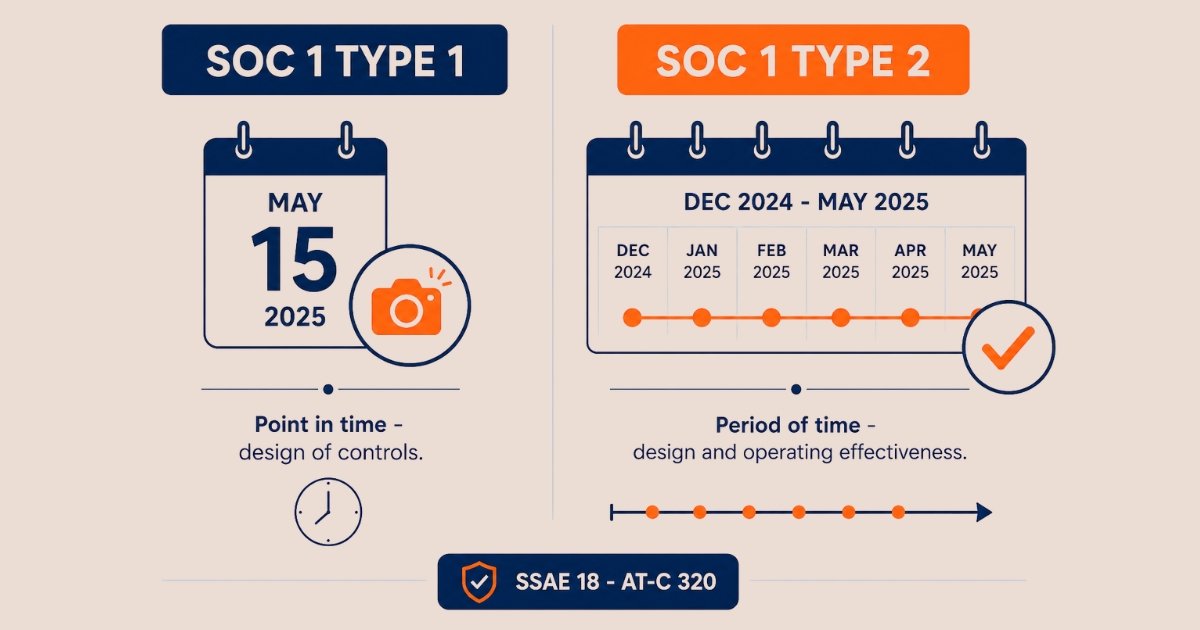
SOC 1 Type 1 and Type 2 - the core difference
Every SOC 1 report is either a Type 1 or a Type 2. This is the single most important thing to understand, and it is the question most people are actually asking when they search for "SOC type 1 and type 2." Here is the difference at a glance.
| Aspect | SOC 1 Type 1 | SOC 1 Type 2 |
| What it assesses | The suitability of the design of controls | The design and the operating effectiveness of controls |
| Time frame | A single point in time (one specific date) | A period of time (usually six months or more) |
| Testing of controls | Controls are described and their design is checked, but they are not tested over time | Controls are tested to see how well they actually worked across the whole period |
| Typical use | A starting point, often the first report a new service company gets | The report most clients ultimately ask for |
| Level of assurance | Lower, because it is only a snapshot | Higher, because it shows controls worked over time |
| Standard | SSAE 18, AT-C 320 | SSAE 18, AT-C 320 |
SOC 1 Type 1 report - a point in time
A SOC 1 Type 1 report looks at your controls on one specific date. The auditor checks whether the controls are designed properly and are in place as of that date. The auditor does not test whether those controls actually worked over a period of time.
Think of it as a snapshot. It answers the question: "On this date, are the right controls designed and in place?" Because it does not test controls over time, a Type 1 report gives a lower level of assurance than a Type 2. It is often used as a first step, so a company can show progress quickly while it works towards a Type 2.
SOC 1 Type 2 report - a period of time
A SOC 1 Type 2 report goes further. It covers a period of time, usually six months or longer, called the test period. During this period the auditor tests whether the controls actually operated effectively, not just whether they were designed well.
This is why the phrase "type 1 and type 2 SOC report" comes up so often. Type 2 answers a stronger question: "Over the last six months (or more), did these controls actually work the way they are supposed to?" Because it involves real testing over time, a SOC 1 Type 2 report gives clients much more confidence. This is the report most clients eventually require.
Which one do you need first?
Many service organizations start with a Type 1 because it is faster to obtain. It lets them show clients that the right controls are designed and in place. They then move to a Type 2, which tests those controls over a period and provides the deeper assurance clients want. If a client is specifically asking for a Type 2, a Type 1 on its own will usually not be enough, but it can be a sensible stepping stone.
SOC 1 vs SOC 2 (and SOC 3)
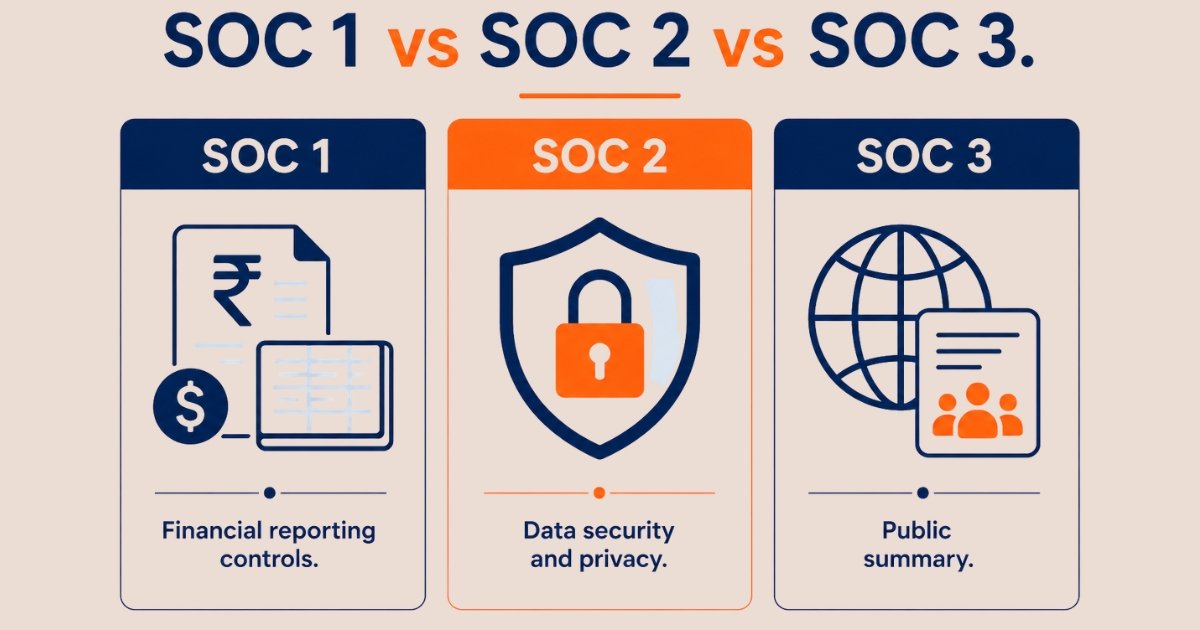
People often search for "SOC 1 vs SOC 2" and "difference between SOC 1 and SOC 2" together, so it helps to be clear on this. The two reports use a similar audit approach, but they cover different things and are meant for different readers.
| Report | Focus | Who it is for |
| SOC 1 | Controls that affect a client's financial reporting | Clients and their financial auditors |
| SOC 2 | Security, availability, processing integrity, confidentiality and privacy of data | Clients, their vendor risk teams, and management |
| SOC 3 | Same subject as SOC 2, but a short summary version | The general public (can be shared openly) |
When you need SOC 1 vs SOC 2
The simple rule is this. If your service affects your clients' financial numbers, you need a SOC 1. If your clients care about how you protect their data, its security, uptime, and privacy, you need a SOC 2. Some companies need both. This is also the answer to "SOC 1 Type 2 vs SOC 2": a SOC 1 Type 2 is still about financial reporting controls over a period, while any SOC 2 is about data protection controls.
We will cover SOC 2 Type 1 and Type 2 in detail on a separate page.
The SOC 1 audit process
The path to a SOC 1 report usually follows these steps. This also answers the common question about the SOC 1 Type 2 process.
- Readiness review. You (often with help from an advisor) identify the control objectives relevant to your clients' financial reporting and check whether your controls are ready.
- Fix any gaps. You put in place or improve any controls that are missing or weak.
- Type 1 report (optional first step). A CPA firm checks that controls are designed and in place as of a chosen date.
- Observation period. For a Type 2, the controls run for a period of time, usually six months or more.
- Type 2 testing and report. The CPA firm tests how well the controls operated over that period and issues the SOC 1 Type 2 report.
SOC 1 report example - what is inside
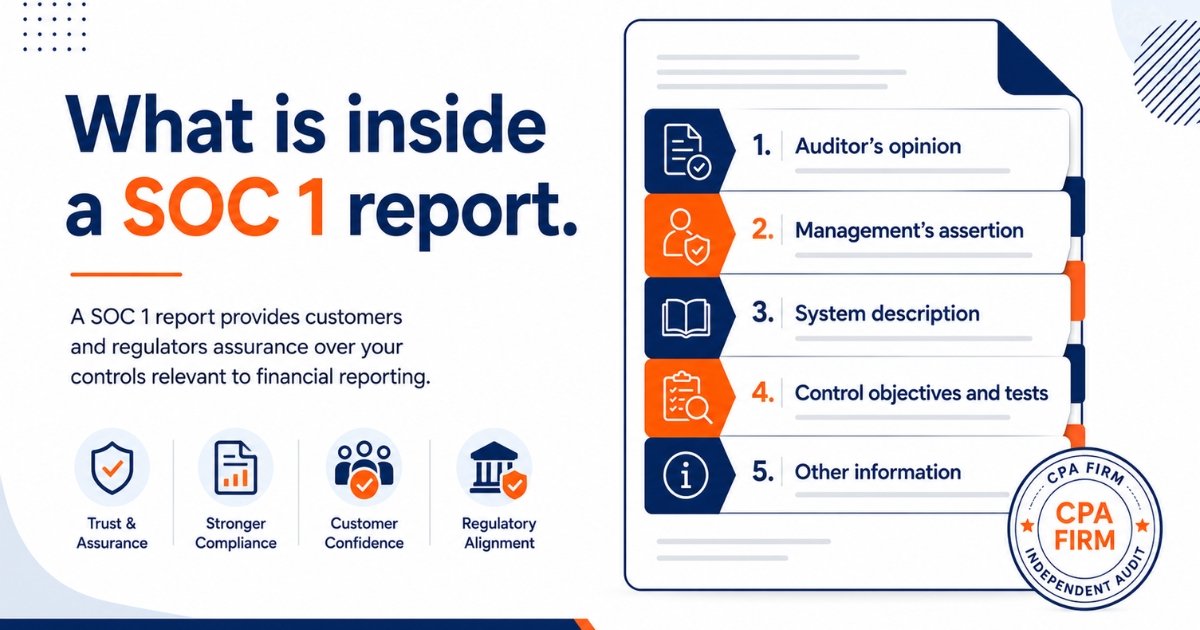
A SOC 1 report is a formal document, not a certificate or a logo. A typical SOC 1 report (including an AICPA SOC 1 Type 2 report) contains these main sections:
- The auditor's opinion. The CPA firm's formal opinion on whether the controls are suitably designed (and, for Type 2, operating effectively).
- Management's assertion. A written statement from your company's management about the system and its controls.
- Description of the system. An explanation of the service you provide and the controls around it.
- Control objectives, controls, and tests. For a Type 2, this section also shows the tests the auditor performed and the results.
- Other information. Any additional details the service organization chooses to include.
SOC 1 for Indian service companies
SOC 1 is a US standard, but it matters a great deal to Indian companies. If you run an IT services, BPO, SaaS, fintech, or payroll company and you serve clients in the US, UK, or elsewhere abroad, those clients' auditors will often ask you for a SOC 1 report before or during their own financial audit. In many cases you cannot win or keep the contract without one.
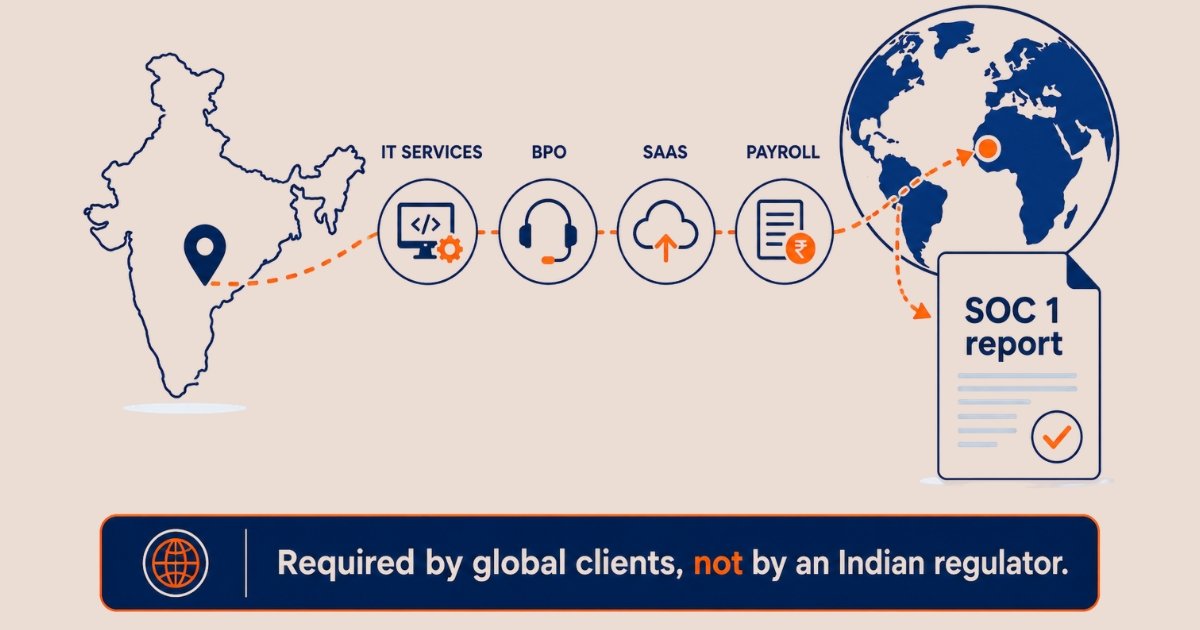
To be clear and honest about this: a SOC 1 report is issued by a licensed CPA firm under US attestation standards. It is not something an Indian government department issues, and there is no statutory fee for it. What an Indian service company needs is the right preparation, the right control objectives, and coordination with a suitable audit firm. That is where we can help.