ISO Certification for Food Industry
ISO food certification primarily refers to ISO 22000 — the internationally recognised standard for Food Safety Management Systems (FSMS). It ensures food safety across the entire supply chain from farm to fork, by identifying and controlling food safety hazards and integrating HACCP and GMP principles. FilingCompany helps businesses across India achieve ISO 22000 and related food industry certifications efficiently.


2000
Happy Clients

1500
Expert Advisors

2+
Branch Offices
Free Consultation by Expert
.png)


.png)
.png)
ISO Certification for Food Industry — ISO 22000:2018, HACCP, GMP and Food Safety Standards for Food Manufacturers and Processors in India
ISO food certification primarily refers to ISO 22000:2018 — the internationally recognised standard for Food Safety Management Systems (FSMS). ISO 22000 details the guidelines and requirements for designing an FSMS that enables food industry players to identify and control food safety hazards across the entire supply chain — from farm to fork.
ISO 22000 is applicable to all organisations in the food chain, including livestock and crop farmers, animal feed producers, food manufacturers and processors, warehouse operators and distributors, retailers, restaurateurs, and food service professionals. ISO 22000:2018 is the current version, published in 2018 and replacing the previous ISO 22000:2005 version.
ISO 22000 integrates elements of Good Manufacturing Practices (GMP), Hazard Analysis Critical Control Points (HACCP), and other leading preventive procedures into a comprehensive Food Safety Management System. An ISO 22000 FSMS is more rigorous than standalone HACCP implementation, as it also covers management system requirements, communication across the supply chain, and continual improvement.
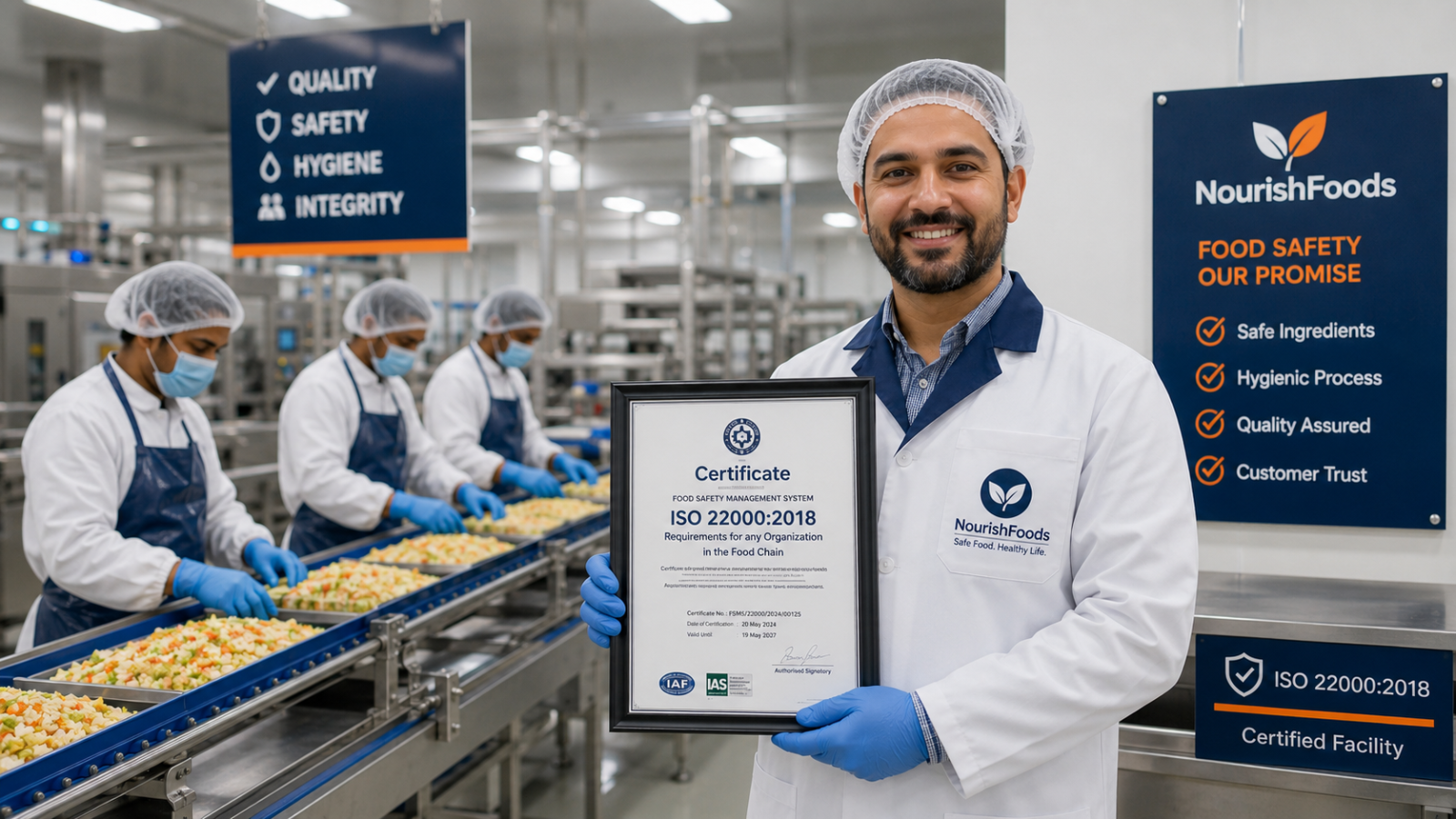

Expertise in ISO Certification for Food Industry

Enquiry Form
Among Asia Top
100
Consulting Firm

Get Consultation
Lowest Fees
100,000 + Clients.

Service Delivery
4.9 Customers Rating
50+ Offices
Contact us today to schedule your appointment.
You can call us on +919953004880 or write to us at info@efilingcompany.com
ISO Standards Applicable to the Food Industry
| ISO Standard | Full Name | Relevance to Food Industry |
| ISO 22000:2018 | Food Safety Management System (FSMS) | Primary food safety standard — integrates HACCP and GMP principles; applicable to all organisations across the food supply chain from farm to fork |
| ISO 9001:2015 | Quality Management System | Supports consistent product quality and customer satisfaction; meets quality expectations of institutional buyers, retailers, and export markets |
| ISO 14001:2015 | Environmental Management System | Helps food manufacturers manage packaging waste, energy consumption, water use, and environmental compliance; increasingly required by global customers with sustainability commitments |
| ISO 45001:2018 | Occupational Health and Safety Management System | Reduces workplace accidents and occupational health risks in farms, food factories, and packaging facilities |
| ISO 50001:2018 | Energy Management System | Helps food manufacturers improve refrigeration, cooking, and food packaging processes; cuts energy costs; improves operational efficiency; meets energy sustainability targets |
| ISO/IEC 27001:2022 | Information Security Management System | Protects digital supply chains, sensitive production data, and customer information from cyber threats; increasingly relevant as food manufacturers digitise operations |
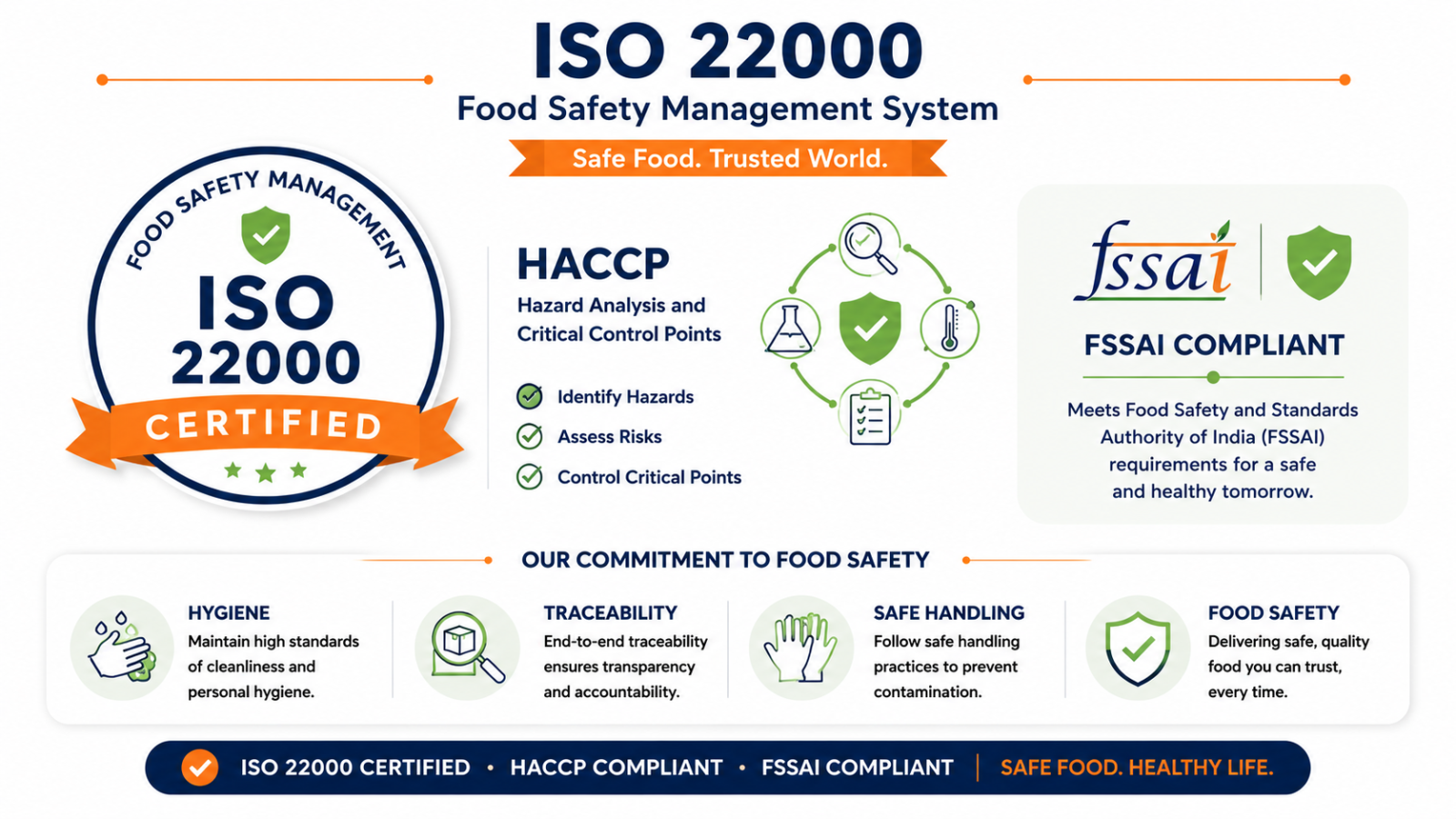
| Key Benefits of ISO 22000 Certification for Food Businesses |
| Detect and Mitigate Food Safety Hazards ISO 22000 requires developing risk-based thinking across your organisation. It establishes systematic processes for identifying, assessing, and controlling food safety hazards before they cause harm to consumers. |
Reduce Downtime and Prevent Recalls Through the implementation of food safety best practices and preventive controls, ISO 22000 helps food businesses avoid costly product recalls, regulatory actions, and the reputational damage associated with food safety failures. |
| Meet Regulatory and Export Requirements ISO 22000 certification demonstrates compliance with food safety regulations across Europe, North America, Asia-Pacific, and the Middle East — enabling food manufacturers to access export markets and meet regulatory requirements of multiple jurisdictions. |
Boost Consumer Trust ISO 22000 provides worldwide recognition of the safety of your products, processes, and services — building consumer confidence and strengthening your brand's credibility in the marketplace. |
| Secure Market Access and Retail Approvals Major retailers, food brands, and institutional buyers increasingly require ISO 22000 or FSSC 22000 as a supply chain qualification condition. Certification helps food businesses win and retain these critical commercial relationships. |
Maintain Traceability from Farm to Fork ISO 22000 requires systematic documentation of food safety practices throughout the supply chain, ensuring full traceability of food products from raw material sourcing through to final product delivery. |
| ISO 22000 vs HACCP vs GMP — Key Differences |
| Aspect | ISO 22000:2018 | HACCP | GMP |
| Scope | Comprehensive Food Safety Management System — entire food chain | Hazard analysis and control at critical control points | Basic conditions and practices for a hygienic food production environment |
| Coverage | Integrates both HACCP and GMP as components of the FSMS | Focused on biological, chemical, and physical food hazards | Focused on production environment, hygiene, and facilities |
| Certification | Formal ISO certification available via accredited bodies | HACCP compliance — verified through inspection or audit | GMP compliance — typically verified through inspection |
| Rigour | More rigorous — also covers management system requirements and continual improvement | Focused on hazard control only | Baseline prerequisite programme |
| Key Challenges ISO Certification Addresses in the Food Industry |
| Managing Food Safety Risks Across Complex Supply Chains Food safety risks exist at every point in complex supply chains, from raw material sourcing to final delivery. ISO 22000 requires organisations to identify and control food safety hazards systematically throughout the entire supply chain. |
Meeting Evolving Regulatory and Labelling Requirements Food regulations are increasingly stringent, covering everything from ingredients and allergen labelling to processing conditions and traceability. ISO 22000 provides a framework for ensuring ongoing compliance without disrupting production. |
| Maintaining Traceability from Farm to Fork Retailers and regulatory bodies increasingly demand full traceability of food products through the supply chain. ISO 22000's systematic documentation requirements ensure food businesses can trace products through every stage of production and distribution. |
Controlling Microbial Contamination and Hygiene Standards Contamination incidents can cause costly recalls, regulatory action, and reputational damage. ISO 22000 requires systematic processes for managing microbial contamination risks and ensuring consistent hygiene standards throughout production. |
| Managing Food Waste and Environmental Impact Food businesses are under growing pressure from customers, regulators, and investors to reduce waste and environmental impact. ISO 14001 and ISO 50001 provide frameworks to manage, measure, and improve environmental performance and energy use. |
Retaining Retailer and Institutional Buyer Approvals Major retailers and institutional buyers increasingly require food safety certification as a qualification condition. ISO 22000 and FSSC 22000 help food businesses meet these requirements and retain approval from key commercial customers. |
| Government of India Support for ISO 22000 and Food Safety Certification |
The Government of India's Ministry of Food Processing Industries (MoFPI) recognises HACCP and ISO Standards as a necessary condition for improving the overall quality of food safety and hygiene in the country and for increasing India's share in global food trade.
| Scheme Detail | Details |
| Grant-in-Aid (General Area) | 50% of eligible project cost, subject to a maximum of Rs. 17 lakh |
| Grant-in-Aid (NE Region and Difficult Areas) | 75% of eligible project cost, subject to a maximum of Rs. 22 lakh |
| Eligible Standards | HACCP, ISO Standards (including ISO 9000, ISO 22000), GMP, GHP, and Food Safety/Quality Management Systems |
| Eligible Organisations | Central/State Government Organisations, IITs, Universities, and private sector organisations in the food processing sector |
| IndiaGHP and IndiaHACCP | Certification schemes launched by the Quality Council of India for food manufacturers and supply chain operators — based on globally accepted Codex Standards |
Note: As per the MoFPI website, the Ministry has not been accepting fresh applications under the grant-in-aid scheme as a temporary measure. Applicants should verify current scheme status directly with MoFPI before applying.
| ISO 22000 Certification Process for Food Businesses |
| 1 | Identify the Relevant ISO Standard — Determine which ISO standard or combination of standards is most relevant to your food business — ISO 22000 for food safety management, ISO 9001 for quality, ISO 14001 for environmental management |
| 2 | Understand the Requirements — Familiarise yourself and your team with the specific requirements of the selected standard. Training programmes are available and the standard can be accessed via iso.org |
| 3 | Gap Analysis — Assess your current food safety practices and processes against the requirements of the selected ISO standard. Identify areas where improvements are required to meet the standard's criteria |
| 4 | Internal Audit — Conduct an internal audit once you have applied the requirements and believe you are ready. An internal audit identifies any remaining non-conformances before the external certification audit |
| 5 | Choose a Certification Body — Select an accredited certification body recognised by your target markets. Ensure top management commitment — a good management system needs commitment from top level through to the entire organisation |
| 6 | External Audit (Stage 1 and Stage 2) — The certification body conducts a Stage 1 documentary review followed by a Stage 2 on-site audit to verify that all processes are fully implemented and effective |
| 7 | Certification and Maintenance — Upon successful completion, the ISO certificate is issued. Periodic surveillance audits are conducted by the certification body to ensure continued compliance throughout the certificate's validity period |