ISO 13485 Certification for Medical Device Manufacturers in India
ISO 13485:2016 Medical Device Quality Management System Certification — For Manufacturers, Importers, Distributors and Service Providers of Medical Devices in India


2000
Happy Clients

1500
Expert Advisors

2+
Branch Offices
Free Consultation by Expert
.png)


.png)
.png)
What is ISO 13485 Certification?
ISO 13485:2016 is the international Quality Management System (QMS) standard written specifically for the medical device industry. It sets out what organisations must do to consistently design, manufacture, install, and service medical devices that meet customer and regulatory requirements for safety and performance. The standard is published by the International Organization for Standardization (ISO), and the 2016 edition is the current and only valid version — it replaced the older 2003 edition.
In India, ISO 13485 aligns closely with CDSCO (Central Drugs Standard Control Organisation) requirements and the Medical Devices Rules, 2017. Medical device companies use it to demonstrate regulatory compliance, enter export markets, and build trust with hospitals, distributors, and global buyers.
eFilingCompany provides end-to-end ISO 13485 certification support as part of our ISO certification services for medical device organisations across India — from gap analysis and complete documentation preparation to audit coordination and IAF-accredited certificate delivery.
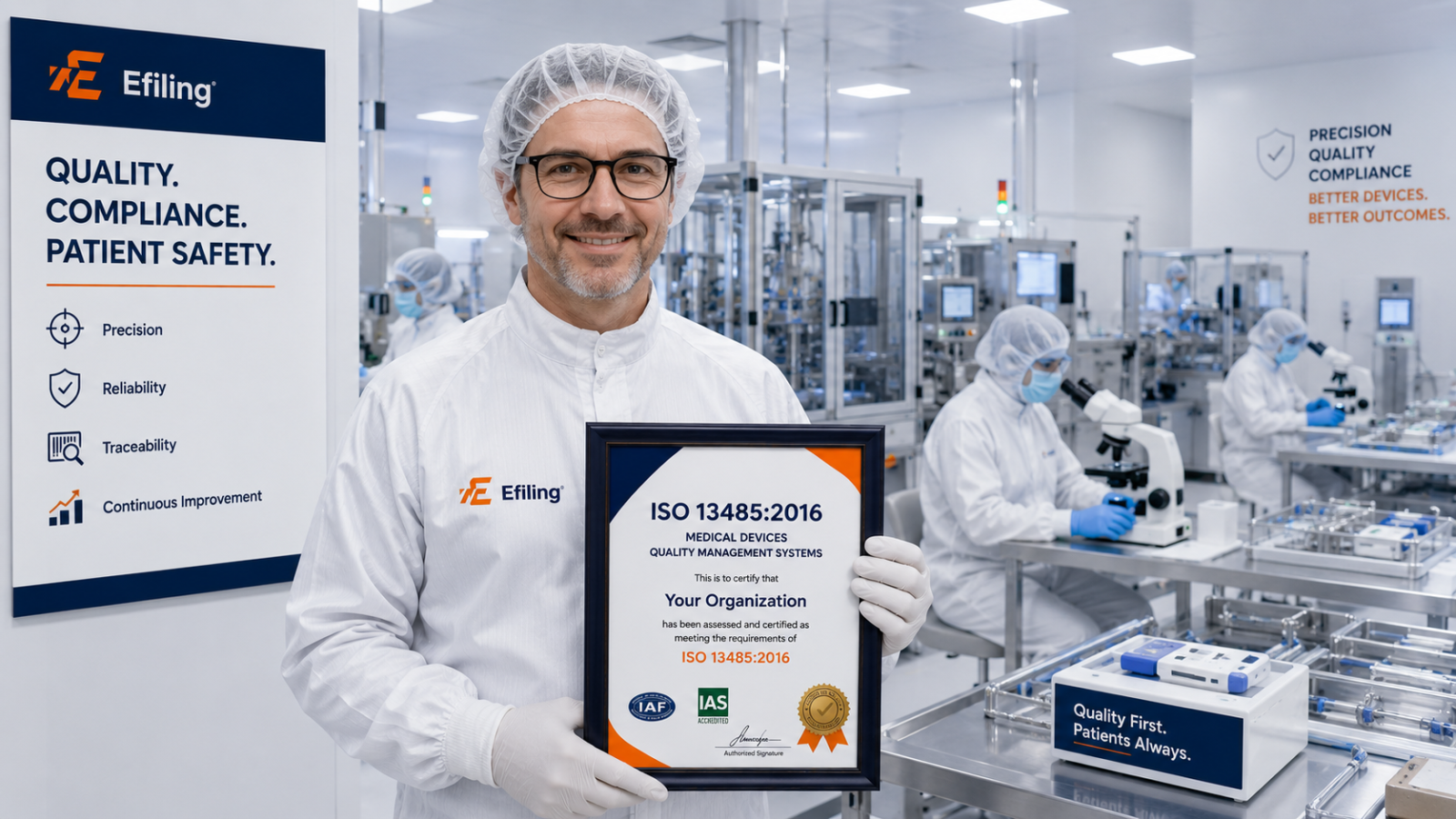

Expertise in ISO 13485 Certification for Medical Device Manufacturers in India

Enquiry Form
Among Asia Top
100
Consulting Firm

Get Consultation
Lowest Fees
100,000 + Clients.

Service Delivery
4.9 Customers Rating
50+ Offices
Contact us today to schedule your appointment.
You can call us on +919953004880 or write to us at info@efilingcompany.com
What Is ISO 13485:2016? (Meaning and Scope)
ISO 13485 meaning is simple: it is the international standard that defines how organisations in the medical device supply chain must manage quality. It applies to companies that design, develop, produce, store, distribute, install, or service medical devices and their components.
The current edition was published in 2016 and is the only valid version today. Any organisation still holding a certificate to the 2003 edition needs to transition to ISO 13485:2016 to remain compliant.
Unlike the general-purpose ISO 9001, ISO 13485 is built around regulatory and risk requirements specific to medical devices. It expects you to maintain detailed records, control the full product lifecycle, and prove traceability from raw materials to the final device.
If your organisation operates in the medical device sector — whether as a manufacturer, importer, or service provider — this standard is the foundation of your quality system. You can explore how it fits into the broader ISO certification framework before deciding whether to certify standalone or integrate with other standards.
ISO 13485 vs ISO 9001: Key Differences
Both are quality management standards, but they serve very different purposes. Here is a simple comparison:
| Factor | ISO 9001 | ISO 13485 |
|---|---|---|
| Purpose | General quality management — any industry | Quality management specifically for medical devices |
| Risk Approach | Risk-based thinking encouraged | Risk management is mandatory across the product lifecycle |
| Regulatory Mandate | Voluntary — not required by regulators | Required by regulators in most markets (CDSCO, MDR, FDA, etc.) |
| Documentation Depth | Focus on process control | Detailed traceability, validation, and design records required |
For medical device manufacturers in most markets, ISO 13485 is a regulatory requirement — not optional. ISO 9001 remains voluntary. If you already hold ISO 9001, the two can be integrated, but ISO 13485 will always take precedence for medical device-specific requirements. Learn more about ISO 9001 certification if you are evaluating both standards.
Why ISO 13485 Certification Matters for Indian Medical Device Companies
Global Market Access & Regulatory Compliance
Most countries require ISO 13485 certification before a medical device can be registered or sold. In the European Union, it supports CE marking under the Medical Device Regulation (MDR). In the United States, it aligns with FDA requirements for 510(k) submissions. For Indian manufacturers targeting global markets, this certification is often the first step toward international regulatory approval.
Risk Management Across the Product Lifecycle
ISO 13485 requires risk management at every stage of a product's life — from design and development through production, post-market surveillance, and eventual disposal. This is more rigorous than general quality standards. For medical devices, where a single failure can cause patient harm, this systematic approach is critical to protecting both users and your business from liability.
CDSCO and Medical Devices Rules 2017 Alignment
In India, medical devices are regulated under the Medical Devices Rules, 2017, administered by CDSCO. ISO 13485 is directly referenced in these rules as the recognised standard for quality management systems. This means that if you are seeking CDSCO Registration for medical devices, having an ISO 13485 certification in place will strengthen your application and demonstrate compliance. You can explore our CDSCO Registration services for further support with the regulatory process.
Buyer Trust and Export Readiness
Hospitals, healthcare distributors, and global buyers almost always ask for proof of ISO 13485 certification before signing supply agreements. It provides independent, audited confirmation that your quality system is reliable and your products meet international expectations. For Indian manufacturers, it is also a practical requirement for participating in global tenders and export contracts.
Who Needs ISO 13485 Certification in India?
Any organisation involved in the medical device supply chain can benefit from certification. The standard is written to be used by:
- Medical device manufacturers — Class A, B, C, and D devices under Indian Medical Devices Rules, 2017. This includes companies making infusion pumps, electro-mechanical devices, surgical instruments, and diagnostic equipment.
- IVD (in-vitro diagnostic) device manufacturers and manufacturers of diagnostic reagents.
- Importers and authorised agents of foreign medical device manufacturers.
- Distributors and wholesalers of medical devices requiring documented quality systems.
- Contract manufacturers and sub-assembly suppliers to device companies.
- Hospital equipment and surgical instrument manufacturers.
- Sterilisation, calibration, and maintenance service providers for medical devices.
- Packaging and logistics suppliers handling sterile or sensitive medical products.
Key Clauses of ISO 13485:2016
ISO 13485 follows a five-clause structure (Clauses 4 to 8) that covers the complete medical device quality management system. Here is what each section requires:
Clause 4: General Requirements
Covers the overall quality management system — documentation requirements, the quality manual, control of records, and the role of management representative.
Clause 5: Management Responsibility
Requires top management commitment, a documented quality policy, defined responsibilities, and regular management reviews.
Clause 6: Resource Management
Covers provision of resources, human resources and competence, infrastructure, and the work environment needed for medical device production.
Clause 7: Product Realisation
The largest clause. Covers planning, customer-related processes, design and development, purchasing, production, and control of monitoring devices.
Clause 8: Measurement, Analysis and Improvement
Requires monitoring, measurement, internal audits, control of non-conforming products, corrective and preventive action, and analysis of data.
Together, these clauses form the medical device quality management system (QMS) that auditors will verify during your certification assessment.
ISO 13485 Documentation Requirements
ISO 13485 requires a comprehensive set of documented procedures and records. Here is what needs to be in place:
How to Get ISO 13485 Certified: Step-by-Step Process
The ISO 13485 certification process follows a clear, structured path. Here is what to expect:
Gap Analysis
We review your current quality system against ISO 13485:2016 requirements, identify the gaps, and give you a clear roadmap to close them.
QMS Documentation
Our consultants prepare the complete Quality Manual, Medical Device File, SOPs, and all other documentation required by the standard — customised to your products and processes.
Implementation & Training
We help your team implement the documented processes and provide training so everyone understands their role in the quality management system.
Internal Audit
We conduct an internal audit across all applicable ISO 13485 clauses, identify non-conformities early, and guide corrective actions before the formal assessment.
Certification Body Audit
The accredited certification body conducts a Stage 1 documentation review and Stage 2 on-site audit. We coordinate with them and stand by you until your certificate is issued. The certificate is valid for 3 years with annual surveillance audits.
ISO 13485 Certification Cost in India
The cost of ISO 13485 certification in India is not a fixed number. It depends on several factors specific to your organisation. Here is what drives the investment:
- Device risk class — Class C and D devices require more rigorous auditing than Class A or B
- Number of employees and sites — more people and locations mean more audit man-days
- Number of product families in scope — broader scope means more documentation and audit time
- Chosen certification body — IAF-accredited bodies charge more but their certificates are accepted globally
- Consultant support vs in-house — engaging an experienced ISO 13485 consultant reduces timeline and audit risk, but adds consultancy fees
Because every medical device business is different, we do not publish a one-size-fits-all price. Instead, we give you an exact, all-inclusive quote after understanding your operations. Our ISO 13485 consultants are among the most experienced in India, with a strong record of first-time audit success.
Get an exact cost for your business. Share a few details about your devices and operations, and we will provide a transparent quote with no hidden charges.
Get a Free ISO 13485 Quote →Latest Version of ISO 13485 (2016 vs Older Editions)
ISO 13485:2016 is the current and only valid edition of the standard. The previous edition, published in 2003, is now obsolete. Any certificate issued against ISO 13485:2003 is no longer recognised by accreditation bodies or regulatory authorities.
The 2016 revision introduced several important updates — closer alignment with regulatory requirements, stronger emphasis on risk management throughout the product lifecycle, and more detailed requirements for software validation and supplier control. It also aligns more closely with other management system standards, making integration with ISO 9001 and ISO 27001 simpler for medical device companies.
If your organisation holds an old 2003 certificate, you need to transition to ISO 13485:2016 to remain compliant with regulators and buyers. Contact us for a transition assessment.
Why Choose eFilingCompany for ISO 13485 Certification
Our ISO 13485 consultants understand the medical device industry inside out. From documentation to audit support, we manage the entire certification journey so your team can focus on what matters — producing safe, high-quality medical devices.
🏆 Industry Expertise
We specialise in ISO 13485 and understand the specific documentation, validation, and traceability requirements that medical device auditors look for.
📄 Complete Documentation
Our consultants prepare the Quality Manual, Medical Device File, SOPs, and all supporting records — fully customised to your devices and processes.
🎯 High First-Time Audit Success
Our internal audit and pre-assessment process catches non-conformities early so there are no surprises on audit day.
🔗 IAF-Accredited Certification
We only work with IAF-accredited certification bodies, so your ISO 13485 certificate is recognised globally — for tenders, exports, and regulatory submissions.
💬 Full Handholding Support
From your first consultation through to certificate delivery and beyond, we stay with you at every step.
💰 Fixed, All-Inclusive Pricing
Our quote is the price we charge. No hidden fees, no surprise add-ons. Everything is disclosed upfront.
Ready to Get ISO 13485 Certified?
Get a free consultation with our medical device quality experts. We will review your requirements and give you a clear timeline and cost estimate.
📞 Call: +91 99530 04880 | ✉️ Email: info@efilingcompany.com
Get a Free ISO 13485 Quote →