Documents Required for GST Registration
Every document you need for GST registration in 2026 - broken down by business type and premises, plus the biometric verification, 30-day bank rule and the new 3-day fast-track route.


2000
Happy Clients

1500
Expert Advisors

2+
Branch Offices
Free Consultation by Expert
.png)


.png)
.png)
Documents Required for GST Registration
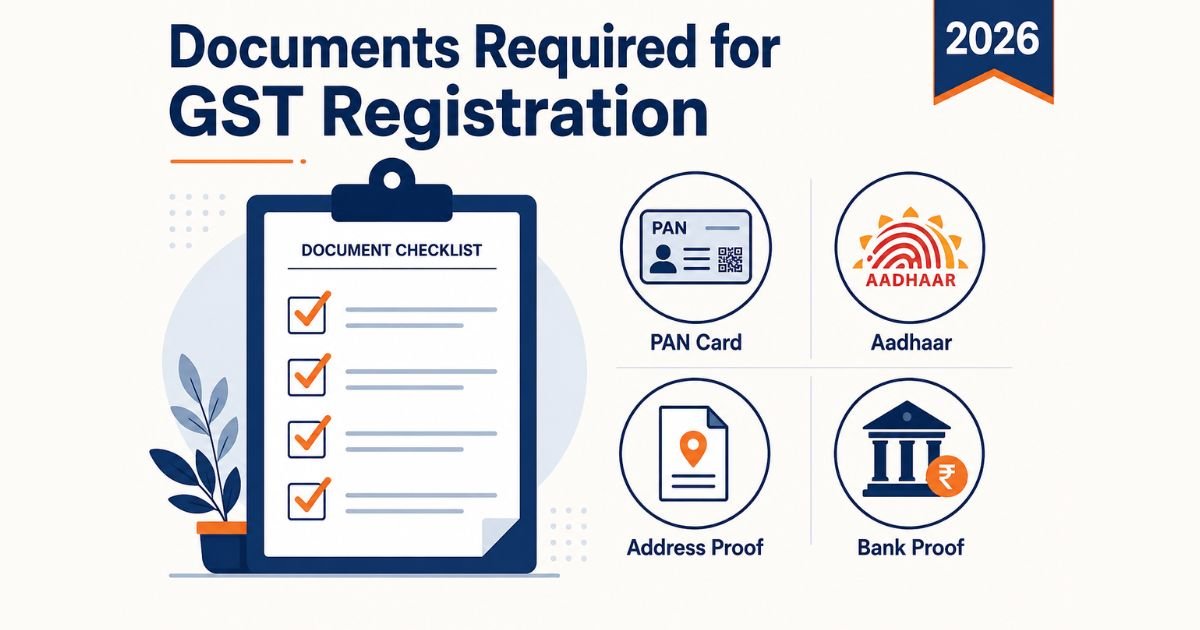
If you are planning to take GST registration, the first question is always the same – what papers do I need to keep ready? The good news is that for most businesses the core list is short and simple. The part that actually changes from person to person is your address proof (depends on whether you own or rent your place) and your proof of business (depends on whether you are a proprietor, a partnership, a company, an LLP or a HUF).
This page gives you the full checklist, then breaks it down by business type and by the kind of premises you have. One thing that surprises a lot of people in 2026 – you do not need to submit your bank details to get your GST number anymore. The bank proof is handled after your GSTIN is granted. We have explained that clearly further down, because missing it is the single most common reason a new registration gets suspended.
For the complete picture of the service, eligibility, fees and the step-by-step process, see our main GST Registration page.

Expertise in Documents Required for GST Registration

Enquiry Form
Among Asia Top
100
Consulting Firm

Get Consultation
Lowest Fees
100,000 + Clients.

Service Delivery
4.9 Customers Rating
50+ Offices
Contact us today to schedule your appointment.
You can call us on +919953004880 or write to us at info@efilingcompany.com
The Basic Documents Everyone Needs
No matter what type of business you run, the following documents form the base of every GST application. Keep clear, readable scans ready before you start – blurred uploads are a common cause of rejection.
| Document | Who it is for | Format & size |
| PAN card | Of the business or the proprietor | JPG or PDF, up to 100 KB |
| Aadhaar card | Of the proprietor, or all partners, or all directors | JPG or PDF, up to 100 KB |
| Photograph | Passport-size, of the owner or signatory | JPEG, up to 100 KB |
| Proof of principal place of business | Everyone (owned or rented – see the address section below) | JPG or PDF, up to 100 KB (rent agreement up to 2 MB) |
| Bank account proof | Everyone – but added after your GST number is granted | Cancelled cheque, passbook or statement |
| Proof of business constitution | Depends on business type (see the next section) | JPG or PDF |
| Digital Signature (DSC) | Companies and LLPs only | Registered on the GST portal |
| Authorisation letter or board resolution | For appointing the authorised signatory | JPG or PDF, up to 100 KB |
Quick tip: The photograph size limit of 100 KB catches many applicants. If your photo is larger, compress it before uploading, otherwise the portal will not accept it.
Documents by Type of Business
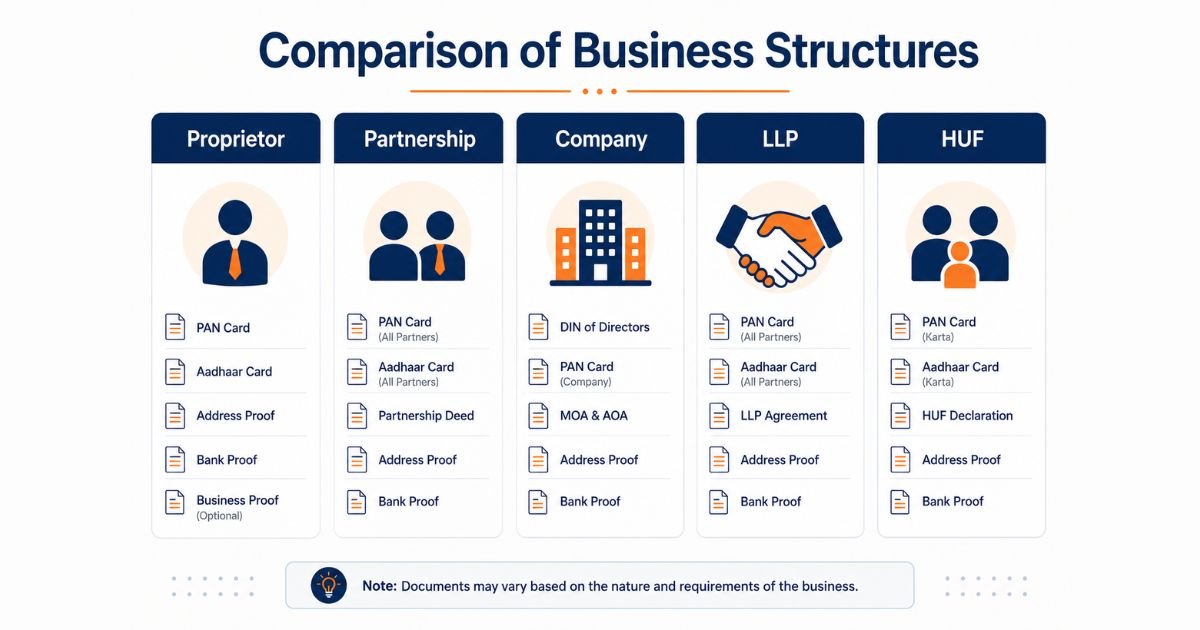
The base documents above stay the same for everyone. What changes is the proof of business constitution – the paper that proves your business legally exists. Here is exactly what each type of business needs.
Proprietorship
This is the simplest case and also the most common. A proprietorship needs the PAN and Aadhaar of the proprietor, a passport-size photo, address proof of the business place, and bank proof (added later). There is no separate incorporation document, because in a proprietorship the proprietor's PAN is the business PAN. Many first-time applicants look for a separate business registration certificate here – you do not need one. Your own PAN and Aadhaar are enough to prove the business.
Partnership Firm
A partnership firm needs the partnership deed, the PAN of the firm, and the PAN and Aadhaar of all partners along with their photographs. You will also need an authorisation letter naming which partner will act as the authorised signatory for GST.
Private Limited Company
A company has the longest list because it is a separate legal entity. You will need the Certificate of Incorporation, the company PAN, the MOA and AOA, and a board resolution authorising the GST registration. Add the PAN, Aadhaar and photograph of all directors, plus the Digital Signature (DSC) of the authorised signatory, which is compulsory for companies. For the full company-specific list, see our Private Limited Company registration documents page.
Limited Liability Partnership (LLP)
An LLP needs the LLP agreement, the Certificate of Incorporation, the PAN of the LLP, and the PAN and Aadhaar of the designated partners. Like companies, an LLP also requires a Digital Signature (DSC) of the authorised signatory.
Hindu Undivided Family (HUF)
A HUF needs the PAN of the HUF and the PAN, Aadhaar and photograph of the Karta (the head of the family who manages the HUF). Address and bank proof follow the same rules as everyone else.
Address Proof – What Counts, Owned vs Rented
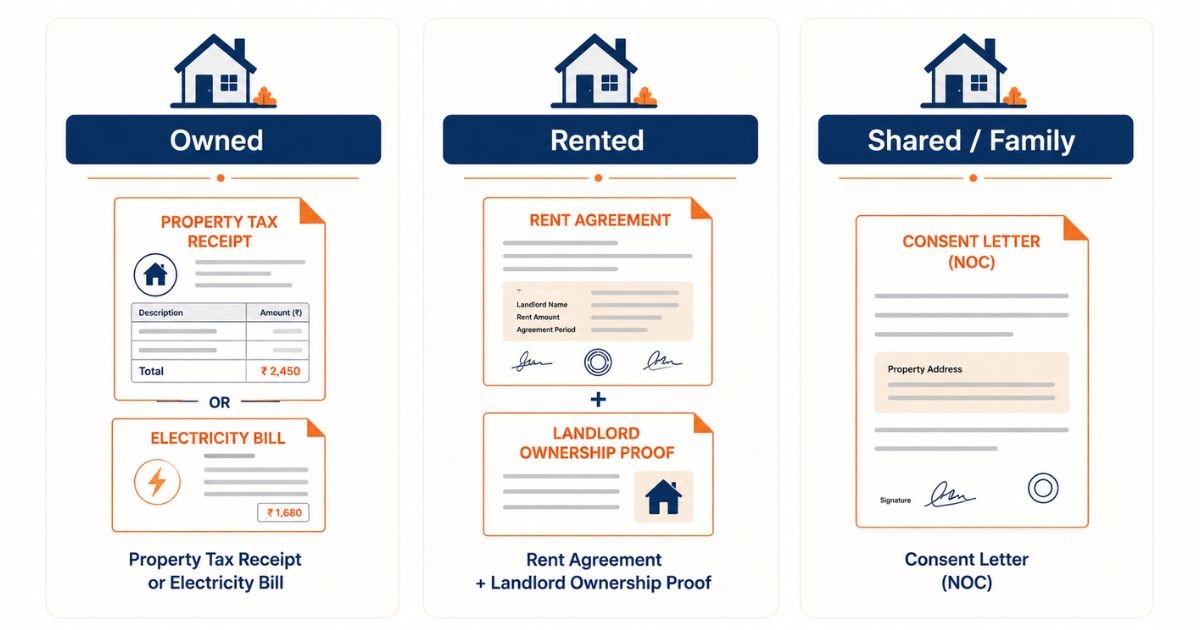
Your proof of place of business depends entirely on your relationship to the premises. This is where most confusion happens, so here is the exact document you need for each situation. All of these are accepted directly by the GST portal.
| Your situation | Document to submit |
| You own the place | Any one of – latest property tax receipt, municipal khata copy, or electricity bill |
| Rented, with a written agreement | The rent or lease agreement, plus any one ownership proof of the landlord (electricity bill or property tax receipt) |
| Rented, without a written agreement | A consent letter (NOC) from the owner, plus any one ownership proof of the owner |
| Place is in a family member's name | A consent letter from that person, plus any one ownership proof |
| Shared space or co-working | A consent letter, plus an ownership proof. On the portal, select "Shared" as the nature of possession |
Note: A rent or lease agreement can be uploaded up to 2 MB. All other address documents should be within 100 KB. Make sure the name and address on your proof are clearly readable.
Aadhaar and Biometric Verification – What Changed
This is the part most old articles miss, and it directly affects how your documents are used. Since 10 July 2024, biometric Aadhaar authentication applies across all of India (Notification No. 13/2024 – Central Tax), not just a few pilot states as before.
After you submit your application, one of two things happens. If you choose Aadhaar OTP authentication and the system does not flag your application, the whole process stays online. But if the portal flags you based on its risk checks, you will get an email asking you to visit a GST Suvidha Kendra (GSK) in person for fingerprint and photo verification, along with a check of your original documents.
So in practice, your documents are step one, and verification is step two. Two things that help – keep your original documents ready to carry to the GSK in case you are called, and make sure the name and date of birth on your Aadhaar match your PAN. A mismatch between the two is a common reason authentication fails.
Bank Account Proof – The 30-Day Rule Most People Miss
Here is something that trips up a lot of new registrations. You do not need bank details to get your GSTIN – that field is optional when you apply. But once your GST number is granted, the rule kicks in.
Under Rule 10A of the CGST Rules, you must add your bank proof – a cancelled cheque, passbook copy, or bank statement – within 30 days of getting your registration, or before you file your first GSTR-1 or use the Invoice Furnishing Facility, whichever comes first. The GST portal now automatically suspends registrations that miss this deadline. A suspended GSTIN cannot raise invoices or file returns, so your business effectively stops.
Adding the bank detail is simple – go to Services, then Registration, then Amendment of Registration (Non-Core Fields), then Bank Account, and upload your proof. Do it as soon as your account is ready so you never hit the suspension. This rule does not apply to TDS, TCS or suo-moto registrations.
The 3-Day Fast-Track Route (Rule 14A)
If you are a small business, there is now a faster option. Since 1 November 2025 (Notification No. 18/2025 – Central Tax), small suppliers whose monthly output tax on supplies to registered businesses stays within ₹2.5 lakh can opt for a simplified route that grants the GST number electronically within 3 working days.
The document checklist is the same as a normal application. The difference is that you must select "Yes" under the Rule 14A option when you apply, and complete Aadhaar authentication. A few honest points to keep in mind – this route is optional, you can take only one registration per state under this rule against the same PAN, and if your tax liability later crosses the limit you have to withdraw from the scheme using Form REG-32. For most small proprietors and B2B service providers, it is a genuinely quicker way in.
To understand the full step-by-step, see our GST Registration Process page.
Common Reasons GST Applications Get Rejected
Most rejections are not about missing documents – they are about small avoidable mistakes. Watch out for these:
- Photograph over 100 KB or in the wrong format
- Blurred or unreadable scans of any document
- Name on the address proof not matching the applicant
- Rent agreement submitted without the landlord's ownership proof
- Name or date of birth on Aadhaar not matching the PAN
- Forgetting the 30-day bank detail step, which leads to suspension after approval