Gst Registration in Delhi
Dealing with the process of GST Registration in Delhi getting too hectic? Connect with Efiling experts and secure your GST Registration.


2000
Happy Clients

1500
Expert Advisors

2+
Branch Offices
Free Consultation by Expert
.png)


.png)
.png)
GST Registration Company in Delhi
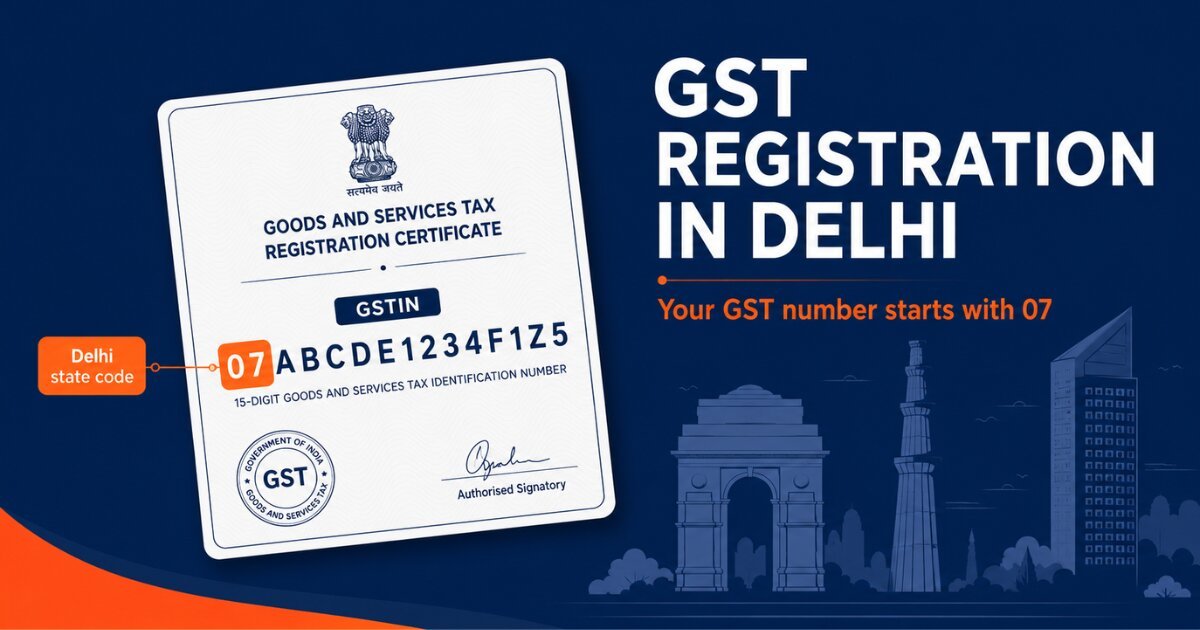
If you run a business in Delhi and your buyers are asking for a GST invoice, you already know why you are here. GST registration in Delhi is done fully online, and once it is approved you get your GST number in Delhi - a 15-digit GSTIN. That number always starts with 07, which is Delhi's state code under GST.
This page is only about Delhi. Who has to register here, which documents work for a Delhi address, how long it actually takes, and what it costs. If you want the basics of what GST registration is in general, that is on our GST registration page. Here we stay on Delhi.

Expertise in Gst Registration in Delhi

Enquiry Form
Among Asia Top
100
Consulting Firm

Get Consultation
Lowest Fees
100,000 + Clients.

Service Delivery
4.9 Customers Rating
50+ Offices
Contact us today to schedule your appointment.
You can call us on +919953004880 or write to us at info@efilingcompany.com
|
Talk to a Delhi GST expert before you apply. A wrong document or a mismatched address is the most common reason Delhi applications get a REG-03 query. Better to get it right the first time. |
GST Registration Limit in Delhi
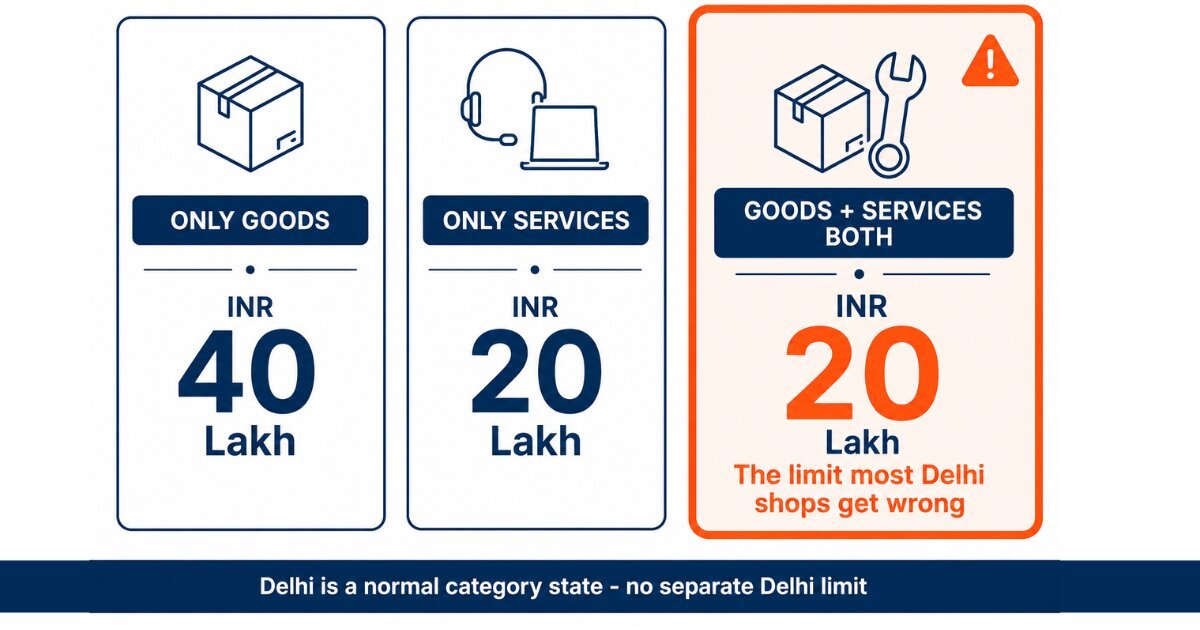
Delhi is a normal category state. It is not a special category state. So the normal limits apply here, and there is no separate Delhi limit. Some websites mix this up with the North Eastern states, so let us keep it clear.
| Your business | Limit in Delhi | Point to note |
| Only goods | INR 40 lakh | Only if you deal purely in goods, nothing else |
| Only services | INR 20 lakh | Most Delhi consultants, agencies and freelancers are here |
| Goods and services both | INR 20 lakh | This is where people go wrong - read the note below |
| The mistake we see most often. Say you have a hardware shop in Delhi and you also charge for installation. You think the INR 40 lakh limit protects you. It does not. The moment you supply services along with goods, the INR 20 lakh limit applies on your whole turnover, not just the service part. We see Delhi shop owners find this out only after they have already crossed it. |
One more thing. Turnover is counted PAN-wise across all of India, not just your Delhi business. If you run a consultancy in Delhi and also get rent from a property somewhere else on the same PAN, both add up in the same limit.
When You Must Register Even Below the Limit
Section 24 of the CGST Act ignores the limit completely for some cases. If you fall in any of these, register from day one:
- You supply goods from Delhi to buyers in other states
- You are a casual taxable person - for example, a stall at an exhibition in Pragati Maidan
- You are a non-resident taxable person supplying into Delhi
- You have to deduct TDS or collect TCS under GST
- You are an Input Service Distributor
- You pay tax under reverse charge
| About online sellers - most Delhi pages get this wrong. Almost every site still says that every online seller must register from the first rupee. That is not fully true since 1 October 2023. A small seller of goods can stay unregistered if he sells only inside Delhi, stays under the limit, sells through e-commerce operators in one state only, and declares his PAN and place of business on the GST portal. But the moment you ship outside Delhi, registration becomes must. In real life almost every Delhi seller on Amazon or Flipkart ships all over India, so most of them do need it. Still, you should know which side you are on. |
On services going outside Delhi, there is a point worth knowing. A Delhi consultant billing a Mumbai client does not need registration only because the client is in another state. The normal INR 20 lakh limit still protects small service providers. The compulsory inter-state rule applies to goods, not to small service supply.
The 3-Day Route: Rule 14A for Delhi Businesses
This is the biggest change in GST registration in years, and almost no Delhi page mentions it.
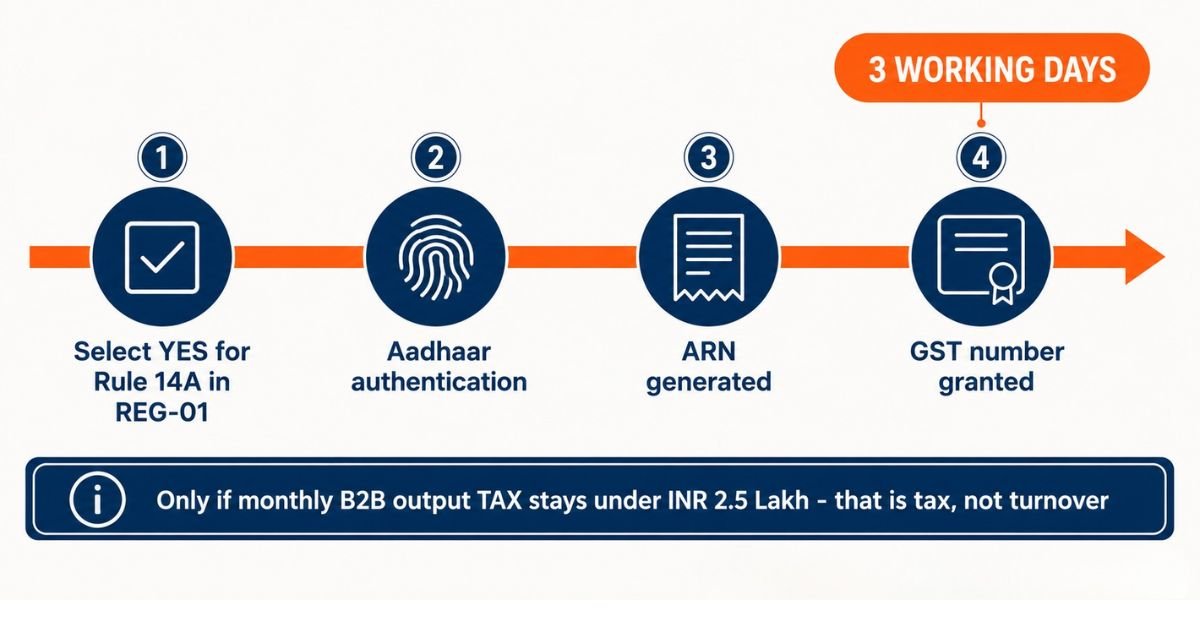
Rule 14A came in through Notification No. 18/2025 - Central Tax dated 31 October 2025, and is effective from 1 November 2025. It is an optional fast route. If you qualify, registration is granted electronically within three working days from the date your ARN is generated, provided Aadhaar authentication is done.
Who Can Take This Route
| 1 | Your own estimate of monthly output tax on supplies to registered buyers should not cross INR 2.5 lakh per month, counting CGST, SGST, IGST and cess together |
| 2 | You do not already have another Rule 14A registration in Delhi on the same PAN |
| 3 | Aadhaar authentication is done for the Primary Authorised Signatory and at least one Promoter or Partner |
| Read this carefully - two things everyone misunderstands.
One. The INR 2.5 lakh is tax amount, not turnover. This is not a 2.5 lakh sales limit. If your goods or services are at 18 percent GST, then INR 2.5 lakh of tax works out to roughly INR 13.88 lakh of B2B supply per month. So the scheme covers many more businesses than people assume. Two. Only supplies to registered buyers are counted. Your B2C sales to normal customers are not counted at all. So a Delhi shop with heavy counter sales but small B2B billing can still qualify comfortably. |
To take this route, you select "Yes" against the Rule 14A option in Part B of Form GST REG-01 and give the declaration. If you do not select it, your application goes through the normal route.
The Part Nobody Warns You About
Rule 14A is genuinely faster. But coming out of it is a process, not a switch. If your B2B tax crosses INR 2.5 lakh a month, you cannot simply report the higher amount - the portal will not let you. You have to formally withdraw first, using Form GST REG-32. The officer then passes an order in Form GST REG-33.
GSTN opened the online withdrawal facility on 21 February 2026. On the portal it sits under Services, then Registration, then Application for Withdrawal from Rule 14A. Before you can file it:
- All returns from your registration date till the withdrawal date must be filed
- At least one tax period's return must be filed (this is the rule now; before 1 April 2026 it was three months)
- No amendment or cancellation application should be pending
- No Section 29 cancellation proceedings should be running
Aadhaar authentication is needed again at the withdrawal stage. You get 15 days to submit the draft application, and 15 days after submission to finish Aadhaar authentication.
| Our honest advice. The withdrawal order works from the first day of the month after the order is passed. It does not apply backwards. So if you cross the limit before the order is in your hand, you are stuck for that period. If you are a small Delhi B2B supplier who will stay under the limit, take Rule 14A. If your B2B billing is growing fast, either plan the withdrawal early or take the normal route. This is a five minute discussion, and it is worth having before you tick that box. |
| Two things you may read elsewhere that are wrong. First, some sites say Rule 14A gives registration "within one hour". There is no such timeline anywhere in the notification. The legal position is three working days. Second, Rule 14A is not the same as Rule 9A. The same notification also brought in Rule 9A, where the system itself may grant registration in three days based on risk and data analysis. Rule 9A is decided by the system. Rule 14A is chosen by you. They are different things. |
Documents Required for GST Registration in Delhi
The list changes with your business type. Here is what is actually needed for each.
| Proprietorship / Individual |
|
| Partnership / LLP |
|
| Private Limited / OPC |
|
If you are also setting up the company itself, see our company registration in Delhi page - most clients do both together.
Delhi Address Proof - Where Applications Actually Fail
This is the single biggest reason Delhi applications get stuck, so it deserves its own section.
| Your premises | What you need |
| Owned | Latest electricity bill, or property tax receipt, in the owner's name |
| Rented | Registered rent agreement plus the landlord's latest electricity bill |
| Relative's place or consent property | NOC from the owner, plus his electricity bill and ownership proof |
Now the practical points, the ones that matter in Delhi:
- A commercial address is not compulsory. Home based businesses in Rohini, Dwarka, Janakpuri or anywhere in Delhi can register on a residential address with proper proof. Do not let anyone tell you otherwise just to sell you an address.
- The name on the electricity bill must match your papers. A bill still running in a late father's name, or in the old tenant's name, is the classic Delhi rejection. Sort this out before you apply, not after the notice comes.
- Be careful with virtual offices. Virtual office addresses are checked closely in Delhi, and CBIC tightened physical verification of premises through its April 2025 instructions. If the officer visits and finds no real business there, you are looking at rejection, or cancellation later. If you genuinely work from one, keep a proper agreement and NOC ready.
Online GST Registration in Delhi - Step by Step
The whole thing is online at gst.gov.in. You do not have to visit any GST office in Delhi. Only if biometric authentication gets triggered, you may have to go to a GST Suvidha Kendra.
| 1 | Fill Part A. On gst.gov.in go to Services, then Registration, then New Registration. Put your PAN, mobile and email. Verify both OTPs. You get a Temporary Reference Number (TRN). Save it. |
| 2 | Log in with the TRN and fill Part B. This is the long part - business type, your principal place of business in Delhi, nature of premises, HSN codes for goods or SAC codes for services, promoter and director details, authorised signatory, bank details. |
| 3 | Decide on Rule 14A. Select "Yes" if you qualify and want the 3-day route. Think before you click. See the section above. |
| 4 | Upload documents. Clear scans, correct file size. Blurry uploads bring queries. |
| 5 | Do the Aadhaar authentication. OTP based is faster. In some cases biometric authentication at a GST Suvidha Kendra is needed. If you skip Aadhaar completely, expect physical verification of your Delhi premises and a much longer wait. |
| 6 | Submit with DSC or EVC. Companies and LLPs must use Class 3 DSC. Proprietors and individuals can use EVC. |
| 7 | Track your ARN. You get an Application Reference Number immediately. Track it on the portal. |
| 8 | Reply to REG-03 within 7 working days. If the officer wants clarification, you reply in Form GST REG-04. Missing this window is how applications die. |
| 9 | Get your GSTIN and download Form REG-06 - your registration certificate - from the portal. |
After the GSTIN Comes - the 30 Day Bank Rule
| This catches new Delhi registrants all the time. Under Rule 10A you have to give bank account details linked to your business PAN within 30 days of registration, or before filing your first GSTR-1 or IFF, whichever is earlier. Miss it and your registration can be suspended. Getting the GSTIN is not the finish line. |
GST Registration Fees in Delhi
Let us be straight, because there is a lot of noise on pricing in this line.
| Cost head | Amount | Notes |
| Government fee for GST registration in Delhi | INR 0 | The GST portal charges nothing. Anyone quoting a government fee is misleading you. |
| Professional charges | Depends on your structure | A proprietorship is simpler than a Pvt Ltd with several directors and DSC work. Ask for it in writing. |
| Class 3 DSC, if needed | Extra, if you do not have one | Needed for companies and LLPs. Proprietors using EVC do not need it. |
| Rent agreement or NOC work | Extra, if applicable | Depends on your premises situation |
We have not printed one headline price here, and that is a choice. Your actual cost depends on your business type, whether you need a DSC, and whether your address papers are clean. Call us and you will get a real number for your case, not a low rate that changes later.
How Long Does GST Registration Take in Delhi
| Route | Time |
| Rule 14A route, with Aadhaar authentication | 3 working days from ARN |
| Normal route, Aadhaar done, papers clean | Around 7 working days |
| Without Aadhaar authentication | Much longer - physical verification is likely, can go up to 30 days |
| If a REG-03 query comes | Add your reply time, plus the officer's review |
Why Delhi GST Applications Get Rejected
We handle these queries regularly. Almost every rejection or REG-03 notice comes from this short list:
| Electricity bill name does not match - the bill is in an old owner's or late family member's name |
| Rent agreement is not registered, or the period has expired |
| NOC missing where the premises belong to a relative |
| Blurry or cropped uploads - the officer cannot read the document |
| Wrong HSN or SAC code for the business you have declared |
| Virtual office address with nothing to show if an officer visits |
| No reply to REG-03 within 7 working days - the application simply dies |
Benefits of GST Registration for a Delhi Business
| Input Tax Credit. You set off the GST you paid on purchases - office rent, supplies, raw material - against the GST you collect. For most Delhi businesses this is the real money argument. |
| B2B credibility. Corporate clients and government departments need a valid GSTIN on your invoice to take their own ITC. Without it, many will simply not deal with you. |
| Selling outside Delhi. Delhi sits in the middle of the NCR trade network. Most growing businesses here supply outward, and a GSTIN removes that barrier. |
| E-commerce. Selling across India on Amazon, Flipkart or Meesho from a Delhi base needs it. |
| Government tenders. A valid GSTIN is standard eligibility. |
| Current account and credit. Banks treat the GST certificate as proper business proof. |
Penalty for Not Registering in Delhi
| Situation | What it costs |
| Not registering when you were liable | 10 percent of the tax due, minimum INR 10,000 |
| Deliberate evasion | Up to 100 percent of the tax due, under Section 122 of the CGST Act |
| Interest | On the tax that should have been collected |
| Here is the part people miss. If you register late, your registration is effective from the date the officer grants it - not from the date you crossed the limit. The gap period still carries tax. And you cannot go back to customers you have already billed and ask them for that GST now. It comes out of your own pocket. Usually that is the expensive part, not the penalty. |
Delhi GST Jurisdiction - Who Handles Your File
Delhi taxpayers come under a dual control system. For turnover up to INR 1.5 crore, the file generally sits with the Delhi State GST department - the Department of Trade and Taxes, GNCTD. Above that, it is shared between the Central GST authorities and Delhi SGST. This decides who contacts you for audits, notices and refunds. Your ward and range are decided from your principal place of business address in Delhi.
Areas We Cover in Delhi
The process is fully online, so we handle GST registration across all of Delhi. You do not need to come to us and we do not need to visit you.
| Rohini | Pitampura | Samaypur Badli |
| Dwarka | Janakpuri | Karol Bagh |
| Laxmi Nagar | Connaught Place | Chandni Chowk |
| Nangloi | Shahdara | Okhla |
| Netaji Subhash Place | Rajouri Garden | Saket |
Your GST Consultant in Delhi
We are a Delhi based team and we handle Delhi GST registration work every week. What that means for you in practice: we check your address papers before applying instead of after the notice comes, we tell you honestly whether Rule 14A suits your billing pattern, and if a REG-03 query does come, we know what the officer is actually asking for. We also handle your GST returns afterwards, so you are not left alone once the GST number arrives.
|
Not sure if you cross the limit, or whether Rule 14A suits you? That conversation is free, and it takes five minutes. |