Types of GST Registration in India
Regular, composition, casual, non-resident, ISD and more - every type of GST registration in plain words, with a simple guide to which one fits you.


2000
Happy Clients

1500
Expert Advisors

2+
Branch Offices
Free Consultation by Expert
.png)


.png)
.png)
Types of GST Registration in India
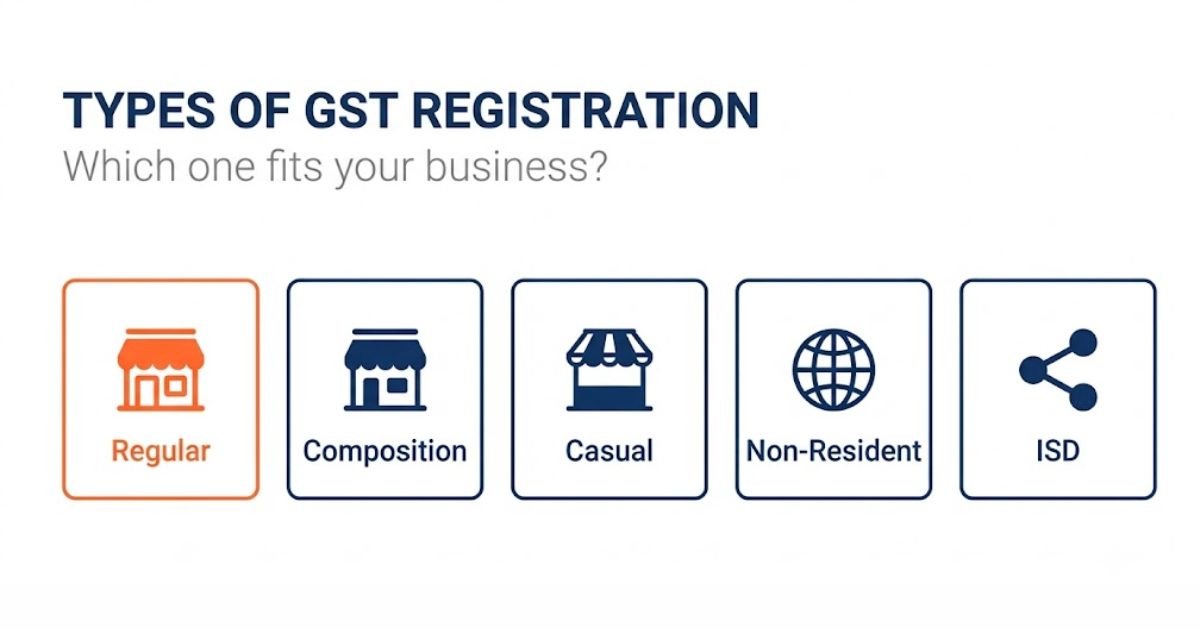
When people say types of GST, they can mean a few different things. The tax itself is split into CGST, SGST, and IGST. There are different GST returns to file. And there are different types of GST registration, depending on what kind of business you run. This page is about the last one, the types of registration, and which one fits you.
There is no single registration that suits everyone. A regular shop, a small trader, a stall at an exhibition, and a foreign company selling in India all register under GST, but they do not register the same way. Picking the right type matters, because it decides your tax rate, your return filing, and whether you can claim input tax credit. If you are new to all this, the GST registration page covers the basics first.
Expertise in Types of GST Registration in India

Enquiry Form
Among Asia Top
100
Consulting Firm

Get Consultation
Lowest Fees
100,000 + Clients.

Service Delivery
4.9 Customers Rating
50+ Offices
Contact us today to schedule your appointment.
You can call us on +919953004880 or write to us at info@efilingcompany.com
The Main Types of GST Registration
Here are the types of registration under GST at a glance, so you can see where you might fit before reading the detail.
| Type of registration | Who it is for |
| Regular taxpayer | The default. Most ordinary businesses that cross the turnover limit or sell online. |
| Composition scheme | Small businesses that want a lower flat rate and simpler filing, and can live without input tax credit. |
| Casual taxable person | Someone selling for a short time in a state where they have no fixed shop, such as an exhibition or a seasonal stall. |
| Non-resident taxable person | A foreign business supplying goods or services in India without a fixed place here. |
| Input Service Distributor | A head office that receives input service bills and passes the credit to its branches. |
| Other categories | SEZ units, TDS deductors, e-commerce operators collecting TCS, online service providers from abroad, and bodies like embassies. Covered lower down. |
Most readers will be one of the first two. The rest are for specific situations. We will go through each so you can see clearly which one is you.
Regular Taxpayer
This is the ordinary, most common type of registration, and it is what most businesses fall under. If you run a normal business and you cross the turnover limit, this is you.
The turnover limits that make registration compulsory are broadly:
- For a business supplying goods, an annual turnover above ₹40 lakh
- For a business supplying services, an annual turnover above ₹20 lakh
- For special category states, these limits are lower, at ₹20 lakh for goods and ₹10 lakh for services
VERIFY: confirm the current threshold figures and the list of special category states against the latest CBIC notification before publishing.
Two things trip people up here. First, if you supply both goods and services together, the lower services limit tends to apply, not the higher goods limit, so do not assume the ₹40 lakh figure covers you. Second, some businesses have to register no matter how small they are, such as anyone selling across state lines or through most e-commerce platforms. Turnover is not the only trigger.
A regular taxpayer charges GST on sales, can claim input tax credit on purchases, and files returns on a regular basis. The ability to claim input tax credit is the main reason this type suits businesses that buy a lot from other registered suppliers.
Composition Scheme
The composition scheme is a simpler, lighter option for small businesses. Instead of the full regular process, you pay GST at a low flat rate on your turnover and file less often.
It is open to businesses whose turnover stays under a set limit. The ceiling is broadly ₹1.5 crore for most states, and lower for special category states, with a separate, smaller limit for service providers.
VERIFY: confirm the current composition turnover limits, including the separate limit for service providers, against the latest notification before publishing.
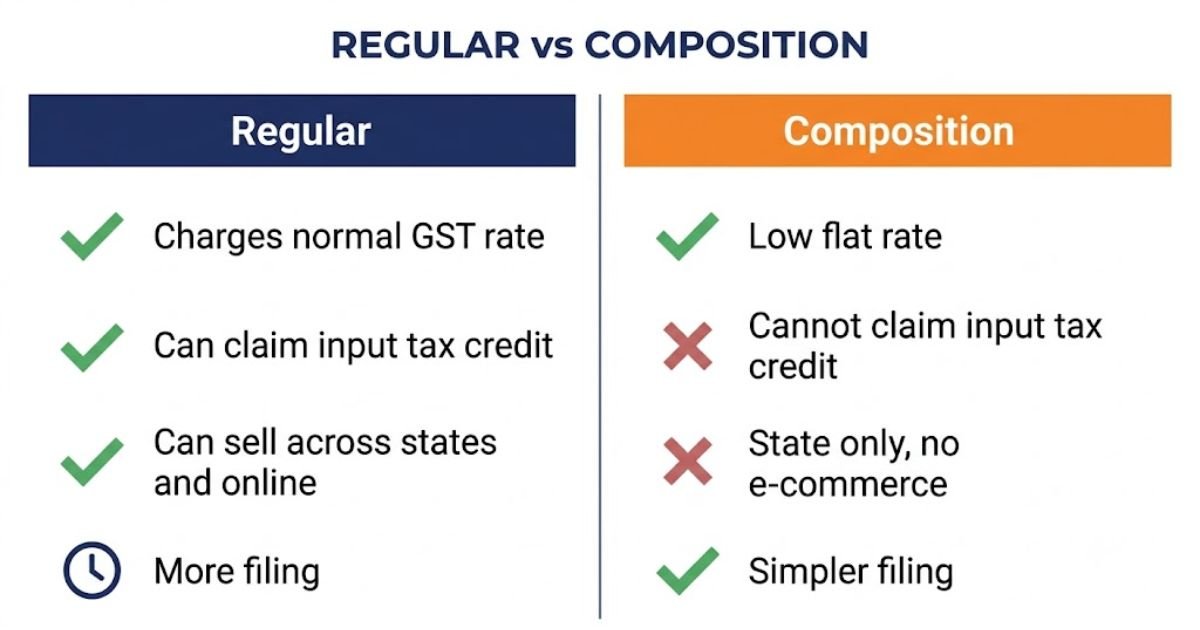
The scheme is attractive because it is easy to run, but it comes with real trade-offs, and you should know them before choosing it:
- You cannot claim input tax credit on your purchases
- You cannot make inter-state sales
- You cannot sell through e-commerce platforms
- You cannot charge GST separately on your invoice the way a regular taxpayer does
So the composition scheme suits a small local business, such as a neighbourhood shop or a small eatery, that sells within its own state and mostly to ordinary customers who do not need a tax invoice for credit. If you deal with business customers who want input tax credit, or you plan to sell online or across states, the composition scheme will hold you back and regular registration is the better fit.
Casual Taxable Person
A casual taxable person is someone who sells for a short period in a place where they do not have a regular, fixed business. The classic example is a stall at a trade fair, an exhibition, or a seasonal market in another state.
Say you run a business in one state and you take a stall at a Diwali exhibition in another state for two weeks. You do not have a shop there, but you will be making sales there, so you register as a casual taxable person for that period.
A few things are specific to this type:
- The registration is taken for a limited period, tied to how long you will be operating
- You pay an advance deposit of tax based on your expected sales for that period
- It can be extended if you need more time, by applying before it runs out
- You still file returns for the active period
This is the type people mean when they search for temporary GST registration. It exists precisely so that someone can sell legally for a short spell without setting up a permanent presence.
Non-Resident Taxable Person
A non-resident taxable person is a business based outside India that supplies goods or services in India but does not have a fixed place of business here.
It works on similar lines to a casual taxable person. The registration is taken for a limited validity period rather than being open-ended, and an advance deposit of tax is required. The difference is simply that this category is for a business coming from abroad, whereas a casual taxable person is usually an Indian business operating temporarily outside its home state.
Input Service Distributor
An Input Service Distributor, or ISD, is a specific and often misunderstood type. It is meant for a business with one head office and several branches.
Here is the idea in plain terms. Suppose your head office receives a bill for a service that actually benefits all your branches, such as a software subscription or an advertising cost. The head office registers as an ISD so it can take the input tax credit on that shared bill and distribute it out to the branches that used the service. All the branches must be under the same PAN.
The important thing to understand is that an ISD only distributes credit. It does not itself supply goods or services under this registration. It is purely a mechanism to share input tax credit fairly across branches. If you are a single-location business, this type does not apply to you.
Other Categories You Should Know
Beyond the main types, GST has a few more registration categories for specific kinds of taxpayers. Most readers will never need these, but it helps to know they exist.
| Category | What it is for |
| SEZ unit or developer | Businesses in a Special Economic Zone register separately, following the rules that apply to SEZ supplies. |
| TDS deductor | Certain government departments and bodies that have to deduct tax at source on payments to suppliers register under this category. |
| E-commerce operator (TCS) | E-commerce platforms that have to collect tax at source on the sales made through them register as TCS collectors. |
| Online service provider from abroad | A foreign provider of online or digital services to customers in India, sometimes called OIDAR, registers under this category. |
| Embassies and UN bodies | Embassies, UN bodies, and certain notified persons get a special identification number to claim refunds of GST paid. |
If your situation is none of these and you are just a business selling goods or services, you belong under the regular taxpayer or composition scheme, not here.
Compulsory vs Voluntary Registration
The types above are about what kind of taxpayer you are. There is a second way to look at registration, which is why you are registering in the first place. This is where compulsory and voluntary registration come in.
Compulsory registration is when the law requires you to register, whether you want to or not. You must register if you cross the turnover limit, and also in certain situations regardless of turnover, such as selling across state lines, selling through most e-commerce platforms, being a casual or non-resident taxable person, or being liable to pay tax under reverse charge.
Voluntary registration is when you register by choice even though the law does not force you to, usually because your turnover is still below the limit. Businesses do this for real reasons:
- To claim input tax credit on their purchases, which they cannot do while unregistered
- To look more established to clients and vendors, many of whom prefer to deal with a registered supplier
- To be able to sell to business customers who want a proper tax invoice
Voluntary registration is worth it when the input tax credit you can claim, or the business you can win by being registered, outweighs the added work of filing returns. It is not worth it if you are a tiny business selling only to ordinary customers who do not care about a tax invoice, because then you take on the compliance without much benefit.
How to Know Which GST Registration You Need
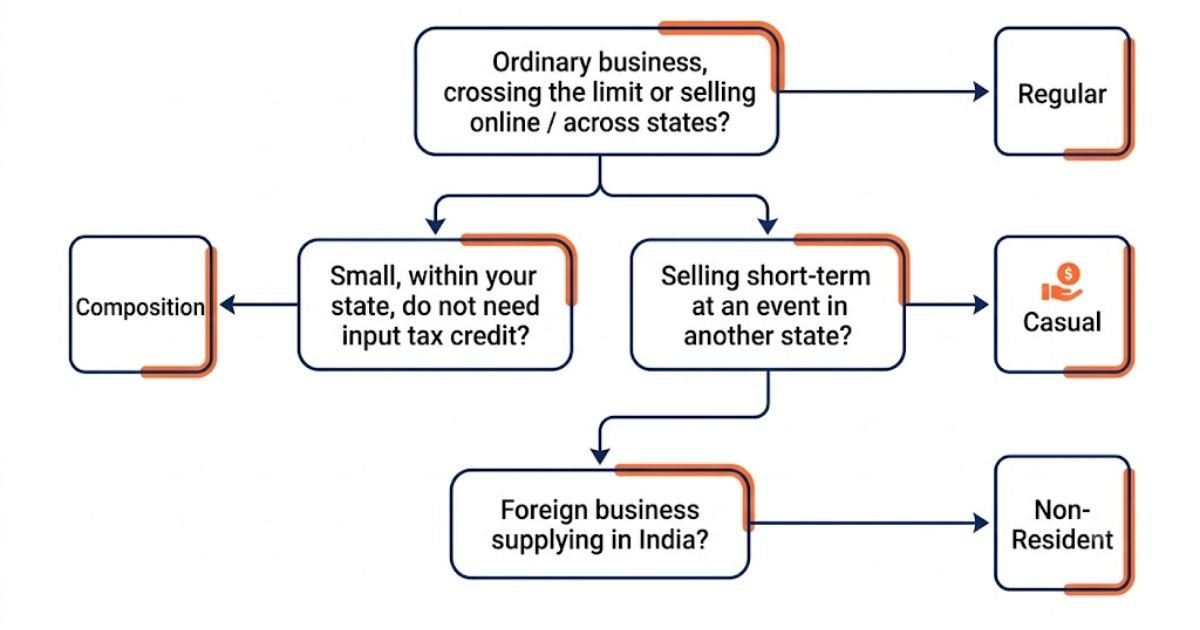
You do not need to memorise all of this. In practice, a few simple questions point most businesses to the right type.
- If you run an ordinary business and cross the turnover limit, or sell online or across states, you need regular registration.
- If you are a small local business under the limit, sell only within your state, and do not need input tax credit, the composition scheme may suit you.
- If you are selling for a short time at an event in another state, you need casual taxable person registration for that period.
- If you are a foreign business supplying in India, you need non-resident registration.
- If you are below the limit but want input tax credit or more credibility, consider voluntary registration under the regular type.
If your case is not obvious, or you supply both goods and services and are unsure which limit applies, it is worth getting it checked before you register, because changing type later is more effort than choosing correctly at the start. Our GST registration page walks through the process once you know your type.
Get Help Choosing the Right Registration
If you are not sure which type of GST registration fits your business, we can look at what you do and tell you plainly, then handle the registration for you. Choosing the right type at the start saves you from problems later.
Call +91 99530 04880 or write to info@efilingcompany.com and tell us about your business.