Documents Required for Company Registration in India


2000
Happy Clients

1500
Expert Advisors

2+
Branch Offices
Free Consultation by Expert
.png)


.png)
.png)
How to Register a Company in India
Getting your documents right is the single biggest reason a company registration gets approved on the first try, and getting them wrong is the single biggest reason it gets rejected. The good news is that the list is not long or complicated once you see it laid out clearly.
The documents you need fall into three simple groups: the documents for the directors and shareholders, the documents for the registered office, and the company's own documents, which are the MOA and AOA. This guide covers all three in plain language, along with the small rules that trip most people up, like how recent your proofs need to be and whose name should be on the utility bill.
If you want the full picture of the registration itself, see our step by step company registration process guide, and if you are still deciding on the structure, start with our Private Limited Company Registration page.


Expertise in Documents Required for Company Registration in India

Enquiry Form
Among Asia Top
100
Consulting Firm

Get Consultation
Lowest Fees
100,000 + Clients.

Service Delivery
4.9 Customers Rating
50+ Offices
Contact us today to schedule your appointment.
You can call us on +919953004880 or write to us at info@efilingcompany.com
Quick Checklist at a Glance
Here is everything at a glance. You can save or print this checklist and tick items off as you gather them.
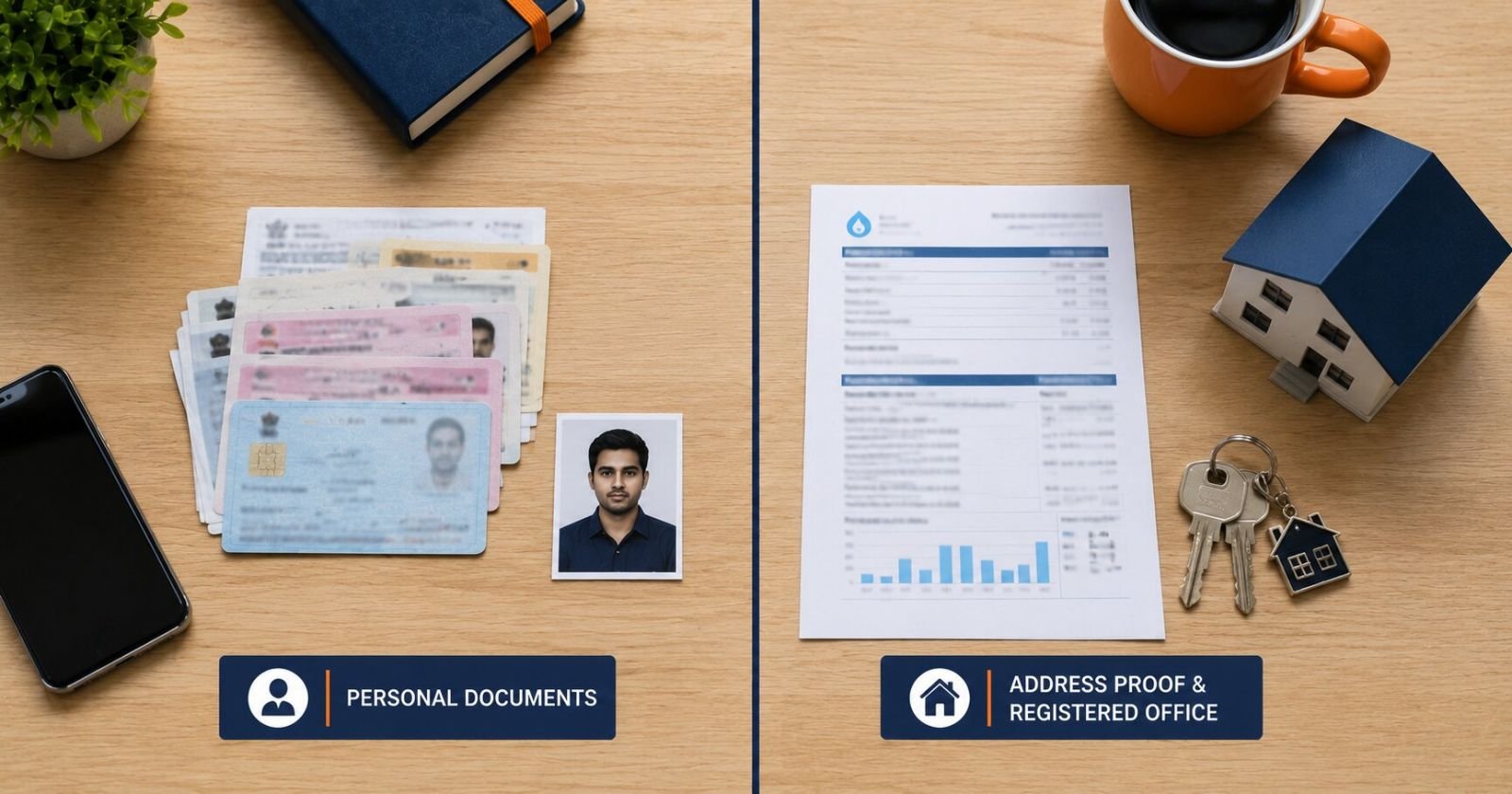
| For Directors and Shareholders | For the Registered Office |
| PAN card Aadhaar card Identity proof (passport, voter ID, or driving licence) Address proof under 2 months old Passport-size photograph Email ID and mobile number Digital Signature Certificate (Class 3) |
Recent utility bill (under 2 months old) No Objection Certificate (NOC) from the owner Rent agreement (if the office is rented) Ownership proof (if the office is owned) |
That is the core set. The sections below explain each part, and cover special cases like foreign directors, a rented versus owned office, and using your home address.
Documents Required for Directors and Shareholders
Every director and shareholder needs to prove who they are and where they live. For Indian nationals, this is straightforward. You need:
- PAN card. This is mandatory for all Indian directors and shareholders. The name on your PAN is what the MCA uses for everything, so make sure it is correct.
- Aadhaar card. Used as identity and address proof.
- Identity proof. Any one of passport, voter ID, or driving licence.
- Address proof. Any one of a bank statement, electricity bill, or mobile bill, and it must not be older than 2 months.
- Passport-size photograph. A recent colour photo.
- Email ID and mobile number. These are used for your DSC and for MCA verification.
One small thing that causes a lot of delays: the name and address on your address proof should match your PAN. If they do not match, the application can get held up, so check this before you file.
Documents for Foreign Nationals and NRIs
If a director or shareholder is a foreign national or an NRI living abroad, there is one extra layer. The documents are the same idea, but they need to be verified for use in India:
- Passport. This is mandatory and serves as both identity and nationality proof. It must be notarised and apostilled in the home country, or attested by the Indian Embassy if the country is not part of the Hague Convention.
- Overseas address proof. A bank statement, utility bill, or government ID, also notarised and apostilled. For foreign nationals, this proof can be up to 1 year old, which is different from the 2 month rule for Indians.
- PAN. A foreign national can apply for PAN through Form 49AA.
- Photograph and DSC. A recent photo, and a Digital Signature Certificate from an Indian Certifying Authority.
The apostille step usually takes the longest, often a week or two, so if you have a foreign director, start their paperwork early. It is almost always the slowest part of the whole timeline.
Documents Required for the Registered Office
Every company must have a registered office address in India, and you have to prove it belongs to you or that you are allowed to use it. What you need depends on whether the office is rented or owned.
If the office is rented, keep these ready:
- Rent agreement
- A No Objection Certificate (NOC) from the owner
- A recent utility bill, under 2 months old
If the office is owned, you need:
- Ownership proof of the property
- A NOC, if the property is not in the company's or a director's name
Can I Use My Home Address as the Office?
Yes, you can. A home address anywhere in India can be used as your registered office, and it is completely legal. This is very common for early-stage founders keeping costs low. You just need a NOC from whoever owns the property and a recent utility bill.
A quick note on the NOC and the bill: the NOC should name the owner, give the full address, and clearly state that the company can use the address as its registered office. And the utility bill should ideally be in the owner's name. Getting these two small things right avoids a surprising number of rejections.
The Company's Own Documents: MOA and AOA
Apart from the documents for people and the office, the company itself has two founding documents. These are the Memorandum of Association (MOA) and the Articles of Association (AOA). A lot of founders find these confusing, so here they are in plain terms.
The Memorandum of Association (MOA) is your company's external rulebook. It tells the outside world who your company is and what it is allowed to do. It contains six main parts:
- Name clause: your company's official name, ending in "Private Limited"
- Registered office clause: the state where your registered office is located
- Object clause: what your business is allowed to do (getting this right matters a lot)
- Liability clause: confirms that members' liability is limited
- Capital clause: your authorised share capital
- Subscription clause: the first shareholders and the shares they take
The Articles of Association (AOA) is your company's internal rulebook. It governs how the company runs day to day: how shares can be transferred, how meetings are held, how decisions are made, and how directors are appointed.
Both documents are filed electronically as e-MOA and e-AOA as part of the SPICe+ form, and both must be signed by all the first shareholders. Your CA or CS usually drafts them for you.
Declarations and Forms You Also Sign
Along with the documents above, there are a few declarations that are part of the paperwork. You do not need to worry about the form names, but it helps to know they exist:
- DIR-2: each director's written consent to act as a director
- INC-9: a declaration by the first shareholders and directors
- Professional declaration: a declaration by a practising CA, CS, or CMA confirming everything is in order
These are all prepared and signed digitally as part of the filing, and your professional normally handles them for you.
How Recent Do Your Documents Need to Be?
This is the detail that catches the most people out, so it is worth stating clearly. The MCA cares about how fresh your proofs are:
- Indian nationals' address proof, such as a bank statement or utility bill: not older than 2 months
- Foreign nationals' address proof: not older than 1 year
- The utility bill for the registered office: not older than 2 months
The MCA system checks the date on your document automatically, and there is no way around it. So before you file, look at the date on your utility bill and bank statement one more time. An old bill is one of the most common reasons an application bounces back.
What Is a Class 3 DSC and Why You Need It
Every director needs a Digital Signature Certificate (DSC) to sign the incorporation forms online, because the whole process is paperless. Here is what you need to know, and one point that many websites get wrong.
You need a Class 3 DSC. The older Class 1 and Class 2 certificates have been discontinued, so Class 3 is now the only class issued for MCA filings. If a provider offers you a "Class 2" DSC, that information is out of date.
Getting one is simple. Indian applicants can usually get a DSC within a few hours through Aadhaar-based verification, while foreign applicants take a few working days. You apply through a Certifying Authority such as eMudhra, Sify, or (n)Code Solutions. Keep in mind the DSC is not a one-time thing, you will use it again for future MCA filings, so it is worth getting sorted early.
Documents You Need After Registration
Once your Certificate of Incorporation arrives, you will need a second set of documents for the things that come next, mainly opening your bank account and registering for GST. It helps to know these in advance.
To open your company bank account, banks usually ask for:
- Certificate of Incorporation
- Company PAN
- A board resolution approving the account opening
- KYC documents of all directors
- The company rubber stamp
For GST registration, you will need your Certificate of Incorporation, company PAN, registered office address proof, bank details, and an authorisation letter. You can read more on our GST registration page.
One thing you do not need to arrange separately: your company PAN and TAN are allotted automatically along with your Certificate of Incorporation.
Common Mistakes to Avoid With Your Documents
Most rejections come from a handful of small, avoidable slip-ups. Watch out for these:
- Using an expired proof, where the address proof is older than the allowed limit
- A name mismatch between the PAN and the address proof
- A missing or unsigned NOC for a rented office
- A utility bill that is in the wrong name
- Forgetting to digitally sign one of the forms
- An expired DSC that fails at the final step
- Foreign documents that have not been apostilled
Why Register Your Company with eFilingCompany
Anyone can hand you a generic list of documents. What we do is make sure yours are actually right before anything is filed, so your application does not bounce back. When you register with us, you get:
- A document checklist made for your exact situation, whether you have Indian or foreign directors
- A careful check of every document before filing, to avoid rejections
- Help with your DSC and all the declarations, handled for you
- Support for both resident and foreign or NRI directors, including the apostille steps
- Complete guidance through your bank account and first compliance steps after incorporation
Want a checklist made for your situation? Call us at +919953004880 or reach out online, and our team will send you a personalised document list and guide you from there.