GST Registration Limit in India Turnover Thresholds Explained
40 lakh for goods, 20 lakh for services - plus the state-wise limits nobody gets right, the mixed-supply trap, and who has to register regardless of turnover.


2000
Happy Clients

1500
Expert Advisors

2+
Branch Offices
Free Consultation by Expert
.png)


.png)
.png)
GST Registration Limit in India Turnover Thresholds Explained
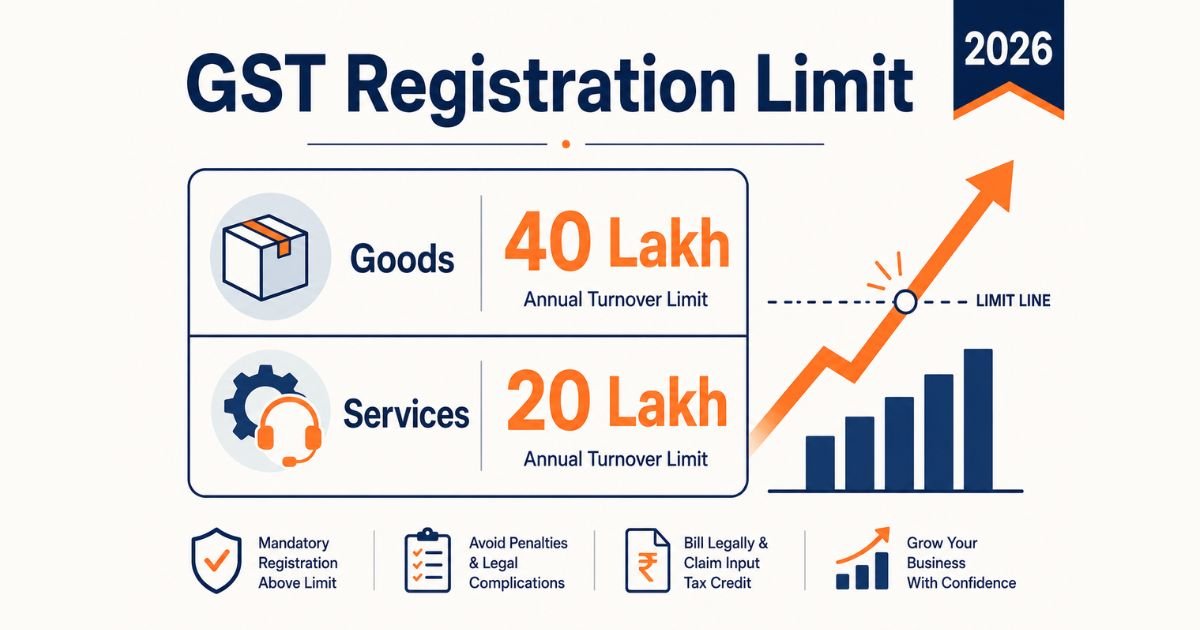
GST registration becomes compulsory once your yearly turnover crosses a set limit. For most businesses that limit is ₹40 lakh for the sale of goods and ₹20 lakh for services, with lower limits in a few special states. That is the short answer.
But the ₹40 lakh figure comes with conditions that a lot of people miss, and the state list is not a simple "normal versus special" split the way most articles show it. This page clears up both, explains what actually counts as your turnover, and tells you who has to register even when they are below the limit. For the full service, see our main GST Registration page.
Expertise in GST Registration Limit in India Turnover Thresholds Explained

Enquiry Form
Among Asia Top
100
Consulting Firm

Get Consultation
Lowest Fees
100,000 + Clients.

Service Delivery
4.9 Customers Rating
50+ Offices
Contact us today to schedule your appointment.
You can call us on +919953004880 or write to us at info@efilingcompany.com
GST Registration Limit at a Glance
Here are the current threshold limits. Once your aggregate turnover in a financial year crosses these, GST registration is mandatory (a few exceptions are explained further down).
| Type of supply | Normal states | Special category states |
| Sale of goods | ₹40 lakh | ₹20 lakh |
| Providing services | ₹20 lakh | ₹10 lakh |
These limits come from Section 22 of the CGST Act read with Notification No. 10/2019 - Central Tax (effective 1 April 2019). Delhi, being a normal category state, uses the ₹40 lakh limit for goods and ₹20 lakh for services.
What Counts as "Turnover" for GST
This is where many people get it wrong. Your turnover for GST is not just your taxable sales. The law looks at your aggregate turnover, which adds up everything you supply under the same PAN, across all of India.
Aggregate turnover includes your taxable supplies, your exempt (nil or exempt-rated) supplies, your exports, and any interstate supplies. It leaves out the GST itself (CGST, SGST and IGST) and any purchases on which you pay tax under reverse charge.
Here is why this matters. Suppose a trader has ₹35 lakh of taxable goods sales and another ₹6 lakh of exempt goods in the same year. Taxable sales alone are under ₹40 lakh, so it feels safe. But the aggregate turnover is ₹41 lakh, which crosses the limit – so registration is required. Always add up the full picture, not just the taxable part.
GST Limit for Service Providers
If you provide services, your limit is ₹20 lakh in normal states and ₹10 lakh in special category states. There is one important point that trips up a lot of service providers.
The famous ₹40 lakh limit applies only to goods. When the government raised the limit in 2019, it raised it for goods alone – the services limit was left unchanged at ₹20 lakh. So if you run a consultancy, an agency, a freelancing practice or any service business, do not assume you get ₹40 lakh. You cross the line at ₹20 lakh. The lower ₹10 lakh services limit applies only in four states, covered in the state section below.
The ₹40 Lakh Limit Has Conditions – The Mixed Supply Trap
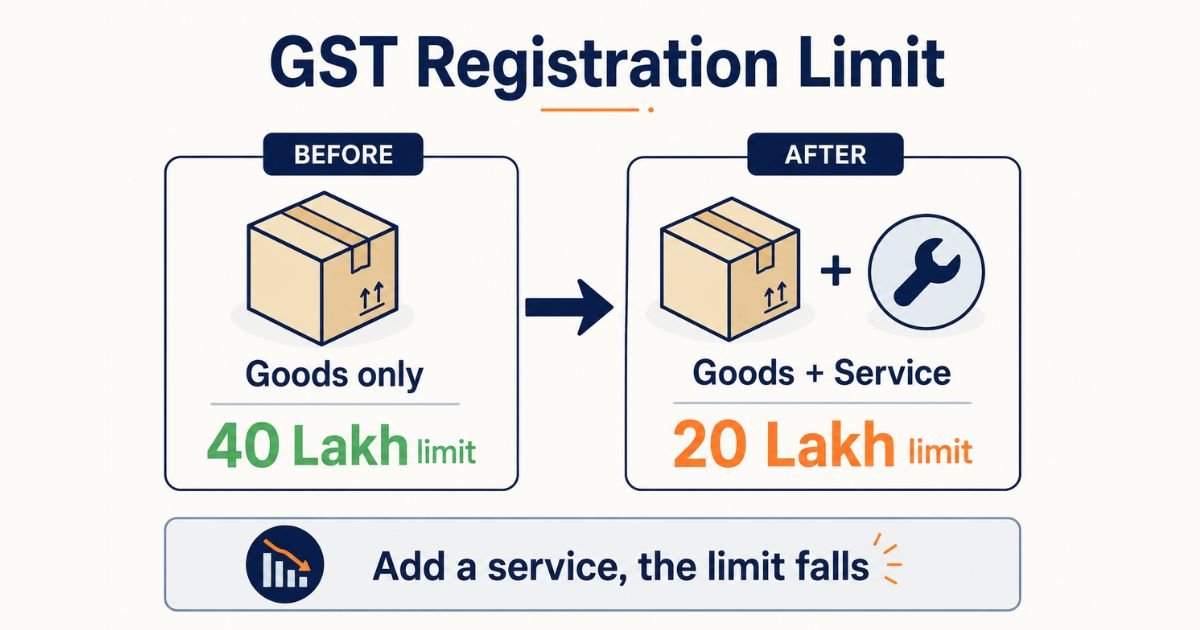
The ₹40 lakh limit is not automatic for anyone selling goods. It applies only if you deal in goods exclusively – meaning goods and nothing else. The moment you add a service, the higher limit is gone.
Take a real example. Say you sell hardware worth ₹38 lakh in a year, and you also earn ₹3 lakh from installation or repair work. That repair work is a service. Because you are no longer supplying goods only, your limit drops from ₹40 lakh to ₹20 lakh – and at ₹41 lakh total you must register. This mix of goods plus a little service is the single most common reason people register later than they should.
The ₹40 lakh limit also does not apply if you deal in ice cream, pan masala or tobacco, or if you fall under any of the compulsory registration categories explained later on this page.
State-Wise GST Limit – It Is Four Groups, Not Two
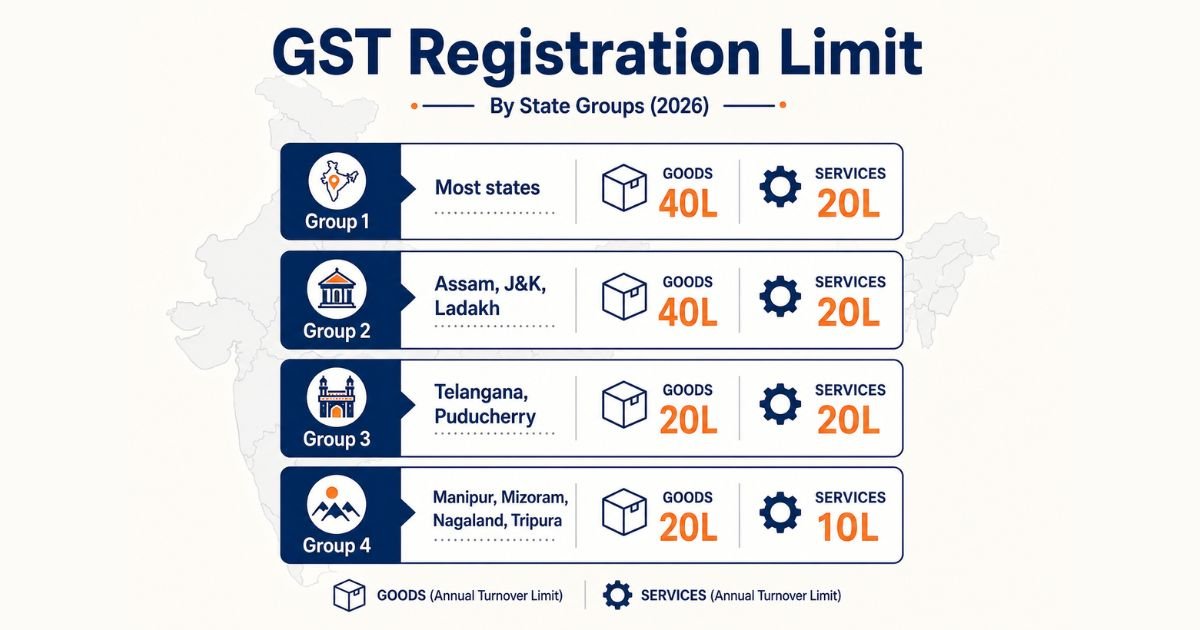
Most articles show states as just "normal" or "special." The reality is more layered, because at the 32nd GST Council meeting the states were given a choice of which limit to adopt. So there are really four groups.
| Group | Goods limit | Services limit |
| Normal states – Delhi, Maharashtra, Gujarat, Tamil Nadu, Karnataka, Uttar Pradesh and most others | ₹40 lakh | ₹20 lakh |
| Special category states that chose the higher goods limit – Assam, Jammu & Kashmir, Ladakh | ₹40 lakh | ₹20 lakh |
| States that kept the lower goods limit – Telangana, Puducherry | ₹20 lakh | ₹20 lakh |
| Special category states with the lowest limits – Manipur, Mizoram, Nagaland, Tripura | ₹20 lakh | ₹10 lakh |
A few north-eastern and hill states – Arunachal Pradesh, Meghalaya, Sikkim, Himachal Pradesh and Uttarakhand – mostly adopted the ₹40 lakh goods limit, but state positions can change over time. If your business is in one of these, it is worth confirming your state's current limit on the GST portal or with us before you decide.
Who Must Register Regardless of Turnover
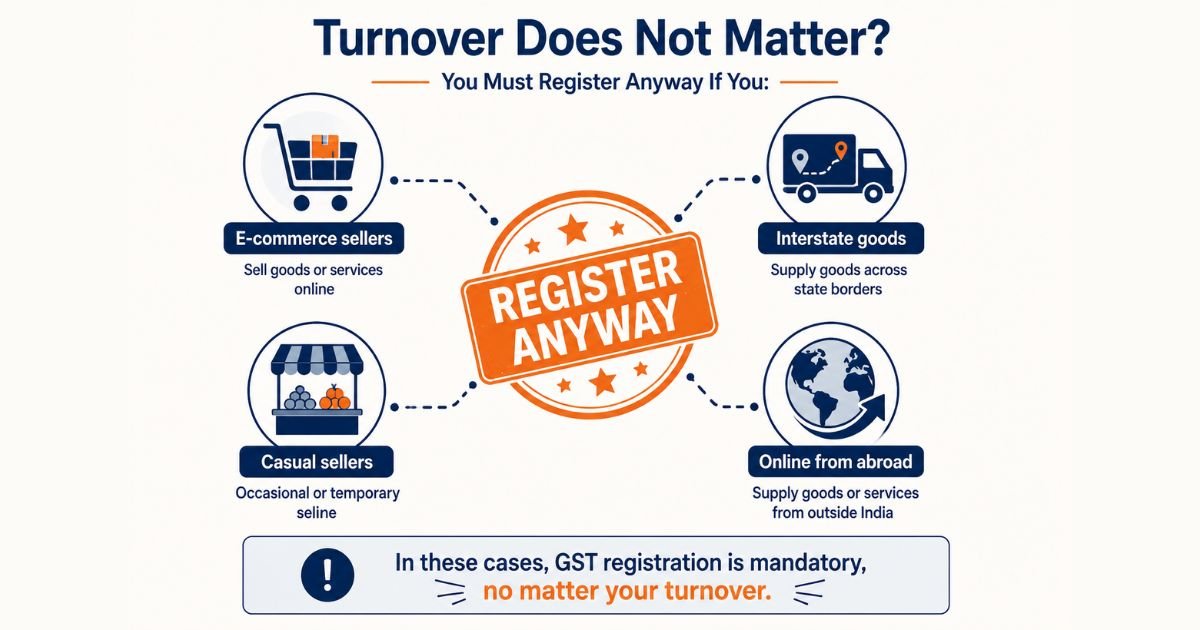
Some businesses have to register even if their turnover is below the limit – even from the very first rupee. Under the GST law, this applies to:
- Anyone selling goods to another state (interstate supply of goods)
- Anyone selling goods through e-commerce platforms like Amazon or Flipkart
- Casual taxable persons – occasional sellers with no fixed place, such as an exhibition or trade-fair stall
- Non-resident taxable persons supplying in India
- People required to pay tax under reverse charge
- People required to deduct TDS or collect TCS
- Input Service Distributors
- Agents supplying on behalf of another person (a principal)
- Online service providers supplying from outside India to Indian customers (OIDAR)
There is some relief worth knowing. Small service providers selling across states, and small sellers of goods supplying within their own state through e-commerce, are not forced to register just for that reason and can use the normal threshold. But for interstate sale of goods and most e-commerce goods selling, registration is required regardless of turnover.
Composition Scheme – A Different Set of Limits
The composition scheme is a simpler option for small businesses, and it has its own turnover limits, separate from the registration threshold above:
- Traders and manufacturers – up to ₹1.5 crore
- Special category and north-eastern states, and Uttarakhand – up to ₹75 lakh
- Service providers and mixed suppliers – up to ₹50 lakh
Under composition you pay tax at a low fixed rate and file simpler returns, but you cannot claim input tax credit on your purchases. It suits small businesses selling mostly to end customers rather than to other GST-registered businesses.
What If You Cross the Limit and Do Not Register
Once you become liable, you must apply for GST registration within 30 days. Missing this is not just a paperwork issue – it costs money.
The penalty for not registering is 10% of the tax due, with a minimum of ₹10,000. If the authorities find the non-registration was deliberate to evade tax, the penalty can be 100% of the tax due. On top of that there is interest, and you cannot go back and recover the GST from customers you have already billed – you end up paying it out of your own pocket. Registering on time is always cheaper than fixing it later.
Should You Register Voluntarily Below the Limit?
Even if you are under the threshold, you can choose to register. Businesses often do this to claim input tax credit on their purchases, to sell to larger companies that prefer dealing with GST-registered vendors, to sell on e-commerce platforms, or simply for credibility.
The trade-off is that once you register, you take on full GST compliance – regular return filing, whether or not you have sales that month. So voluntary registration is worth it for some businesses and unnecessary for others. It depends on who your customers are and where you want to grow.
Getting GST Registration in Delhi
The turnover limits on this page are the same across the country, including Delhi. What is different from city to city is the local process – which GST office your area falls under, how address proof is checked, and the common reasons applications get held up locally.
If your business is in Delhi and you are ready to register, our GST Registration in Delhi page covers the Delhi-specific process, jurisdiction, documents and fees in detail, and our team can handle the whole filing for you.