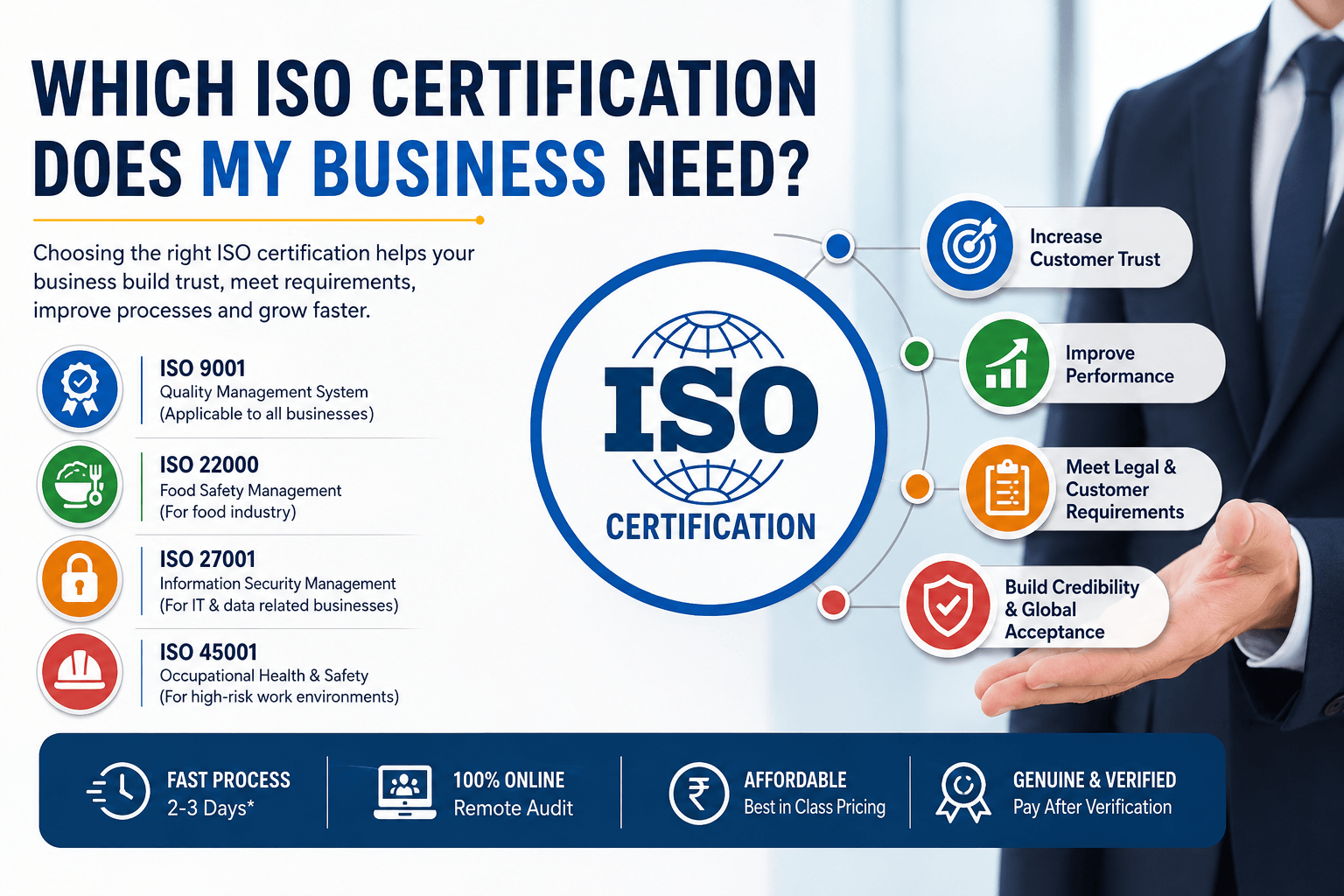
Which ISO Certification Does My Business Need?
One of the most common questions I receive from business owners is, “Which ISO certification should my business get?”
After helping businesses across different industries obtain ISO certifications, I have found that many entrepreneurs are confused about which standard actually applies to their business. Some assume that every ISO certification serves the same purpose, while others delay the process because they believe certification is expensive, complicated, or only meant for large organizations.
In reality, choosing the right ISO certification is usually quite straightforward once you understand your business activities, customer requirements, and industry expectations.
My Experience Helping Businesses Choose the Right ISO Certification
Over the years, I have worked with companies from manufacturing, trading, service, technology, food processing, consulting, and many other sectors. While each business is unique, one thing remains consistent: almost every organization can benefit from an appropriate ISO certification.
The biggest challenge is not obtaining the certification. The challenge is determining which certification is actually relevant to the business.
Many clients approach us asking for a specific ISO certification because a friend recommended it or because they saw a competitor displaying it on their website. However, after understanding their operations, we often recommend a different standard that is more suitable for their business objectives.
Why ISO 9001 Is Usually My First Recommendation
If a business owner asks me which ISO certification they should obtain first, my answer is usually ISO 9001.
ISO 9001 is a Quality Management System (QMS) standard that can be applied to almost every type of organization, regardless of size or industry.
It is suitable for:
-
Manufacturing companies
-
Trading businesses
-
Service providers
-
Consultants
-
Startups
-
E-commerce businesses
-
Educational institutions
-
Healthcare organizations
-
Professional firms
Because of its broad applicability, ISO 9001 serves as an excellent foundation for most businesses.
It demonstrates that the organization follows structured processes, focuses on customer satisfaction, and is committed to maintaining consistent quality standards.
In many cases, ISO 9001 is also the certification most frequently requested by customers, vendors, and government agencies.
When ISO 22000 Is the Right Choice
For businesses involved in the food industry, ISO 22000 is often essential.
I regularly advise food-related businesses to consider ISO 22000 because food safety is one of the most critical aspects of their operations.
This certification is particularly relevant for:
-
Food manufacturers
-
Food processors
-
Food exporters
-
Food packaging companies
-
Food distributors
-
Restaurants and catering businesses
If your business handles food products at any stage of the supply chain, ISO 22000 can significantly strengthen customer confidence and demonstrate compliance with recognized food safety practices.
When ISO 27001 Becomes Important
For technology and IT-related businesses, ISO 27001 is often the most appropriate certification.
As businesses become increasingly dependent on digital systems, information security has become a major concern for customers and business partners.
ISO 27001 is commonly recommended for:
-
Software development companies
-
IT service providers
-
SaaS businesses
-
Data processing companies
-
Technology startups
-
Cloud service providers
Whenever a company handles sensitive information, customer records, confidential business data, or digital assets, ISO 27001 can provide assurance that appropriate security controls are in place.
When Businesses Should Consider ISO 45001
ISO 45001 focuses on occupational health and safety management.
Businesses operating in environments where employee safety is a major concern should evaluate whether this certification is appropriate.
Industries that commonly benefit from ISO 45001 include:
-
Manufacturing
-
Construction
-
Engineering
-
Warehousing
-
Industrial operations
The certification demonstrates a commitment to creating safer workplaces and reducing occupational risks.
How We Determine Which ISO Certification a Business Needs
When a client contacts us, we do not simply issue a certificate based on their request. Instead, we first understand the business and evaluate which standard is genuinely applicable.
Some of the factors we consider include:
-
Nature of business activities
-
Industry sector
-
Customer requirements
-
Government tender requirements
-
Vendor registration conditions
-
Export obligations
-
Food safety requirements
-
Data security requirements
-
Manufacturing versus service-based operations
This consultation process helps ensure that businesses invest in certifications that genuinely support their objectives.
Common Misconceptions About ISO Certification
One misconception I encounter frequently is that ISO certification is expensive.
Many business owners are surprised when they learn that obtaining ISO certification can be both affordable and straightforward.
Another common misconception is that certification requires months of paperwork and complicated procedures.
Today, much of the process can be completed efficiently through proper guidance, documentation support, and remote audits.
I also meet business owners who believe ISO certification is only useful when a customer specifically demands it. In reality, certification can strengthen credibility, improve business processes, and create opportunities long before it becomes a mandatory requirement.
My Advice to Startups
Many startups ask whether they should wait until they become larger before pursuing ISO certification.
My recommendation is usually to obtain ISO 9001 as early as possible.
The certification is relatively affordable and helps establish professional systems from the beginning.
Benefits often include:
-
Improved credibility
-
Better customer confidence
-
Stronger internal processes
-
Increased eligibility for tenders
-
Enhanced brand reputation
Building these systems early can create long-term advantages as the business grows.
Why Businesses Pursue ISO Certification
In my experience, businesses rarely obtain ISO certification for a single reason.
Most organizations pursue certification because it helps them achieve several objectives simultaneously, including:
-
Compliance requirements
-
Customer expectations
-
Marketing advantages
-
Process improvement
-
Tender eligibility
-
Vendor registration
-
Export opportunities
The businesses that gain the greatest value are those that view ISO certification as both a compliance tool and a growth strategy.
How eFilingCompany Helps Businesses Obtain the Right ISO Certification
At eFilingCompany, our first step is always to provide free consultation regarding the applicability of various ISO standards.
We help businesses understand which certification is relevant to their operations before beginning the certification process.
Our support includes:
-
Free applicability assessment
-
Process guidance
-
Application assistance
-
Documentation support
-
Audit preparation
-
Audit report assistance
-
Certification issuance
The entire process can be completed online, including remote audits where applicable, making the experience convenient and hassle-free.
One of the key advantages we offer is transparency. Businesses can verify the genuineness and authenticity of their certification before making final payment.
We focus on making ISO certification:
-
Affordable
-
Fast
-
Reliable
-
Fully online
-
Easy to understand
In many cases, certifications can be completed within just 2 to 3 days, depending on the standard and readiness of the organization.
Final Thoughts
If you are unsure which ISO certification your business needs, the answer usually depends on your industry, customer requirements, and operational risks.
For most businesses, ISO 9001 is the ideal starting point because it applies across almost every sector.
Businesses involved in food operations should consider ISO 22000. Technology and IT companies should evaluate ISO 27001. Organizations with significant workplace safety responsibilities may benefit from ISO 45001.
The most important step is not obtaining a certificate quickly. It is obtaining the right certification that genuinely supports your business objectives.
A brief consultation with an experienced ISO professional can often save significant time, cost, and confusion while ensuring your business chooses the most appropriate certification from the start.
Share With Us