Pvt Ltd Company Registration Cost in India
An Honest, Complete Breakdown of Every Fee, With Real 2026 Numbers


2000
Happy Clients

1500
Expert Advisors

2+
Branch Offices
Free Consultation by Expert
.png)


.png)
.png)
Pvt Ltd Company Registration Cost in India
If you are trying to work out the pvt ltd company registration cost before you commit, here is a straight answer. For a normal two-director company with modest capital, the all-in cost usually lands somewhere in the region of ₹7,000 to ₹25,000. That is a wide range, and the reason it is wide is honest: the final figure depends on three things, your state, your authorised capital, and whether you do it yourself or hire a professional.
The good news is that the government has actually made the core part free. The MCA filing fee is zero for authorised capital up to ₹15 lakh, which covers most new startups. So the cost is usually lower than people fear. In this guide we break down every rupee, plainly, so there are no surprises. We will not quote you a single fake all-in number, because your stamp duty alone changes from one state to the next.
If you also want to know how the registration actually works or what papers you need, see our company registration process and documents required guides. To understand the structure itself, start with our Private Limited Company Registration page.

Expertise in Pvt Ltd Company Registration Cost in India

Enquiry Form
Among Asia Top
100
Consulting Firm

Get Consultation
Lowest Fees
100,000 + Clients.

Service Delivery
4.9 Customers Rating
50+ Offices
Contact us today to schedule your appointment.
You can call us on +919953004880 or write to us at info@efilingcompany.com
What Decides Your Pvt Ltd Registration Cost
Before we get into the actual numbers, it helps to know what moves them. Four things decide where your cost lands:
- Your authorised capital. A higher authorised capital means higher stamp duty and slightly higher fees, so most founders start small.
- Your state. Stamp duty is a state charge, and it varies a lot from one state to another. This is the single biggest reason two founders pay different amounts.
- The number of directors. Each director needs a Digital Signature Certificate, so more directors means a little more cost.
- Whether you hire a professional. You can file it yourself and pay only government costs, or use a CA or CS and pay a professional fee on top.
The Full Cost Breakdown
Here is where your money actually goes. A pvt ltd registration is not one single fee, it is a handful of smaller ones. Let us go through each.
Government and MCA fees. This is the part the government has made cheap. The main SPICe+ filing fee is zero for authorised capital up to ₹15 lakh. Reserving your company name costs ₹1,000, though you can often do this within SPICe+ Part A. Your DIN (director identification number) is included, and your company PAN and TAN are allotted automatically with your Certificate of Incorporation at no extra charge.
Stamp duty. This is a state government charge on your MOA and AOA, and it is the most variable cost of all. It gets its own section below, because it deserves a proper explanation.
Digital Signature Certificate (DSC). Each director needs one to sign the forms online. This has its own short section below too.
Professional fees. If you use a CA or CS to handle the drafting and filing, this is usually somewhere between ₹5,000 and ₹15,000, depending on the firm and how complex your setup is.
Put simply, here is how the pieces stack up:
| Cost Component | What You Pay |
| MCA SPICe+ filing fee | ₹0 for authorised capital up to ₹15 lakh |
| Name reservation | ₹1,000 (often included in SPICe+ Part A) |
| DIN | Included in SPICe+ |
| PAN and TAN | Auto-allotted, free, with the COI |
| Stamp duty (MOA and AOA) | Varies by state and capital (see below) |
| DSC (per director) | Around ₹1,500 to ₹2,500 each |
| Professional fees | Around ₹5,000 to ₹15,000 (optional) |
Notice there is no single total in that table. That is on purpose. Because stamp duty changes by state, an honest total is a range, not one number, and we would rather tell you that than make up a figure.
How Much Does a DSC Cost?
A Digital Signature Certificate usually costs around ₹1,500 to ₹2,500 per director. You need the Class 3 type, which is the only class issued now, and every director needs their own. A DSC is valid for one or two years, and you will reuse it for your future MCA filings, so it is not money wasted.
State-Wise Stamp Duty: Why the Cost Differs by State
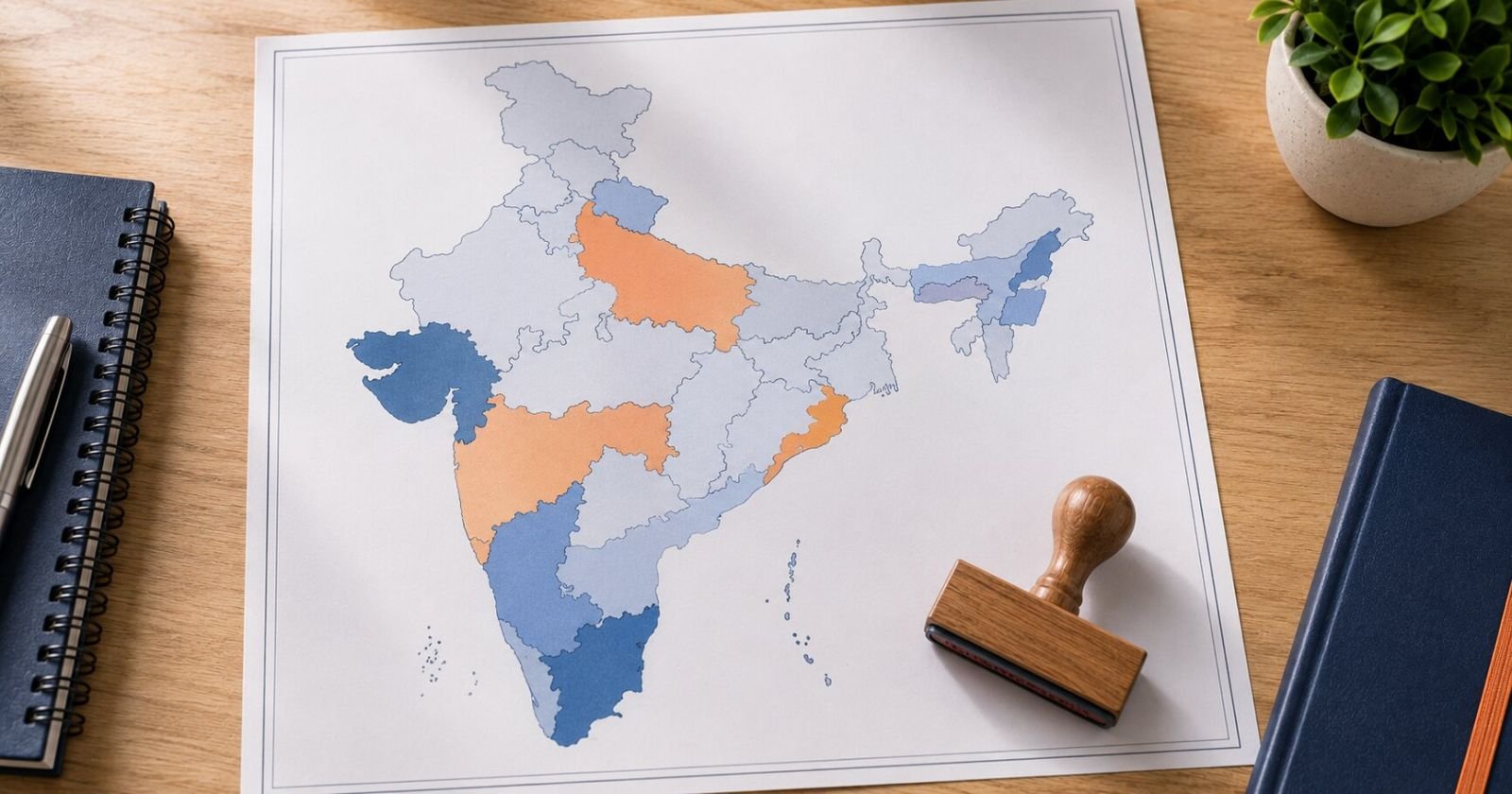
This is the part that confuses most people, so let us keep it simple. Stamp duty is a charge your state government puts on your company's two founding documents, the MOA and the AOA. It is the single most variable cost in the whole registration, and it goes up as your authorised capital goes up.
Roughly speaking, states fall into three groups for a small-capital company:
- Generally lower: states like Delhi, Karnataka, and Maharashtra tend to be on the lower side for small authorised capital.
- Moderate: states like Rajasthan and Telangana usually sit in the middle.
- Generally higher: states like Punjab, Kerala, and Madhya Pradesh tend to be higher, and percentage-based states like Tamil Nadu get expensive once your capital is large.
We are deliberately giving you groupings rather than exact rupee figures for every state, because these rates change with state notifications and vary by capital, and we do not want to quote you a number that turns out to be stale. Here is the reassuring part: you never have to calculate this yourself. The MCA SPICe+ portal works out your exact stamp duty automatically at the time of filing, based on your state and your capital. So you will always pay the correct, current amount.
| A money-saving tip: If your business is fully remote and you have flexibility on where your registered office sits, choosing a lower stamp duty state can save you a few thousand rupees. But do not force it, a registered office should match where you actually operate. |
Can You Register a Pvt Ltd Company for Free?
No, not entirely, and anyone promising a completely free registration is not being straight with you. The MCA filing fee is genuinely ₹0 for authorised capital up to ₹15 lakh, which is a real saving. But you still have to pay for your DSC, your state stamp duty, and, if you use one, a professional. So even doing everything yourself, there is always a small unavoidable cost, usually a few thousand rupees for the DSC and stamp duty combined.

Costs After Registration You Should Plan For
Here is something most cost pages quietly leave out, and it catches founders by surprise. The registration fee is not the whole story. Once your company exists, a few more costs follow, and it is better to know them now.
Right after incorporation, you will usually deal with:
- Opening the company bank account, which is generally free or low cost
- GST registration, if your turnover or business type needs it (see our GST registration guide)
- Optional registrations like MSME or trademark, only if you need them
In your first year, every company has some mandatory compliance, and it costs money:
- Appointing your first auditor (Form ADT-1)
- Filing INC-20A, the declaration that your business has started
- Director KYC (DIR-3 KYC)
- Your statutory audit
- Annual filings (AOC-4 and MGT-7)
- Your income tax return
Taken together, this first-year compliance work is a real cost, often a similar amount to the registration itself. The point is simple: budget for the first year, not just for the day you incorporate. A good service will tell you both numbers upfront.
| Do not miss this: You must file INC-20A within 180 days of incorporation. If you miss it, the company can be fined 50,000 rupees, each director can be fined 1,000 rupees per day, and the Registrar can strike the company off. Late MCA filings also carry escalating extra fees. Set a reminder the day your COI arrives. |
How to Keep Your Registration Cost Low
A few simple choices can genuinely bring your cost down without cutting any corners:
- Start with modest authorised capital. Begin with ₹1 lakh to ₹10 lakh, which is plenty for an early-stage startup, and increase it later through Form SH-7 when you actually need to. This keeps your stamp duty low.
- Use SPICe+ Part A for the name. It includes name approval, so you may not need to pay separately for RUN.
- Get a fixed-fee quote. Ask two or three CA or CS firms for a fixed price, not hourly billing, and compare. The government fees are the same everywhere, so you are only comparing the professional part.
- Only add what you need now. You do not have to register for GST, MSME, or trademark on day one unless your business actually requires it.
Doing It Yourself vs Using a Professional
Can you register a Pvt Ltd company yourself and pay only the government costs? Yes, the MCA portal is open to everyone. But here is the honest trade-off. The MOA and AOA drafting, the object clause, and the stamp duty steps are where applications get rejected, and a rejection means re-paying the non-refundable stamp duty and starting over. So while doing it yourself is cheaper on paper, a mistake can end up costing more than a professional would have. Most founders use a professional to get it right the first time. You can see exactly what the steps involve on our company registration process page.
Why Register Your Company with eFilingCompany
When it comes to cost, the thing that matters most is honesty, and that is what we lead with. When you register with us, you get:
- Transparent pricing, with a real breakdown of your government fees and an honest estimate of your state's stamp duty, not a fake all-in figure
- A fixed-fee quote so you know your professional cost upfront
- Qualified CA and CS support at every step, to avoid rejections that cost you more
- Clear guidance on your first-year compliance costs, so nothing surprises you later
- Help choosing the right authorised capital so you do not overpay on stamp duty
Want an honest, itemised quote for your exact situation? Call us at +919953004880 or reach out online, and we will give you a clear number with no hidden extras.